
Rumen Radev’s Progressive Bulgaria Wins Bulgaria Parliamentary Election, Exit Polls Show
Key Takeaways
- Exit polls show Progressive Bulgaria leading the election ahead of GERB.
- The bloc is described as pro-Russian with Moscow ties.
- Coalition formation is likely as a majority is not guaranteed.
Radev’s election surge
Bulgaria’s parliamentary election on Sunday produced a clear lead for former president Rumen Radev, with multiple outlets describing his Progressive Bulgaria as set for a decisive win while still leaving open questions about how he would govern.
“Former President Rumen Radev’s centre-left Progressive Bulgaria party is on course to win the country’s parliamentary election, according to an exit poll published hours after voting closed”
El País said Radev won “clearly” in Bulgaria’s early elections this Sunday, the eighth in five years, obtaining 45% of the votes in a parallel count and 43% in the official count, which it said would translate into “a comfortable majority of 135 seats” out of 240.

The BBC, by contrast, described exit polls putting Progressive Bulgaria at 37%, more than double GERB’s 16%, and said “Three or four other parties look set to cross the 4% threshold and enter Parliament,” meaning Radev’s mandate might not be enough to govern alone.
Al Jazeera reported an exit poll by Sofia-based Alpha Research showing Progressive Bulgaria winning 38.1 percent, with GERB at 15.9 percent and We Continue the Change–Democratic Bulgaria projected at 14.1 percent.
Japan Today similarly put Alpha Research’s final exit poll at 38.1%, with GERB led by former Prime Minister Boyko Borissov at 15.9%, and said Radev would need coalition partners to form a majority in parliament.
The Guardian said projections from polling agencies put Progressive Bulgaria at 44%, which it said would give “an absolute majority of at least 129 seats in the 240-seat parliament,” while Euronews said Radev already secured majority with “over 43% to 45%,” ahead of GERB projected at roughly 13%.
In his victory framing, Radev told reporters, “People rejected the self-satisfaction and arrogance of old parties and did not fall prey to lies and manipulation,” and he promised to build “a strong Bulgaria in a strong Europe.”
Protests, euro, and instability
The election unfolded against a backdrop of repeated political crises and anti-corruption unrest, with outlets tying the snap vote to the collapse of the previous government and to mass demonstrations that had pushed Bulgaria into another election cycle.
Al Jazeera said Bulgarians cast their ballots on Sunday for the eighth time in five years “after mass protests led to the removal of the previous conservative government in December,” and it described Radev as having backed the anticorruption protests that saw “hundreds of thousands” take to the streets in December.
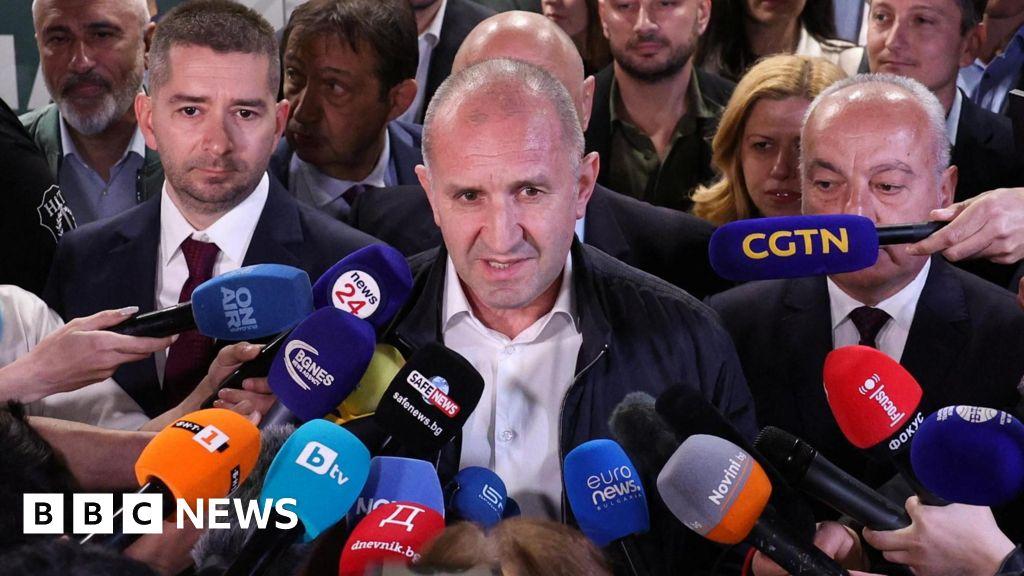
The BBC said the election was called after the previous government tried to push through a “controversial budget last December,” prompting mass demonstrations which Radev, as president, supported.
TVP World described the snap election as triggered by the collapse of the previous government in December “following weeks of anti-corruption protests and mounting public anger over economic conditions and proposed fiscal measures,” and it said the country had been mired in political instability with “fragile coalitions repeatedly collapsing after a string of inconclusive elections.”
DW said the snap vote followed the resignation of a conservative-led government amid nationwide anti-corruption protests last December, and it added that Bulgaria has been gripped by a political crisis since 2021 when a conservative government of Boyko Borissov was toppled “also amid anti-corruption rallies.”
Multiple outlets also placed Bulgaria’s euro adoption at the center of the political context: El País said Bulgaria has had the euro as legal tender since “last January,” while Al Jazeera said Bulgaria adopted the euro as its currency in January this year.
In this environment, Radev’s campaign message emphasized stability and anti-corruption, with the BBC quoting his victory speech that he thanked voters for “their trust” and promised “a strong Bulgaria in a strong Europe.”
Radev’s Russia-leaning line
Radev’s campaign and political identity were repeatedly described through his stance on Russia, Ukraine, and European sanctions, with outlets quoting his language about “mutual respect” and his opposition to military support for Ukraine.
“Bulgaria’s parliamentary election sees former President Rumen Radev’s Progressive Bulgaria party leading the polls, with odds for Radev becoming the next Prime Minister at This is Bulgaria’s eighth parliamentary election in six years”
The BBC said Radev is “seen as a pragmatic, somewhat pro-Russian leader,” who “has criticised EU sanctions, and called for constructive dialogue with the Kremlin,” and it added that he “opposes Bulgarian military support for Ukraine.”
Al Jazeera reported that Radev is “a left-leaning eurosceptic” who “has called for renewing ties with Moscow and criticised supplying Ukraine with weapons,” and it said he “opposed the 10-year defence agreement signed between Bulgaria and Ukraine in March.”
Euronews said Radev “has often argued that supporting Ukraine risks drawing Bulgaria into the conflict,” and it reported that he called for dialogue with Russian President Vladimir Putin, contributing to his reputation as sympathetic to Russia.
The Guardian said Radev has called for renewing ties with Russia and “opposes military aid to Ukraine,” while also quoting his remarks about relations with Russia: he hoped for “practical relations with Russia, based on ‘mutual respect and equal treatment’.”
POLITICO.eu described the “Key question” as whether Radev would build a coalition and whether he would choose allies from “the pro-EU or pro-Moscow camp,” and it said Radev had encouraged Ukraine to sue for peace and “does not support sending arms to Kyiv.”
DW said Radev has advocated for Bulgaria to renew ties with Russia and has been critical of sending military aid to Ukraine, while also stating that he “officially denounced Russia's invasion and said he would not use his country's veto to block EU aid to Kyiv if elected.”
Coalition math and party splits
Even as exit polls pointed to a strong showing for Progressive Bulgaria, outlets diverged on whether Radev would have enough support to govern alone, and they mapped the coalition arithmetic across parties that were projected to clear the 4% threshold.
The BBC said exit polls put Progressive Bulgaria at 37% and that “Three or four other parties look set to cross the 4% threshold and enter Parliament,” while it also noted that Radev’s victory “does not give Progressive Bulgaria a strong enough mandate to govern alone.”
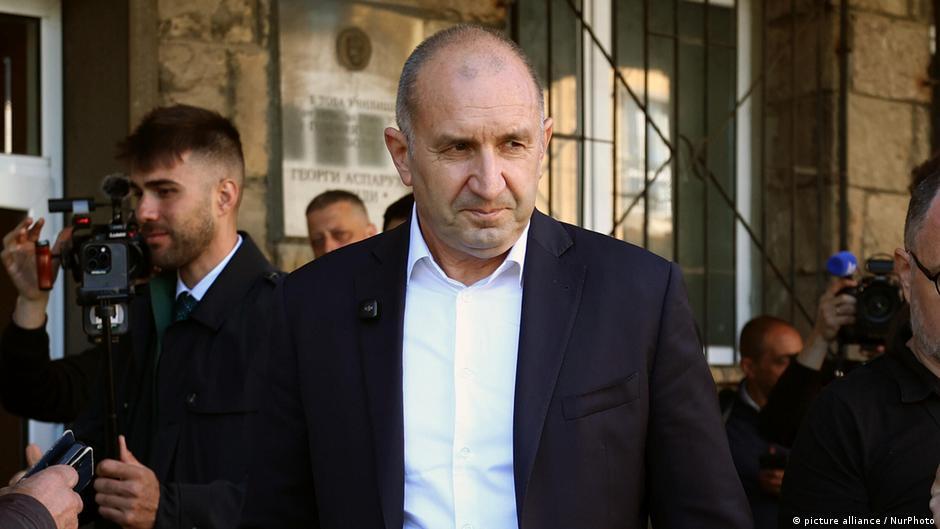
TVP World likewise said Radev’s Progressive Bulgaria was projected to win 37% but “is set to fall short of the numbers needed to govern alone,” and it listed exit poll projections including GERB at 16.2%, PP-DB at 13.1%, DPS–New Beginning at 9.2%, and Vazrazhdane at 5.3%, with the Bulgarian Socialist Party hovering around the 4% threshold.
Al Jazeera’s exit poll projected Progressive Bulgaria at 38.1%, GERB at 15.9%, and PP-DB at 14.1%, and it reported that Radev said he would be willing to work with them but that “a minority government was also an option.”
Japan Today said Radev would need coalition partners to form a majority in parliament, while also quoting him: “We are ready to consider different options so that Bulgaria can have a regular and stable government.”
POLITICO.eu framed the coalition choice as a “Key question” about whether Radev would ally with pro-EU liberal reformists “on about 14 percent,” or with “the Socialist party (on about 4 percent) and nationalists (on about 5 percent),” which it said could allow a pro-Moscow bloc.
GERB’s Boyko Borissov offered a negotiating-focused message on Facebook, saying, “Elections decide who comes first, but negotiations will decide who governs.”
Europe-wide implications
The election’s implications for Europe were framed through Bulgaria’s role in EU and NATO decisions, its euro adoption, and the possibility that Radev’s Russia-leaning positions could reshape how Bulgaria handles Ukraine and sanctions.
“An pro-Russian candidate, former president Rumen Radev, has won clearly in Bulgaria's early elections this Sunday, the eighth in five years, in which he obtained 45% of the votes, which amounts to a comfortable majority of 135 seats, according to a parallel count based on projections of official vote data, completed entirely by the polling firm Myara”
El País said Radev’s win could “break the recent instability in this country of 6.5 million inhabitants that has the euro as legal tender since last January,” and it described his party as left-wing and led by Radev, 62, a former commander of the Air Forces, who would elevate the former president to prime minister and form a government “without the need for coalitions.”

Al Jazeera connected the vote to broader European developments by noting that Bulgaria’s election comes “in the wake of Viktor Orban’s defeat in Hungary last week,” and it said Orban’s defeat followed Hungary’s 16 years in power.
The BBC described Bulgaria as “an important supplier of ammunition and explosives to Ukraine, through third countries, especially neighbouring Romania,” and it said the war had boosted an arms industry that struggled since the Soviet era, citing the VMZ factory in Sopot producing explosives and “NATO-grade 155 mm artillery shells.”
The Guardian added that the election had international attention and said Radev denounced a “10-year defence agreement signed last month between Bulgaria and Ukraine,” while also reporting turnout exceeded 50% and that police seized “more than €1m (£870,000) in raids against alleged vote-buying operations.”
Euronews said Radev’s remarks about Europe included a critique of Europe’s ambition to act as a moral leader, quoting him: “Europe has, in many ways, become a victim of its ambition to act as a moral leader in a world without clear rules,” and it tied that to his promise that “Bulgaria will continue on its European path.”
PBS, citing an Associated Press exit poll, said the predicted percentages could not be enough for Radev to form a one-party government and that he would face “the uphill task of looking for partners to govern,” while also describing the election as potentially bringing “a left-leaning, pro-Russian leader” to power “just days after Hungarian voters rejected” Viktor Orbán’s policies.
More on Europe
Iran-Linked Group Ashab Al-Yamin Claims Arson Attack on Kenton United Synagogue in London
20 sources compared
Pedro Sánchez, Lula, and Lars Klingbeil Rally Global Left in Barcelona Against Far-Right Populists
13 sources compared

Exit Polls Show Rumen Radev’s Progressive Bulgaria Set to Win Bulgaria Election
45 sources compared
Bournemouth Reach Agreement To Appoint Marco Rose As Andoni Iraola Successor
13 sources compared