France offers to broker Lebanon-Israel talks: What do we know?
Key Takeaways
- France offers to broker Lebanon-Israel talks, with Macron signaling mediation.
- Lebanese leaders are willing to engage in direct talks with Israel.
- Israel's attacks in Lebanon have killed over 800 people and displaced about 800,000.
France mediation offer
France, via President Emmanuel Macron, said Paris is ready to mediate a truce between Lebanon and Israel and that Lebanese leaders are willing to engage in direct talks, signaling a major shift in Beirut’s approach toward Israel.
“French President Emmanuel Macron has said Paris is ready to mediate a truce between Lebanon and Israel, saying that Lebanese leaders are willing to engage in direct talks in a major shift in the country’s approach towards Israel”
Macron spoke on Saturday as Israel continued its attacks, killing more than 800 people in Lebanon and displacing some 800,000, with evacuation orders for all residents south of the Litani River and reports that Israeli forces are preparing for a major ground invasion.
He said he spoke with Lebanese President Michel Aoun, Prime Minister Nawaf Salam and Speaker Nabih Berri, and that the Lebanese government has indicated its willingness to engage in direct talks with Israel, urging Israel to abandon its large-scale offensive and cease its massive airstrikes and to stop Hezbollah's escalating conflict.
France is ready to facilitate these discussions by hosting them in Paris, Macron said, adding that everything must be done to prevent Lebanon from descending into chaos.
On Saturday evening, France’s Ministry for Europe and Foreign Affairs denied any plan of mediation, saying France is merely open to facilitating and supporting Lebanon in holding direct talks with Israel.
However, a source familiar with the effort told Al Jazeera that the plan does exist and that France hopes to bring the United States on board and fold it into a broader diplomatic push to end the conflict.
Axios cited three sources saying the French officials drafted a proposal that would require the Lebanese government to recognise Israel in exchange for an end to the war.
Talks could start in the coming days either in Cyprus or Paris, two sources told Haaretz; Al Jazeera could not independently confirm the reports.
Lebanon and Hezbollah positions
Lebanese officials have offered to pursue direct negotiations with Israel, a major concession in a country where ties with Israel are a divisive issue.
The Lebanese government has hardened its stance against Hezbollah, accusing the group of jeopardising the country’s security; on March 2 the prime minister banned Hezbollah’s military activities and restricted its role to the public sphere.
Berri, the parliament speaker who represents the Shia community and is an ally of Hezbollah, has welcomed the idea of direct talks but said he would negotiate only after Israel stops its attacks on Lebanese territory and displaced people can return to their homes, a position aligned with Hezbollah.
Israel, meanwhile, has repeatedly said it would not hold its fire until Hezbollah disarms.
A Hezbollah source told Al Jazeera that the group has so far not received an offer for negotiations.
Regardless of the diplomatic initiatives, the battlefield suggests that neither Hezbollah nor Israel is ready to sit at the negotiating table, with Zeina Khodr of Al Jazeera stating that the battlefield is still taking shape and neither side is in a position to impose its conditions for the time being.
Ground reality and displacement
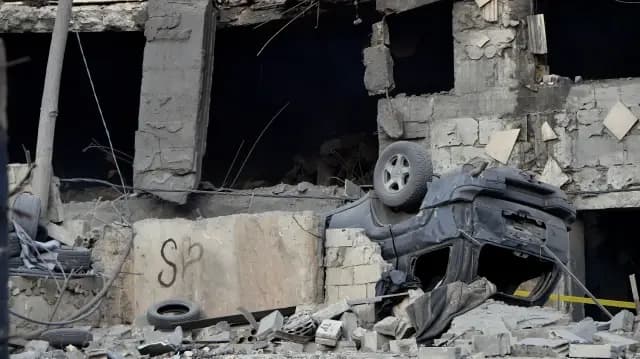
Israel continues to pound Lebanon, with the destruction of residential areas including health centres and Hezbollah rockets fired at Israel.
“French President Emmanuel Macron has said Paris is ready to mediate a truce between Lebanon and Israel, saying that Lebanese leaders are willing to engage in direct talks in a major shift in the country’s approach towards Israel”
Israel maintains a sustained bombing campaign targeting Beirut and other locations across the country, with air raids forcing more than 830,000 people out of their homes, about 14 percent of the population.
Many are struggling to find shelter as aid agencies warn of a humanitarian catastrophe.
Israel has also called for the forced evacuation of Beirut’s southern suburbs and parts of the eastern Bekaa Valley.
Senior Israeli leaders, including Finance Minister Bezalel Smotrich, said Beirut and its southern suburbs would become like Khan Younis, a city in the southern Gaza Strip that has been razed to the ground.
Historical ceasefire context
Hezbollah and Israel agreed to a US-backed ceasefire in November 2024 following more than a year of cross-border fighting, including two months of an all-out war in which Israel killed the group’s leader, Hassan Nasrallah.
The two sides committed to stop fighting and pull their forces back from south of the Litani to pave the way for the Lebanese army to redeploy in the area.
In practice, however, the deal reduced the intensity of the fighting but never fully stopped it.
Israel maintained a presence in at least five positions and continued to carry out military attacks on an almost daily basis.
Hezbollah has refused to lay down arms, saying it would do so only after Israel fully withdrew from Lebanese territory and stopped its air attacks.
Zeina Khodr of Al Jazeera noted that the battlefield remains dynamic and neither side is in a position to impose its conditions for the time being.