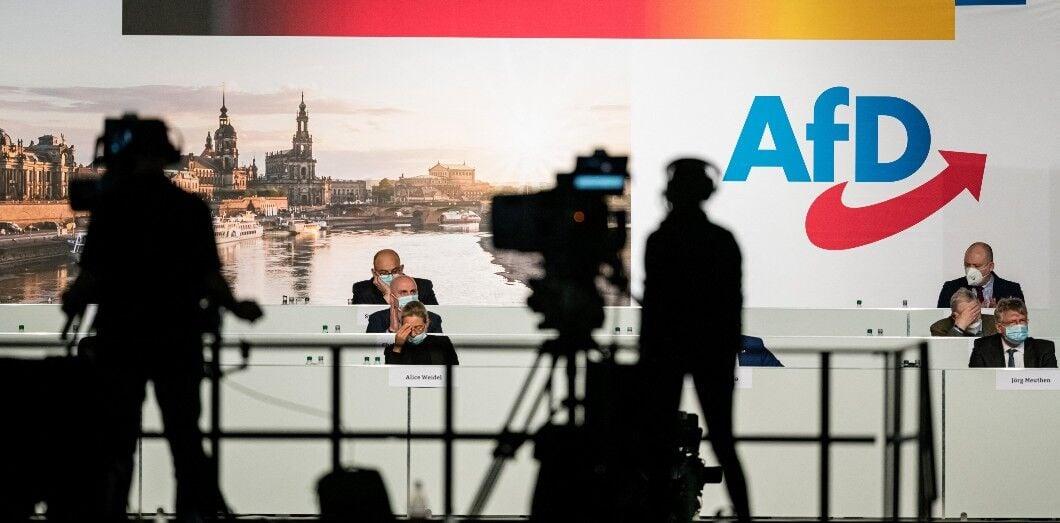
German Police Ban Regno di Germania After Destre Blitz in Seven Land
Key Takeaways
- Germany debates banning AfD after legal assessments.
- German intelligence classifies AfD as extremist.
- Ban discussions provoke political division across German parties.
German far-right crackdown
German police carried out a “Destre Blitz” in seven Land against the “Regno di Germania,” a group described as the largest in the “galassia dei «Cittadini del Reich»,” and the organization was then banned.
“The organization GFF states that the party violates the principle of democracy and human dignity, and highlights the racist character of its political program”
Il Manifesto says the association had “6.000 aderenti” and was designed to replace the Bundesrepublik with a “monarchia super-autoritaria” led by Peter Fitzek, who had autoproclaimed himself “sovrano a vita.”

The same article reports that the plan included a digital currency called “E-Mark” with a value of “1,10 euro ciascuna” and that the investigation involved the Ufficio per la protezione della Costituzione.
Il Manifesto also says the intelligence report described the group’s 2022 acquisition of “un terreno di oltre 50.000 metri in Sassonia” and an “ecovillaggio” with an “autarchia fascista.”
In a separate account of the broader political fight, Slate.fr frames Germany’s constitutional debate as whether “to safeguard democracy, should one declare one's enemies illegal?”
AfD ban debate and courts
Germany’s far-right Alternative for Germany (AfD) is at the center of a debate over whether it should be banned, after the party was officially suspected by German intelligence services on March 4.
Slate.fr says that designation allowed police “to intercept its communications or even to infiltrate agents within its ranks” and that the case could then go before the Constitutional Court to seek the AfD’s ban.
Il manifesto | Western Mainstream reports that the Bundestag began discussion on banning AfD after a motion anti-migrants by leader Cdu Merz, and it describes AfD as “una forza politica incompatibile con i valori della democrazia.”
The same Il manifesto | Western Mainstream says a first motion would “interdire quanto prima Afd” and that a second motion asks for an expert commission to examine the odds of success so the ban “regga il giudizio” of the Corte Costituzionale di Karlsruhe.
In the background of the legal process, El País reports that a legal report by the NGO Society for the Rights of Freedom (GFF) concluded “AfD is unconstitutional” under Article 21, Section 2, of the Basic Law.
Reactions and stakes
Heidi.news describes the AfD ban question as tied to Germany’s “wehrhafte Demokratie,” citing Article 21, which allows banning a party if its aims or members threaten the democratic order promoted by the Basic Law.
“Al bando i vetero-fasci del Regno di Germania”
Heidi.news also says the Federal Office for the Protection of the Constitution can place parties and associations under surveillance, and it states that “Currently, the AfD as a whole is classified as a suspected case.”
In a separate legal framing, El País reports that the GFF analyzed “nearly three million social media posts, 77,000 parliamentary documents, and 55,000 press releases,” and that the report’s conclusion was “unequivocal: AfD is unconstitutional.”
El País adds that the consequences of realizing AfD’s objectives would be “far-reaching,” including that “democratic competition would be significantly weakened.”
Meanwhile, Il manifesto | Western Mainstream reports that the government’s security delegation and the chancellor Friedrich Merz assigned the safety mandate, and it quotes Interior Minister Alexander Dobrindt saying the government “non tollerà più alcun attacco all’ordine costituzionale.”
More on Europe

Federal Jury Deadlocks Jonathan Rinderknecht Arson Trial Over Palisades Fire
11 sources compared

Deutsche Bahn Suspends Trains Nationwide After GSM-R Digital Radio System Disruption
21 sources compared
Afghan Taliban Holds Closed-Door Talks With EU Officials in Brussels on Deportations
27 sources compared
Trump Escalates Feud With Italy’s Giorgia Meloni Over Disputed G7 Photo Claim
13 sources compared