
Global Sumud Flotilla Sets Sail From Barcelona To Break Israeli Blockade On Gaza
Key Takeaways
- The flotilla sails from Barcelona to Gaza to break Israel's blockade.
- Second flotilla in under a year seeks to challenge the blockade.
- Medical and humanitarian supplies, including healthcare professionals, form central cargo.
A new flotilla sets sail
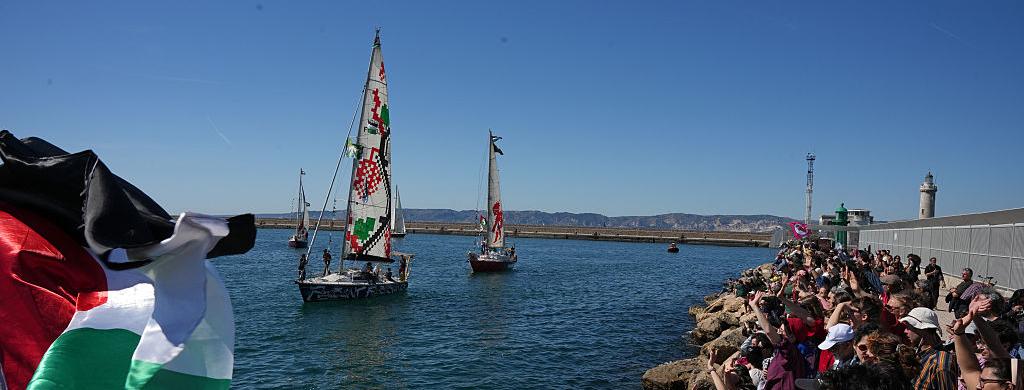
A second Global Sumud Flotilla carrying humanitarian aid to Palestinians in Gaza is due to set sail on Sunday from the Spanish port of Barcelona, aiming to break the Israeli blockade on the coastal Palestinian enclave.
The Times of Israel says “Thirty-nine boats were due to leave” Barcelona, while the South China Morning Post describes “About 30 boats planned to leave” and Al-Monitor (via Reuters) also reports “About 30 boats planned to leave.”
The Times of Israel adds that “more vessels also laden with medical aid and other supplies are expected to join along the route towards the Gaza Strip,” and that “Rough seas mean the flotilla will sail to another port then head out to international waters later in the week.”
Al-Monitor likewise frames the mission as a second flotilla due to set sail “from the Spanish port of Barcelona to try to break the Israeli blockade,” and it ties the departure to the same organization that faced an earlier halt.
The South China Morning Post reports that the Israeli military halted “the roughly 40 boats assembled by the same organisation in October last year,” arresting “Greta Thunberg and more than 450 other participants.”
The flotilla’s stated purpose is to open access for aid delivery organizations, with Saif Abukeshak telling Reuters, “This is a mission that aims to open a humanitarian corridor so the aid delivery organisations can arrive.”
Why activists say they’re sailing
Across the reporting, the flotilla is presented as a response to Israel’s blockade and to what activists and aid bodies describe as insufficient supplies reaching Gaza.
The Times of Israel says Israel “has said previous flotillas have brought insignificant amounts of aid,” while “humanitarian organizations have said the amount entering is still insufficient,” and it describes the mission as seeking to “unload aid in the war-torn territory to help the civilian population.”

The South China Morning Post similarly states that “Israel, which controls all access to the Gaza Strip, denies withholding supplies for its more than 2 million residents,” but it adds that “Palestinians and international aid bodies say supplies reaching the territory are still insufficient.”
Al-Monitor (via Reuters) repeats that framing, noting Israel denies withholding supplies for “its more than 2 million residents,” while Palestinians and international aid bodies say supplies are still insufficient “despite a ceasefire reached in October which included guarantees of increased aid.”
Al Jazeera places the blockade in a longer timeline, saying the Gaza Strip has been “under an Israeli blockade since 2007,” and it describes “severe restrictions on fuel and medical supplies” alongside “approximately 1.5 million of the enclave’s 2.4 million residents displaced and homeless.”
Amnesty International adds that the Global Sumud Flotilla is challenging “Israel’s unlawful blockade on the occupied Gaza Strip,” and it says the mission is “aim at breaking Israel’s unlawful blockade” while responding to a “dire humanitarian crisis.”
Voices: solidarity, law, and medical access
The flotilla’s backers and critics are quoted directly, with multiple voices linking the mission to legal obligations and humanitarian access.
“Gaza aid flotilla aims to break Israeli blockade MADRID, April 12 (Reuters) - A second flotilla carrying humanitarian aid to Palestinians in Gaza was due to set sail on Sunday from the Spanish port of Barcelona to try to break the Israeli blockade”
Liam Cunningham, an actor who “starred in the Game of Thrones television series,” told Reuters, “Every kilogram of aid that is on these ships is a failure because all these people on these ships giving up their time to help their fellow human beings are doing what their governments are legally obliged to do.”
Saif Abukeshak, a Palestinian activist and member of the flotilla’s organizing committee, told Reuters, “This is a mission that aims to open a humanitarian corridor so the aid delivery organisations can arrive.”
Amnesty International’s Erika Guevara-Rosas, Amnesty International’s “Senior Director of Research, Advocacy, Policy and Campaigns,” said, “Israeli authorities must ensure safe passage for these unarmed activists and human rights defenders,” and she added, “There must be no repeat of Israel’s unlawful interceptions and arbitrary detentions that occurred in 2025.”
Amnesty also quotes Guevara-Rosas saying, “As the occupying power, Israel is legally obligated to ensure that Palestinians in Gaza have unfettered access to humanitarian aid, ranging from basic goods to life-saving supplies and goods.”
Al-Monitor’s Reuters report also brings in the World Health Organization, stating, “The World Health Organization has said that even during armed conflicts, states are obliged under international humanitarian law to ensure that people are able to reach medical care in safety.”
A record of interceptions and arrests
The flotilla’s planned departure is framed against a history of Israeli interceptions and attacks at sea, with Al Jazeera providing a detailed timeline of prior campaigns.
It says that “Since 2010, all flotillas attempting to break the Gaza blockade have been intercepted or attacked by Israel in international waters,” and it recounts that in 2010 Israeli commandos raided the aid ship Mavi Marmara, killing “10 activists and injured dozens,” with the ship carrying “humanitarian aid and more than 600 passengers.”
Al Jazeera adds that in 2013 Israel apologised for “operational mistakes” in the raid, and it says “Israeli soldiers and officials who took part in the attack are being tried in absentia in Turkiye for war crimes.”
The same account describes Freedom Flotilla II in 2011, saying it was “set to sail on 10 vessels” but that “intense diplomatic pressure from Israel” and “reported sabotage of ships and restrictions by host countries” prevented most boats from departing, leaving only “The Dignite-Al Karama” close to reaching Gaza before Israeli naval commandos intercepted it and towed it to Ashdod.
For 2015, Al Jazeera says Israeli naval forces intercepted the Swedish-flagged Marianne of Gothenburg “about 100 nautical miles (185km) off the Gaza coast, in international waters” on June 29, 2015, boarding it and diverting it to Ashdod, with activists detained and later deported.
Al Jazeera also ties the current moment to the most recent attempt, saying the flotilla’s departure comes “just months after the Israeli military intercepted the first Global Resilience Flotilla in early October 2025,” which “was attacked in international waters, with hundreds arrested and later deported.”
What’s at stake if aid is blocked
The reporting emphasizes that the stakes are humanitarian and legal, with Amnesty and Al Jazeera describing the Gaza crisis and the risk of further detentions.
Amnesty says the Spring 2026 mission includes “a dedicated medical fleet of 1,000 healthcare professionals,” and it describes the flotilla as featuring “more than 70 boats and 3,000 participants from 100 countries.”

It warns that “There must be no repeat of Israel’s unlawful interceptions and arbitrary detentions that occurred in 2025,” and it cites “the seizure of the Madleen and other vessels participating in the Global Sumud Flotilla” and “the abuse and ill-treatment inflicted on activists during their detention last October.”
Amnesty also argues that Israel continues to impose restrictions on items needed for survival, stating that “Israel continues to impose restrictions on the entry into Gaza of items indispensable to the survival of the civilian population including adequate food, medicines, medical equipment and assistive devices,” and it adds that Israel is “limiting the distribution of aid, including by restricting which organizations are allowed to deliver relief within the Gaza Strip.”
Al Jazeera provides a broader humanitarian picture, saying the prolonged assault has “devastated infrastructure, including hospitals,” and that it has left “approximately 1.5 million of the enclave’s 2.4 million residents displaced and homeless,” while also describing “severe restrictions on fuel and medical supplies.”
In this context, Amnesty’s Erika Guevara-Rosas concludes that “States must also ensure the protection of those taking action to stop Israel’s impunity for its violations of Palestinians’ rights in Gaza.”
More on Gaza Genocide

Israel Prevents Essential Materials as Aid Trucks to Gaza Fall After Iran War
11 sources compared

Israeli Police Detain Alex Sinclair, Cut Palestinian Flag From Kippah in Modi'in
10 sources compared

Israel Kills Lebanese Journalist Amal Khalil in Airstrikes on Al-Tiri Shelter
11 sources compared
Benjamin Netanyahu Says He Received Successful Treatment for Early-Stage Prostate Cancer
50 sources compared