
Pentagon Comptroller Jules Hurst III Says U.S. Iran War Costs $25 Billion
Key Takeaways
- Acting Pentagon Comptroller Jules Hurst III testified the Iran war has cost about $25 billion.
- The testimony occurred at a House Armed Services Committee hearing with Hegseth and Dan Caine.
- Outlets including NBC News and CBS News report the $25 billion figure.
Cost, hearings, and the 60-day clock
The U.S. war with Iran has already cost the United States an estimated $25 billion, according to acting Pentagon Comptroller Jules Hurst III, who testified at a House Armed Services Committee hearing as the conflict nears a 60-day mark.
NBC News reported that Hurst told lawmakers, “Approximately, of this day, we're spending about $25 billion on Operation Epic Fury,” and said “most of those costs are from munitions and included operations, maintenance and equipment replacements.”
NBC News also said Hurst promised lawmakers a cost breakdown after questions from Rep. Maggie Goodlander, and that he said, “just reflects the costs of the war,” adding that the total “reflects the munitions that have been spent to date and other operational costs.”
The Guardian described the same cost-focused confrontation as Democrats grilled Defense Secretary Pete Hegseth over “the war’s costs in dollars, lives and the diminishing stockpiles of critical weapons,” and said Hegseth denied the war was “a quagmire.”
In the NBC News hearing, Rep. Adam Smith, D-Wash, pressed Hurst on whether the Pentagon planned to ask Congress for supplemental funding, and Hurst replied, “We will formulate a supplemental, through the White House, that will come to Congress once we have a full assessment of the cost of the conflict.”
NBC News further reported that in March Pentagon officials told Congress the war cost $11.3 billion in just the first six days, and that the cost estimate is tied to the legal and political timeline Congress is watching as the conflict is slated to exceed 60 days this week.
The Guardian added that Senate minority leader Chuck Schumer said Democrats would force another vote on a war powers resolution, calling it “the sixth time in recent weeks,” as the war rages on.
Democrats press for breakdown
The hearing spotlighted not only the total cost but also what lawmakers said they still lacked: a basic breakdown of how the money was spent.
NBC News reported that Rep. Maggie Goodlander, D-N.H., criticized the Pentagon’s explanation, telling Hegseth, “We are 60 days in to your war of choice in Iran and you can’t give us an answer on the basic breakdown of American taxpayer dollars that have been spent?”

NBC News said Goodlander asked Hurst whether the money was taken from funds already allocated elsewhere, and Hurst answered, “The department deals with contingency operations all the time within its normal budget.”
In the same NBC News account, Hurst told lawmakers that the promised breakdown would come after further questions, and he said, “So we’ve already spent the dollars on munitions and things like that, so we’re factoring in costs of munitions expended in that total.”
The Guardian framed the broader political clash as Democrats attacked the war’s trajectory and stockpile impacts, with California Democrat John Garamendi calling it “astounding incompetence” that led to “political and economic disaster at every level.”
The Guardian also quoted Garamendi saying, “The president has gotten himself and America stuck in a quagmire of another war in the Middle East,” and said Hegseth responded, “Your hatred for president Trump blinds you to the truth of the success of this mission … you call it a quagmire, handing propaganda to our enemies? Shame on you for that statement.”
NBC News added that Hurst’s testimony came as the conflict neared a 60-day mark, and that the 1973 War Powers Resolution allows military force without congressional approval for up to 60 days, after which the president can request a 30-day extension or Congress can vote to authorize the war.
The Guardian said the Senate armed services committee would hear a similar presentation on the Trump administration’s 2027 military budget proposal, which would boost defense spending to “a historic $1.5 trillion.”
Trump, Merz, and troop cuts
As lawmakers pressed the Pentagon on costs, President Donald Trump also signaled possible changes to U.S. deployments in Europe, while German Chancellor Friedrich Merz criticized the war approach.
“American media: Trump ordered preparations for a long-term naval blockade on Iran”
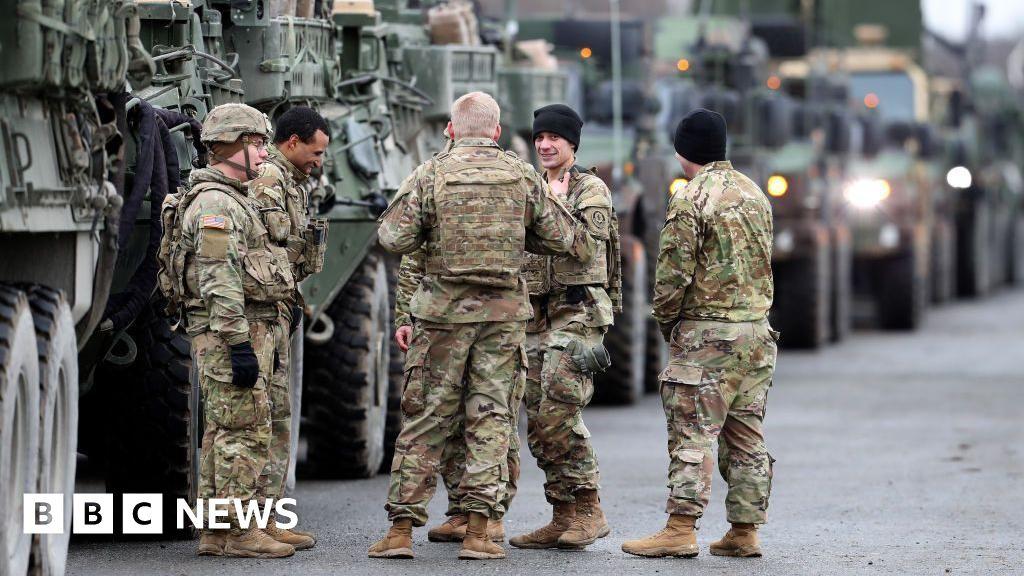
The BBC reported that Trump announced via social media that the U.S. was “studying” whether to reduce “the thousands of troops it has stationed in Germany,” and said Trump wrote that he was “studying and reviewing the possible reduction of Troops in Germany, with a determination to be made over the next short period of time.”
The BBC said Merz had criticized Trump’s approach to the war in Iran, suggesting the U.S. had been “humiliated” by Iranian negotiators, and quoted Merz telling university students that “The Iranians are obviously very skilled at negotiating, or rather, very skilful at not negotiating, letting the Americans travel to Islamabad and then leave again without any result.”
The BBC also reported that Trump responded the following day with a post to Truth Social saying Merz thought it was “OK for Iran to have a Nuclear Weapon” and “doesn't know what he's talking about,” and that the post added, “No wonder Germany is doing so poorly, both Economically, and otherwise!”
The BBC said Merz made no mention of Trump’s comments during a visit to German soldiers in Northern Germany on Wednesday, while stressing “transatlantic solidarity” and that “the importance of the Nato defensive alliance.”
In the NBC News account of the U.S. war’s cost, Trump warned that Iran “better get smart soon” as negotiations stalled, and NBC News said President Trump and other top administration officials met with energy industry executives to discuss possible next steps in continuing the blockade of Iran’s ports.
The Guardian tied the political pressure to the war powers fight, saying Schumer would force another vote on a war powers resolution for the sixth time, while the House also moved on other legislation.
Economy, oil, and demand destruction
Multiple outlets linked the Iran war to rising energy costs and broader economic strain, emphasizing how the Strait of Hormuz closure and blockade affect prices and spending.
NBC News said gas prices continued to soar across the U.S. and around the globe due to the ongoing closure of the Strait of Hormuz, describing it as “a crucial maritime passageway for oil tankers.”
CNBC reported that Brent crude futures rose to a wartime high of $126 a barrel before erasing gains to trade at $114.70, and said U.S. West Texas Intermediate futures slipped to $105.12 as of 7:33 a.m. ET, while also citing Goldman Sachs estimates that exports through the Strait of Hormuz chokepoint have fallen to just 4% of normal levels.
CNBC also quoted ING Bank strategist Warren Patterson saying, “The longer this disruption persists, the less the market can rely on inventory, and the greater the need for further demand destruction,” and said the same note argued that “The only way to drive this would be through higher oil prices.”
CNN framed the economic mechanism as “demand destruction,” describing it as a price shock that is “so large, so persistent and so painful that spending behaviors shift,” and quoted Joe Brusuelas saying, “Time is not the ally of the American economy.”
CNN reported that fast-rising gas prices “have quickly eaten away Americans’ hard-earned pay and tax refunds,” and said inflation “has jolted higher, wage growth sharply slowed and consumer sentiment slumped.”
CNN also warned that the longer the war keeps the Strait of Hormuz blocked, the greater the danger of “drastically worse outcomes,” and it described a chain reaction where oil price spikes lead to less money spent elsewhere, confidence sinks, big purchases freeze, and businesses face margin pressure.
Even as some economic indicators looked better, CNN quoted Nancy Vanden Houten saying, “It looks like what we thought could be a worst-case scenario will be avoided,” while adding, “But then again, things could turn around very quickly.”
Blockade, frozen conflict, and next moves
As negotiations stalled and blockades continued, Al Jazeera and Anadolu Ajansı described the war’s trajectory as potentially protracted, while other reports highlighted the U.S. posture and market uncertainty.
Al Jazeera said negotiations between the United States and Iran “appear deadlocked,” with competing blockades of the Strait of Hormuz continuing to disrupt global energy supplies and the future of Iran’s nuclear programme unresolved.

Al Jazeera quoted White House spokesperson Anna Kelly saying the U.S. was still engaging with Iran on negotiations but would “not be rushed into making a bad deal,” and it quoted Mehran Kamrava of Georgetown University in Qatar saying, “Iran cannot afford to have its ports blocked indefinitely and neither can the US maintain an indefinite blockade of Iran.”
Al Jazeera also described a “frozen” scenario, quoting Kamrava: “For the time being, we might see a short-term frozen conflict, but this cannot continue for several months or years.”
The same Al Jazeera report cited the Quincy Institute estimate that Washington’s costs incurred over the first month of the war were between $20bn and $25bn, and it said the U.S. military has imposed a naval blockade on Iranian ports and vessels since April 13.
Anadolu Ajansı, citing the Wall Street Journal, reported that Trump issued directives to prepare for a “long-term naval blockade” of Iran’s ports and said the newspaper cited informed U.S. officials that Trump decided to continue pressure targeting Iran’s oil revenues and economic resources to force Tehran to roll back its nuclear program.
Anadolu Ajansı also stated that the Islamic Revolutionary Guard Corps announced the closure of the Strait of Hormuz on March 2 and that the United States began a naval blockade of shipping to and from Iranian ports on April 13.
In the NBC News report, Trump warned Iran “better get smart soon” as negotiations stalled and the administration discussed possible next steps in continuing the blockade of Iran’s ports.
More on Iran
Iran Mocks Donald Trump as Oil Prices Surge Past $125 and Strait of Hormuz Stays Closed
13 sources compared

Donald Trump Says U.S. Naval Blockade of Iranian Ports Could Last Months
23 sources compared

US Besieges Iranian Ports as Trump Mulls Extended Blockade, Driving Oil Prices Higher
10 sources compared

Oil Prices Surge as US Siege of Iranian Ports Threatens Strait of Hormuz Supply
11 sources compared