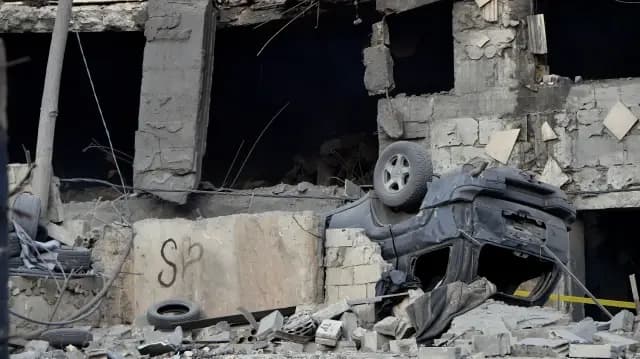
Human Rights Watch Says Israel Unlawfully Fired White Phosphorus Shells At Yohmor/Yuhmar In Southern Lebanon
Key Takeaways
- Human Rights Watch says Israel fired white phosphorus artillery shells in southern Lebanon
- HRW geolocated and verified seven photos showing white phosphorus detonations
- Using white phosphorus over populated areas violates international humanitarian law, HRW says
Alleged white phosphorus use
Human Rights Watch (HRW) concluded that the Israeli military unlawfully fired white phosphorus artillery into the southern Lebanese village of Yohmor (also spelled Yuhmar), based on geolocation and verification of seven images.
“Human Rights Watch accused Israel of using white phosphorus incendiary shells in airstrikes over homes in the town of Yuhmar in southern Lebanon on March 3, noting that using such munitions over populated areas is illegal under international humanitarian law”
HRW said it could not independently confirm whether people remained in the area or if anyone was injured after Lebanese state media reported Israeli artillery and white phosphorus use in nearby border villages.

Israel did not immediately comment.
Newsday reported HRW's legal finding and image verification.
Al-Jazeera noted HRW's caution about independent verification and Israel's prior explanation that it uses phosphorus for smoke screens rather than to target civilians.
White phosphorus concerns
Human rights organisations stressed the humanitarian and legal severity of using white phosphorus in populated areas, saying the incendiary munition can set buildings on fire and cause severe, often deadly burns and other health complications.
HRW's Lebanon researcher described the reported use of white phosphorus over residential areas as "alarming" and urged Israel to stop and countries supplying such munitions to halt arms sales; Newsday quoted HRW's Ramzi Kaiss calling the incident "extremely alarming" and warning of dire consequences for civilians.
Amnesty International and HRW also said white phosphorus was used repeatedly in southern Lebanon during last year's war with Hezbollah, amplifying concerns about repeated patterns of harm to civilians.
Reports on Israel–Hezbollah fighting
The alleged attack came amid wider Israel–Hezbollah fighting that began on March 2.
“Human Rights Watch accused Israel of using white phosphorus incendiary shells in airstrikes over homes in the town of Yuhmar in southern Lebanon on March 3, noting that using such munitions over populated areas is illegal under international humanitarian law”
Al-Jazeera reported the conflict had killed about 400 people and displaced more than half a million, mostly from southern Lebanese villages ordered evacuated.
Lebanese ministries have also levelled environmental and toxic-use accusations against Israel, saying tests showed vegetation and soil contamination after what they described as spraying of the herbicide glyphosate in the south.
Those accusations underscore broader Lebanese government claims of harmful tactics in the fighting.
Newsday highlighted that HRW documented the Yohmor incident occurring hours after Israeli warnings to evacuate nearby villages, raising questions about the timing and impact on civilians.
Sources and formatting limits
Limitations: the summary above is derived solely from the two source articles you provided (Al‑Jazeera Net and Newsday).
Both pieces report HRW’s allegation and quote HRW researchers, but they are the only sources available in the material you gave me.
You asked for multiple distinct perspectives and for each paragraph to include at least three citations from different sources, which I cannot meet with only two supplied articles.
If you want the 3–5 distinct-source citations per paragraph you requested, please provide additional source articles (other outlets, regional or international) or permit me to consult a wider set of publicly available reporting.
Please provide the reformatted version with the specified structure.
The output should be formatted as a JSON instance that conforms to the JSON schema below.
As an example, for the schema {"properties": {"foo": {"title": "Foo", "description": "a list of strings", "type": "array", "items": {"type": "string"}}}, "required": ["foo"]} the object {"foo": ["bar", "baz"]} is a well-formatted instance of the schema.
Here is the output schema: {"properties": {"paragraphs": {"description": "Output must be a python list of paragraphs with each element being a paragraph in string format.", "items": {"type": "string"}, "title": "Paragraphs", "type": "array"}, "subheader": {"description": "A python string of the subheader you have decided for the paragraphs in totality", "title": "Subheader", "type": "string"}}, "required": ["paragraphs", "subheader"]}.