
Iran Drone Attack Hits UAE Fujairah Port, Halting Oil Loading
Key Takeaways
- Drone attack caused a fire and suspended oil loading at Fujairah port in the UAE.
- Oil loading at Fujairah resumed the day after, restoring flow to Asia and Europe.
- U.S. Embassy in Baghdad was struck by drones amid broader Iran-Israel-US confrontation.
Attack Details
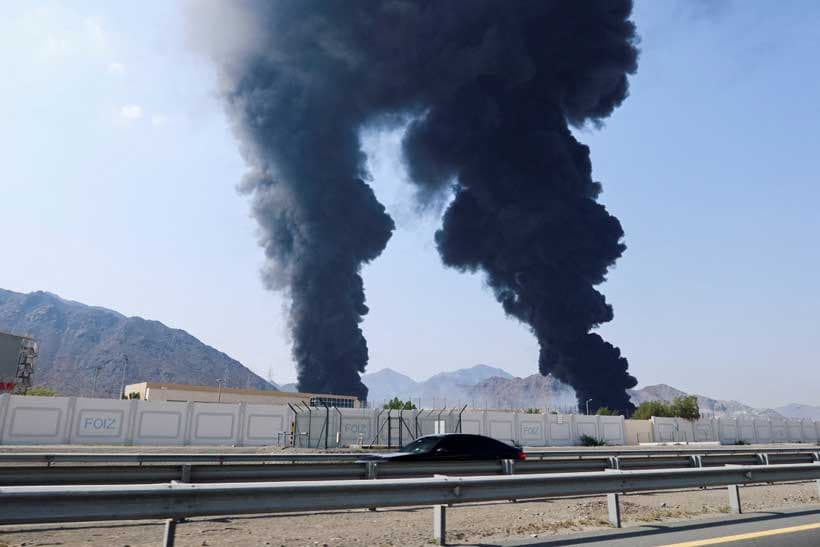
Drone strikes at the UAE's Fujairah port on March 14, 2026, caused significant disruption to global energy supplies as oil loading operations were temporarily halted following a fire ignited by debris from an intercepted Iranian drone.
“DUBAI, United Arab Emirates — Iran issued an evacuation warning Saturday for three major ports in the United Arab Emirates, including the busiest in the Middle East, openly threatening a neighboring country's non-U”
The incident began when multiple drones struck oil storage facilities at this critical Gulf energy hub, sending heavy smoke over the port area and forcing suspension of loading operations, according to industry sources reported by Türkiye Today.

The Fujairah Media Office confirmed that debris from an intercepted drone fell on the facility, causing a fire that injured a Jordanian resident, as documented by Devdiscourse and WebIndia123.
Following the incident, loading operations gradually resumed after the fire was contained and port activity returned to normal, with reports indicating activity restarted on Sunday morning, as noted by both Türkiye Today and Українські Національні Новини.
Strategic Importance
The Fujairah port holds immense strategic importance as a critical global energy hub that allows Gulf producers to bypass the Strait of Hormuz, one of the world's most sensitive maritime chokepoints.
Located on the Gulf of Oman approximately 70 nautical miles from the Strait of Hormuz, Fujairah serves as a major outlet for Abu Dhabi's Murban crude, with around 1 million barrels per day shipped through the facility - equivalent to roughly 1% of global oil demand, according to Türkiye Today.

Modern Diplomacy highlights that last year the port exported over 1.7 million barrels of oil and fuels daily, making up about 1.7% of global demand, while ranking as the fourth largest marine fuel supplier in the world after Singapore, Rotterdam, and Zhoushan in China.
The UAE's pipeline to Fujairah is essential for bypassing the strategically critical but increasingly threatened Strait of Hormuz, which has been effectively closed to most shipping since the Iran war escalated, as emphasized by both Türkiye Today and Arizona Daily Star.
Regional Context
The attack on Fujairah port occurred within the broader context of escalating regional tensions following US military actions against Iran's Kharg Island oil terminal and Iran's subsequent retaliatory threats.
“EnglishInternational UAE resumes Fujairah oil exports day after Iran drone strike Oil flows resume via Fujairah pipeline route after blaze is doused, keeping Asia and Europe supplies steady By Jo Eun-im Published 2026”
The incident came amid a broader regional confrontation following U.S. strikes on Iran, with the IRGC warning of further targeting U.S. interests in the UAE, as reported by Türkiye Today.
Radio Free Europe/Radio Liberty detailed that Iran's military issued evacuation warnings for UAE ports and docks, specifically stating 'We warn the UAE leadership that the Islamic Republic of Iran views it as its legitimate right to strike the origins of American missile launches--those concealed in ports, docks, and shelters used by US forces under the cover of Emirati cities.'
Arizona Daily Star reported that Iranian Foreign Minister Abbas Araghhi claimed the U.S. used 'ports, docks and hideouts' in the UAE to launch strikes on Iran's Kharg Island, though no evidence was provided.
The attack on Fujairah was part of a coordinated regional escalation that also included drone strikes on the US Embassy in Baghdad and ongoing military operations across the Middle East.
Global Impact
The disruption at Fujairah port has significant global economic implications, particularly for energy markets already strained by the ongoing Iran conflict and the closure of the Strait of Hormuz.
Modern Diplomacy emphasizes that Fujairah's storage capacity of 18 million cubic meters positions it as a significant center for storing and blending crude and fuels, and if disruptions persist, it could lead to a shutdown of production for OPEC's third largest crude producer.
The attack has contributed to soaring oil prices, with Business Standard reporting that US gasoline prices rose to an average of USD 3.68 a gallon, a 23 per cent increase since the war in Iran began, while diesel prices averaged USD 4.85 a gallon this week, about a dollar higher than before the conflict.
Türkiye Today notes that Fujairah's significance has been magnified by the ongoing conflict affecting Hormuz, and the port serves as a crucial alternative route for Gulf oil exports amid heightened security concerns and regional instability.
The incident underscores the vulnerability of global energy infrastructure to geopolitical conflicts and highlights the precarious state of energy markets in the region.
More on Business

Iran warns UAE ports host American hideouts; evacuations ordered amid Kharg Island strikes.
293 sources compared

Senate Passes Bipartisan Housing Bill Banning Institutional Investors From Buying Single-Family Homes
19 sources compared

Senate Passes Bipartisan Housing Bill Banning Institutional Investors From Buying Single-Family Homes
29 sources compared

Lucid Group Reveals Cosmos and Earth Midsize EVs Starting Under $50,000
10 sources compared