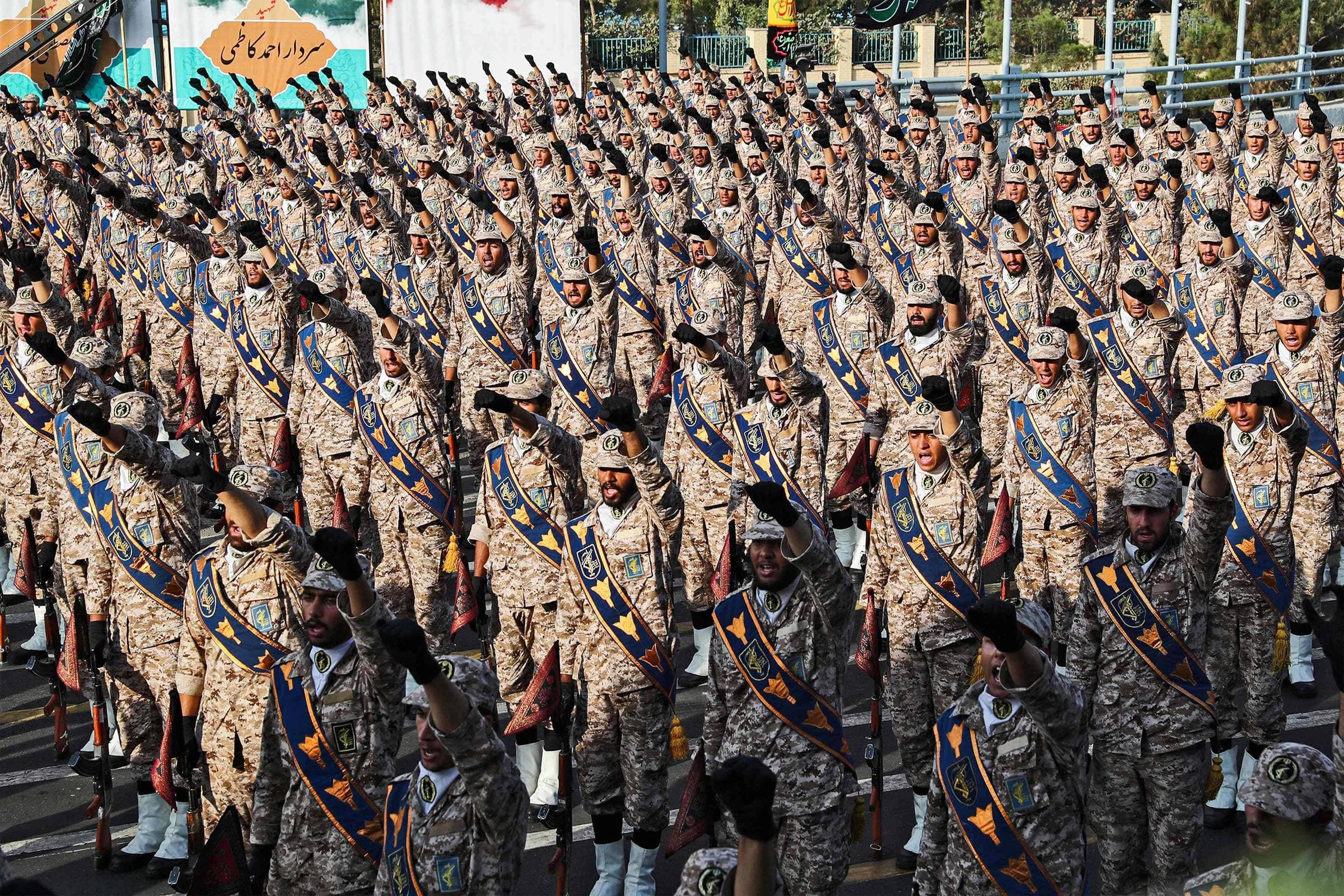
Iran's Revolutionary Guard is the backbone of a militarized state; explained
Key Takeaways
- Revolutionary Guard deployed across Tehran and other Iranian urban centers after Israel and US airstrikes
- Plainclothes Revolutionary Guard members, often armed with Kalashnikovs, set up checkpoints searching cars and phones
- Revolutionary Guard operated as a domestic security force across neighborhoods and city centers
Revolutionary Guard responses in Iran
Hours after the first airstrikes by Israel and the United States hit Iran, members of the Revolutionary Guard spread across neighborhoods in Tehran and other urban centers, witnesses and videos quietly posted online showed.
“Hours after the first airstrikes by Israel and the United States hit Iran, members of the Revolutionary Guard spread across neighborhoods in Tehran and much of the country’s urban centers”
Men in plain clothes, often armed with Kalashnikov rifles, set up checkpoints where they searched cars and cellphones; black riot-control vehicles were parked in places like closed schoolyards.
Saeid Golkar, a political science professor at the University of Tennessee, said the Guard sought both to create the illusion abroad that they are in control and to create fear domestically so people do not dare to take to the streets.
President Donald Trump suggested the Guard lay down its arms to boost public support for a regime change; analysts consider that scenario highly unlikely and describe the Guard as the backbone of a militarized state and the main obstacle to any change in the country.
Guard origins and influence
The article traces the Guard’s origins to Ayatollah Ruhollah Khomeini’s distrust of the traditional Armed Forces (the Artesh) after the 1979 Islamic Revolution, quoting Khomeini as saying, "The Artesh has the shah in its blood."
The Guard’s core came from neighborhood committees organized around mosques and was hardened by the 1980–1988 war with Iraq, during which it built a missile development program.
After Khomeini’s death in 1989, the new supreme leader, Ali Khamenei, transformed the Guard into an elite force, tying his office to its power and allowing expansion into politics and the economy.
The Guard created a reconstruction arm, built infrastructure, and became adept at smuggling goods including oil after Western sanctions following 2002.
After the U.S. toppling of Saddam Hussein in 2003, it used its Quds Force to build an axis of predominantly Shia militias in Lebanon, Syria, Iraq, Yemen, and the Gaza Strip, becoming a central actor in Iran’s foreign policy.
Behnam Ben Taleblu, a senior researcher at the Foundation for Defense of Democracies, says the Guard controls at least 25% of the country’s economy, possibly twice that amount.
Guard structure and leadership
The Guard now numbers between 125,000 and 180,000 members within broader national security forces that analysts estimate could total up to 1.5 million including police; not all Guard members are combatants.
“Hours after the first airstrikes by Israel and the United States hit Iran, members of the Revolutionary Guard spread across neighborhoods in Tehran and much of the country’s urban centers”
Its four main military branches are ground, naval, aerospace and the Quds Force, and it controls allied bodies including its own intelligence agency and the Basij neighborhood militias.
The organization follows a 'mosaic' strategy of decentralized command with 31 provincial commands and smaller units for protest suppression, giving regional commanders autonomy over actions such as launching missiles or drones.
Analysts say the strategy was refined after Khamenei was targeted in a 12-day war waged by Israel and the U.S., and they quote Hamidreza Azizi saying, 'The system is working without Khamenei.'
Israeli and American strikes killed two Guard commanders—one in June and another on Feb. 28—and Brigadier General Ahmad Vahidi was appointed on March 1 to head the Guard.
The article describes Vahidi as a veteran hard-line officer with a reputation for brutality, a former interior and defense minister, a founding Quds Force commander in 1988 who led it for eight years, and someone Argentina accused of approving the 1994 bombing of a Jewish community center in Buenos Aires that killed 85 people (Argentina unsuccessfully sought his arrest through Interpol and Iran repeatedly denies involvement).
The article says the Guard is not monolithic — it includes conscripts and many who despise the Islamic system — but that a core of about 2,000 to 3,000 hard-line officers with status and wealth tied to the organization will 'fight to the end.'
The article also states that Mojtaba Khamenei 'enlisted in the Guard during the war with Iraq and maintains particularly strong ties' and that, 'as his father’s chief adviser, he appointed his senior officers over the past two decades and is today considered their favorite among them, analysts say.'
The article’s phrasing calling him 'the son of the late supreme leader and political heir' is ambiguous in the context of earlier references and does not clearly identify which figure it intends.
More on Iran-Israel

Escalation in Iran Pushes Oil Near $120, Sparks Gas Price Surge in Los Angeles
10 sources compared
U.S. Intercepts Iran Message Activating Sleeper Cells After U.S.-Israel Strike Kills Khamenei
14 sources compared

Iran Threatens To Confiscate Property Of Iranians Abroad Who Support US And Israel
14 sources compared
Ukraine Sends Drones, Experts to Shield U.S. Bases in Jordan From Iran
16 sources compared