Israel Attacks Lebanon as Iran Strikes Dubai's Airport, Expanding Middle East War
Key Takeaways
- Beirut explosions indicate intensified Israeli attacks on Lebanon.
- Iran retaliated with a drone strike that briefly shut Dubai's airport.
- U.S. and Israel attacked Iran's capital while expanding campaigns in Lebanon.
War Escalation
The Middle East conflict has escalated dramatically with Israel launching a major campaign against Lebanon while Iran retaliated by striking Dubai's international airport.
“The war in the Middle East raged on multiple fronts on Monday, as the US and Israel pummeled military targets in Iran’s capital, Israel stepped up its campaign against Lebanon and Iran retaliated with a drone strike that temporarily shut Dubai’s airport, a crucial hub for travelers”
This has created a multi-front war that threatens to engulf the entire region.
Monday saw coordinated military actions across multiple theaters as the United States and Israel targeted infrastructure in Iran's capital.
Simultaneously, they intensified their assault on Iran-backed Hezbollah militants in Lebanon.
Iran's response included a drone strike that temporarily shut down Dubai's airport, a critical global travel hub.
This demonstrates the conflict's international reach and has disrupted regional air travel significantly.
The attacks represent a dangerous escalation in the ongoing hostilities that began with the U.S.-Israeli attack on Iran more than two weeks ago.
Lebanon Assault
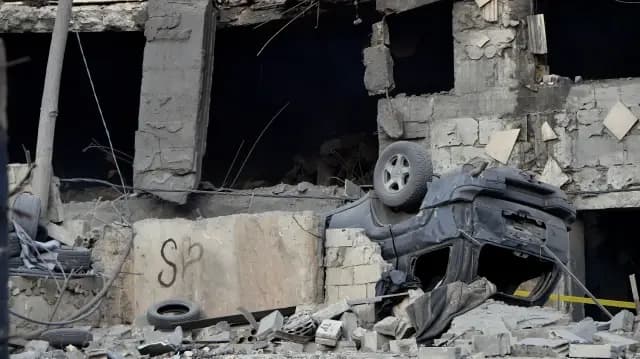
Israel has dramatically intensified its military campaign against Lebanon, focusing on infrastructure related to the Iran-linked Hezbollah militia group.
Massive explosions rocked Beirut early Monday as Israeli forces launched new attacks on the Lebanese capital.
The Israeli army issued widespread evacuation orders for numerous neighborhoods in Beirut as well as southern Lebanon.
The campaign has resulted in significant casualties, with at least 850 people killed by Israeli strikes in Lebanon so far.
Seven people were killed in recent southern Lebanon airstrikes, including paramedics responding to an earlier strike.
Lebanon's state-run National News Agency confirmed the paramedic casualties.
Israeli troops have reportedly pushed into southern Lebanon.
This raises fears that Israel is preparing for a large-scale invasion of the country as part of its broader regional strategy against Iranian-backed forces.
Iranian Retaliation
Iran retaliated forcefully against the U.S.-Israeli attacks by launching a drone strike that temporarily shut down Dubai's international airport.
“By DAVID RISING, BASSEM MROUE and SAMY MAGDY BEIRUT, Lebanon (AP) — Thewar in the Middle Eastraged on multiple fronts on Monday, as the U”
This is one of the world's busiest travel hubs, severely disrupting international air travel across the region.
In parallel, Iran has maintained its stranglehold on shipping in the Strait of Hormuz.
This vital waterway typically transports a fifth of the world's oil.
Iran has attacked commercial vessels and created an atmosphere of fear that has slowed shipping to a trickle.
Iranian Foreign Minister Abbas Araghchi has rejected any notion of negotiations.
He dismissed claims that Iran is seeking 'truce nor talks' as 'delusional'.
Araghchi maintained that the Strait of Hormuz remains 'open' but not for 'the United States, Israel and its allies.'
This coordinated Iranian response demonstrates a strategic approach to both retaliate directly and exert economic pressure on Western and allied nations.
Humanitarian Crisis
The expanding conflict has created a devastating humanitarian crisis across the region.
Israel's campaign in Lebanon has displaced more than 800,000 people.
These people have been forced from large swaths of the country's southern region.
They have also been displaced from Beirut's southern suburbs.
The civilian toll continues to mount with at least 850 people reported killed in Lebanon by Israeli strikes.
Iran has suffered casualties of over 1,300 people according to the Iranian Red Crescent.
The conflict has also resulted in Israeli casualties.
Twelve people have been killed by Iranian missile fire in Israel.
At least 13 U.S. personnel have been affected, though sources don't specify whether these were casualties or injuries.
Severe restrictions on information flow from Iran have made it difficult to obtain complete casualty figures.
These restrictions include internet outages, round-the-clock airstrikes, and tight journalist restrictions.
Military Scale
Military operations have reached unprecedented scales with Israel carrying out approximately 7,600 strikes on Iran.
“Israel steps up campaign in Lebanon, as Iran keeps stranglehold on shipping Israel steps up campaign in Lebanon, as Iran keeps stranglehold on shipping BEIRUT, Lebanon (AP) — The war in the Middle East raged on multiple fronts on Monday, as the U”
These strikes have successfully knocked out 85% of Iran's air defenses according to Israeli military spokesman Lt. Col. Nadav Shoshani.
They have also destroyed 70% of Iran's missile launchers.
Despite these significant gains, Shoshani indicated Israel still has thousands of targets to hit.
He would continue attacks 'for as long as needed,' suggesting a prolonged conflict is anticipated.
The Israeli military has launched new strikes on Tehran, targeting infrastructure there.
More details about these operations remain limited due to the information blackout in Iran.
Since the U.S.-Israeli attack on Iran more than two weeks ago, Tehran has regularly fired drones and missiles.
Iran has attacked Israel, American bases in the region, and Gulf Arab countries' energy infrastructure.
This demonstrates Iran's extensive retaliatory capabilities and reach across the Middle East.
Global Impact
The conflict has triggered significant economic repercussions globally.
Fears of a major energy crisis have emerged as Iranian strikes on commercial ships have slowed shipping through the Strait of Hormuz.
The vital waterway has seen traffic reduced to a mere trickle.
This disruption has dramatically increased oil prices.
Brent crude, the international standard, remained over $100 per barrel on Monday.
This puts substantial pressure on Washington to address the situation for consumers and the global economy.
U.S. President Donald Trump has reportedly demanded that approximately seven countries send warships.
His goal is to keep the Strait of Hormuz open.
However, his appeals have not yet produced any concrete commitments from nations.
Only a small number of ships have successfully crossed the strait this weekend.
These include two Indian-flagged vessels and one Pakistani-flagged ship.
This highlights the severe impact on international trade and energy supplies.