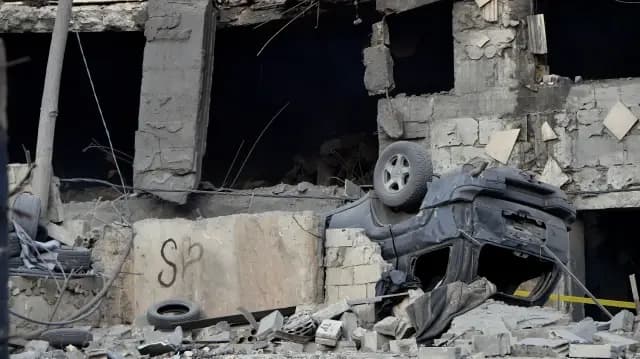
Israel Expands Ground Offensive Against Hezbollah in Lebanon
Key Takeaways
- Israel expanded its ground offensive in southern Lebanon against Hezbollah.
- The operation is described as an intensified campaign against Hezbollah.
- Date of escalation reported as March 16, 2026.
Offensive Initiation
Israel has launched a significant expansion of its ground offensive against Hezbollah in southern Lebanon.
“Israel advanced into new areas of southern Lebanon on Monday (16), sending troops in a ground offensive to attack Hezbollah”
The Israel Defence Forces (IDF) announced on March 16, 2026, that it had begun 'limited and targeted ground operations' against key Hezbollah strongholds.

Israeli Defense Minister Israel Katz confirmed the operation, stating it was intended 'to remove threats and protect the residents of the north.'
The Israeli military has been reinforcing troops along the northern border with Lebanon to strengthen 'readiness for various offensive and defensive scenarios.'
The fighting between Israeli forces and Hezbollah intensifies amid the broader Middle East conflict that began with a US-Israeli air campaign against Iran on February 28.
Military Expansion
Israeli forces have been advancing strategically toward the Blue Line, the UN-demarcated boundary between Israel and Lebanon.
They are establishing positions in towns and strategic points throughout the border region.

The Israeli Army spokesperson, Lieutenant Colonel Nadav Shoshani, confirmed that soldiers were operating in 'new locations where our troops had not been operating until then.'
Tel Aviv has maintained five military positions in southern Lebanon since the ceasefire signed with Hezbollah that ended the previous conflict in late 2024.
The current offensive represents a substantial increase in operational scope and territorial control.
Clashes Intensify
Security sources and eyewitnesses have reported fierce clashes between Israeli troops and Hezbollah fighters along multiple border axes.
“Lebanon: An Israeli tank drives in southern Lebanon near the border, as seen from northern Israel, March 13, 2026”
Hezbollah fighters have been fortifying their positions and pushing back against Israeli advances.
This escalation represents some of the most intense border clashes since the fragile ceasefire ended the previous year-long war in late 2024.
That ceasefire had displaced hundreds of thousands of people and caused significant infrastructure damage.
Hezbollah, which controls much of southern Lebanon and is a key Iranian ally, has regularly exchanged rocket and drone fire with Israeli forces since March 2.
The group renewed attacks after the killing of Iran's former Supreme Leader Ali Khamenei in a US-Israeli strike.
Israeli Warnings
Israel's Defense Minister Israel Katz has issued strong warnings about Hezbollah's consequences.
He vowed that Hezbollah will 'pay a heavy price' for its continued military activities.
Katz appeared in a Defense Ministry video seated in the Israeli Army's control room beside military officers.
He asserted that Lebanese residents won't return south of the Litani River until Israeli security is guaranteed.
The minister stated the Israeli Army will destroy Hezbollah's infrastructure in southern Lebanon.
The Israeli military also destroyed an aircraft used by Iran's top leadership at Tehran's Mehrabad Airport.
Regional Context
The expanding ground offensive is taking place within a wider regional conflict.
“Gift this articleShare to FacebookPrint article Article printing is available to subscribers only Print in a simple, ad-free format Subscribe Comments: SaveZen Reading Zen reading is available to subscribers only Ad-free and in a comfortable reading format Subscribe”
This conflict began with a US-Israeli air campaign against Iran on February 28, 2026.
It has created a complex web of retaliatory actions and escalating tensions.
The Israeli military's decision to deepen ground operations signals a more comprehensive strategy against Hezbollah.
This appears to involve not just targeted strikes but a broader campaign.
The timing after Iran's former Supreme Leader's death suggests Israel is addressing multiple fronts.
Israel appears to be attempting to establish a new security paradigm.
This paradigm would reduce the threat posed by Iranian-aligned forces.