
Israel Intensifies Ceasefire Violations, Establishing ‘Yellow Line’ in Southern Lebanon
Key Takeaways
- Israel established a Gaza-style 'Yellow Line' in southern Lebanon, enforcing a new border boundary.
- A US-brokered ceasefire began, but renewed Israeli strikes continued, violating the truce.
- Civilians faced displacement and housing destruction amid ongoing violations and border operations.
Ceasefire Meets a “Yellow Line”
A 10-day ceasefire between Israel and Lebanon began on Thursday night after 46 days of Israeli bombardment and a ground invasion in southern Lebanon, but renewed Israeli attacks and the creation of a military boundary similar to the “Yellow Line” in Gaza are casting doubt on the agreement.
Al Jazeera reports that within hours Israeli forces were carrying out demolitions, artillery shelling and land-clearing operations in several border areas in violation of the ceasefire, while Israeli attacks have killed more than 700 people and wounded around 2,000 since the US-brokered “ceasefire” was agreed last October.
At the centre of the dispute is what Israel calls a “Yellow Line” — a military zone stretching roughly 10km (6 miles) north of the border inside southern Lebanon.
Al Jazeera says Israeli officials intend to keep the zone under military control while reserving the right to strike the area to root out Hezbollah, and it adds that Lebanon and Hezbollah have rejected the move as an occupation of sovereign territory that violates the premise of a ceasefire.
Prime Minister Benjamin Netanyahu is quoted saying Israeli forces “are remaining in Lebanon in a reinforced security buffer zone,” and he adds, “This is a security strip ten kilometres deep, which is much stronger, more intense, more continuous and more solid than what we had previously. That is where we are and we are not leaving.”
Senior Israeli military officials told reporters during a briefing on Saturday that “the ‘Yellow Line’ model implemented in Gaza will be replicated in Lebanon; the IDF [Israeli military] has already established a ‘Yellow Line’ and its forces are currently working towards it,” and they said residents will not be allowed to return to 55 Lebanese towns and villages within that area.
Violations, Demolitions, and Firepower
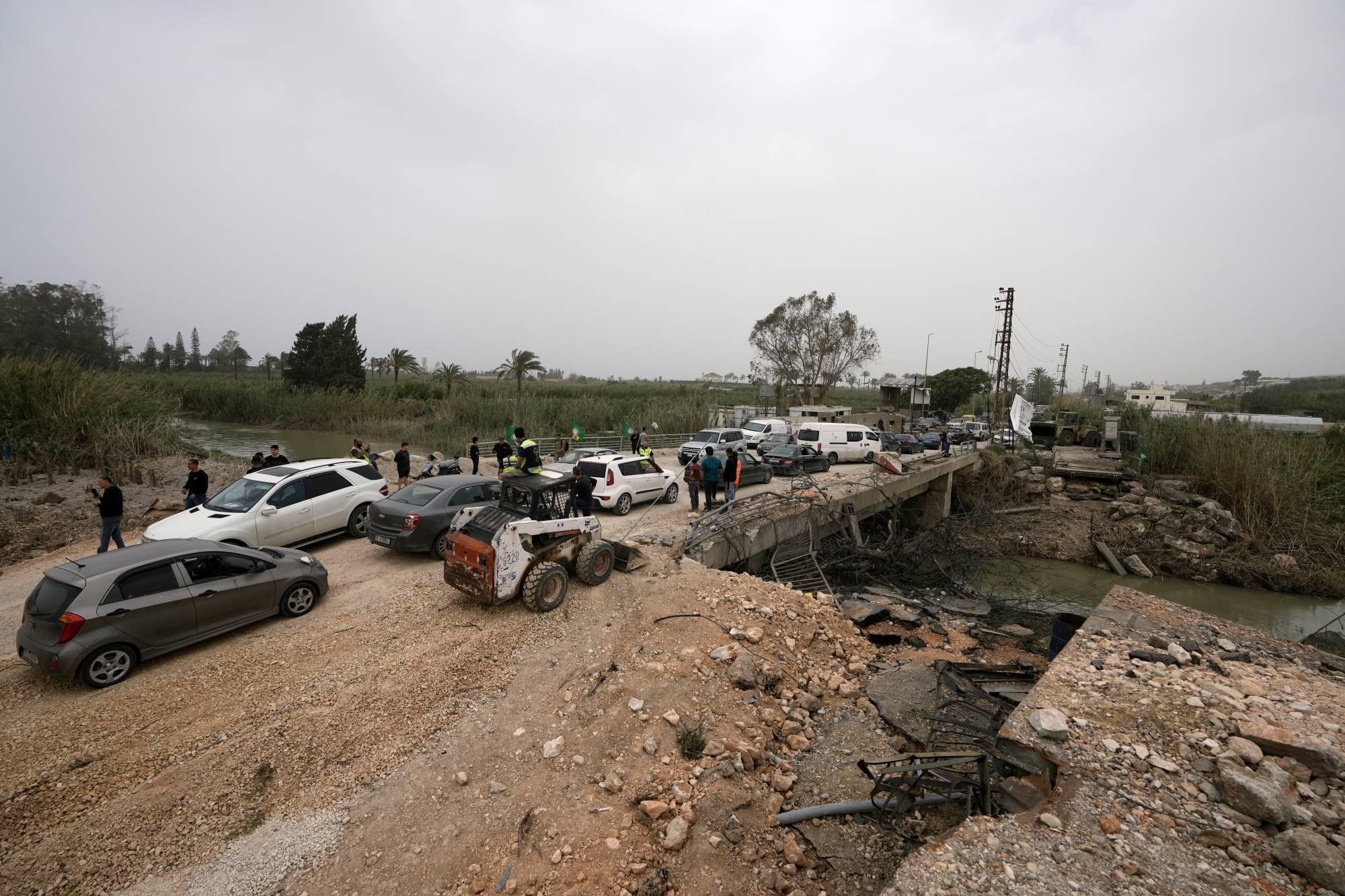
As residents began cautiously inspecting their homes across southern Lebanon and Beirut’s southern suburb (Dahiyeh), Al-Manar says Israeli violations continued for the third day after the ceasefire took effect on Friday.
Al-Manar correspondents reported demolishing houses across border areas and artillery shelling, and they list towns where bombing targeted houses, including Khiam, Markaba, Ayta Al-Shaab, Bint Jbeil, Deir Seryan, Hanin, Shamaa, Al-Bayyada, Al-Qantara, Rshaf and Naqoura.

The outlet also reports artillery shelling targeting Kawnin, Yuhmor Al-Shaqif, Deir Mimas, Beit Yahoun, and it adds that the shelling on Yuhmor Al-Shaqeef employed phosphorus ammunition.
Al-Manar further says Israeli warplanes flew over low altitude across southern Lebanon, especially over the southern city of Nabatieh and nearby towns, while residents continued returning afterward to places of displacement.
In parallel, Asharq Al-Awsat describes Israeli violations of the US-brokered ceasefire as continuing alongside military operations and airstrikes against targets Israel claims are affiliated with Hezbollah, and it says residents who had returned to some southern villages were forced to leave again immediately.
Asharq Al-Awsat also ties the violations to Israel’s creation of a “yellow line” in southern Lebanon, saying it effectively prevents residents from returning to 55 Lebanese towns located within this line.
The same report says that over the past 24 hours, forces operating south of the yellow line identified individuals they described as militants who violated the ceasefire and approached from the north of the line, and it says the army struck those individuals in several areas immediately after detecting them.
Al Jazeera adds that it reported Israeli forces blew up homes in the town of Haneen on Saturday, while artillery shells were fired towards Beit Lif, al-Qantara and Toul, and it says bulldozers continued demolition and land-clearing operations in several areas of southern Lebanon.
Hezbollah’s Vows and Netanyahu’s Buffer
Hezbollah’s leadership framed the ceasefire as conditional on Israel stopping aggression, with Xinhua reporting that Hezbollah leader Naim Qassem said on Saturday the ceasefire must mean a complete halt to aggression and that the group will retaliate against Israeli violations in southern Lebanon.
China Daily quotes Qassem saying, “There is no ceasefire from one side only,” and it adds that he said Hezbollah fighters “will respond to violations of aggression accordingly.”
China Daily reports that Qassem outlined five key steps including “a permanent halt to hostilities across Lebanon,” “a full Israeli withdrawal,” “detainee releases,” “the return of displaced residents,” and “reconstruction with Arab and international support.”
The same China Daily account says Qassem added that Hezbollah had not been defeated and would continue to pursue Lebanon’s liberation and independence, while it also says he was open to “a new page” of cooperation with the Lebanese government.
Al Jazeera, meanwhile, reports that Israeli Defence Minister Israel Katz announced on Friday that the Israeli military “will continue to hold and control all the positions it has cleared and secured,” and it frames this as part of Israel’s insistence on staying in Lebanon in a reinforced security buffer zone.
Al Jazeera also quotes Netanyahu’s insistence that “This is a security strip ten kilometres deep,” and it says senior Israeli military officials told reporters that the “Yellow Line” model from Gaza will be replicated in Lebanon.
Asharq Al-Awsat adds that the Israeli security line is described by Brig. Gen. Fadi Daoud as unofficial but effectively a dangerous point of friction, saying it is known in the field as the Israeli technical line along the Lebanon-Israel border.
In the same report, a security source tells Asharq Al-Awsat that violations include not only artillery shelling, drone strikes, or clashes with Hezbollah fighters, but also “the deliberate booby-trapping and complete demolition of homes under the pretext of destroying the group’s infrastructure.”
Disputed Ceasefire Language
The dispute over whether Israel can continue attacks during the ceasefire is tied to how the agreement’s wording is interpreted, with Al Jazeera saying the text says Israel and Lebanon “will implement a cessation of hostilities,” while later saying that Israel “shall preserve its right to take all necessary measures in self-defence, at any time, against planned, imminent, or ongoing attacks.”
Al Jazeera reports that analysts describe these clauses as leaving wide room for interpretation, and it quotes Al Jazeera’s Heidi Pett from Beirut saying terms released by the US State Department appeared to allow Israel to act in what it defines as self-defence.

Pett is quoted saying, “And Israel defines that fairly broadly, so not just imminent and ongoing threats, but even planned ones,” and she adds that Israeli forces continued demolitions in Lebanese villages, artillery fire and machinegun attacks targeting communities on or near the front line — or the “Yellow Line.”
Al Jazeera also says Israel announced the launch of air strikes after the ceasefire began, with the first targeting fighters approaching Israeli troops near the “Yellow Line” and the second claiming to target men entering a tunnel inside the same zone.
Pett is quoted again saying, “So Israel seems to be enforcing this in the same way as the “Yellow Line” in Gaza, through gunfire or indeed air strikes,” and she adds, “And Israel is arguing that these do not violate the terms of the ceasefire.”
Asharq Al-Awsat similarly describes Israel’s justification, saying its forces struck individuals it described as militants who violated the ceasefire and approached from the north of the line “in what it called a direct threat,” and it stresses that it is authorized to act against threats despite the ceasefire.
The same Asharq Al-Awsat report says UNIFIL forces are unable to enter towns under full Israeli control, making it difficult to quantify violations, and it adds that the mechanism committee is currently not in place, leaving no mechanism to address new Israeli attacks.
Al-Manar’s account, by contrast, frames the ceasefire as being violated by “the Israeli enemy” and describes residents inspecting their homes while Israeli occupation forces carry out demolitions and artillery shelling, including phosphorus ammunition.
No “New May 17”
In a separate set of remarks during a tour of villages in the Bint Jbeil District, Hassan Fadlallah, described as a member of the Loyalty to the Resistance parliamentary bloc, said there will be no new May 17 in Lebanon and argued that without the resistance the enemy would have taken a victory photo at Baabda Palace.
Elnashra reports that Fadlallah said the objective of the aggression was to occupy southern Litani and prevent its residents from returning, but that the resistance’s steadfastness from Khiam to Bint Jbeil, Ainata, and al-Bayyadah thwarted those aims.
The outlet quotes Fadlallah saying, “The return of the displaced was the completing step in the resistance’s resilience,” and it adds that he said the enemy tried to secure a victory image in Bint Jbeil but failed.
Elnashra also says Fadlallah warned that the Israeli enemy continues to violate the ceasefire through certain attacks and the blowing up of houses, which he said threatens the truce.
He is quoted saying, “there is an American memo written by the enemy, and there were not two sides; it is Israeli dictates, and the authorities have issued no comment,” and he adds, “which is not enough.”
Elnashra reports that Fadlallah renewed his rejection of direct negotiations, calling them “a concessionary political path that yields surrender to the enemy’s terms,” and it says he argued, “there will be no new May 17 in Lebanon.”
He also said the issue is not sectarian and that Hezbollah and the Amal Movement announced their rejection of direct negotiations, while he argued that “no one can push it through.”
Finally, Elnashra says Fadlallah called for pressure via Pakistan on the American side to stop Israeli violations, and he said, “let us call on the brothers in Iran to pressure via Pakistan on the American side to stop Israeli violations.”
More on Other

Pope Leo XIV Leads Open-Air Mass in Douala as 120,000 Attend
15 sources compared

Israel And Lebanon Hold Historic Talks In Washington To Disarm Hezbollah
18 sources compared

NASA Artemis II Crew Returns Safely After Record-Breaking Moon Voyage
16 sources compared

Israel Reprimands Spain After Netanyahu Effigy Packed With Explosives Blown Up
14 sources compared