Gaza Genocide01 May, 20267 min read
Israeli Army and Settlers Chase Palestinian Workers Near Hebron, Killing Yusri Abu Qubita
This article is an automated aggregation of coverage from news outlets. Our editorials offer in-depth analysis curated by the NewsCord team.
Palestinian workers risk death or injury crossing the separation wall to Israel. Israeli forces and settlers pursue workers attempting the crossing.

Work Sought, Firepower Followed
A search for work in the southern West Bank ended in pursuit and gunfire when Palestinian youth Yusri Abu Qubita and his companions were chased by the Israeli army and settlers in an exposed area south of the West Bank. The incident occurred on Wednesday evening in an open area south of Hebron, where workers used to cross into Israel, but this time “the Israeli army and settlers were waiting,” Al Jazeera Net said. The account describes that the Israeli forces “opened fire and chased them,” causing a vehicle to overturn and killing Yusri Abu Qubita from the town of Yatta south of the city, while wounding eight others with bullets and bruises.
Al Jazeera Net also quoted Yusri’s father, Majed Abu Qubita, who told it that his son was “an ordinary young man seeking a living for himself and his family.” The same report says that since the start of the war of extermination against Gaza in October 2023, Israel has prevented tens of thousands of workers from returning to their workplaces, forcing many to take risks by entering to provide for their families.

It adds that the occupation army pursues workers “with bullets,” and that surveillance cameras have documented injuries to workers on the separation barrier in areas east of Jerusalem, south of Hebron, and elsewhere. In the same narrative, a friend of Yusri, Diaa Fansha, described how bad weather prevented them from crossing the usual route, and that firing began from the settlers—with the army present—at their vehicle and other vehicles as the driver tried to flee.
Scaling the Wall for Work
As Israeli authorities revoked work permits after the October 7 attack on Israel and the start of Israel’s war against Gaza, Palestinians increasingly attempted to reach jobs by scaling the separation wall, even as Israeli patrols and tightened security made the crossings more lethal. Association France Palestine Solidarité describes a case in which Saher, a 26-year-old Palestinian construction worker, began scaling the wall expecting Israeli forces to be distracted by the fallout from Iranian rocket attacks, but “an Israeli patrol suddenly appeared.” The account says that Saher “panicked,” “let go of the rope and I fell,” and that he fell from the top of the wall, described as “a concrete barrier, eight meters high in places.”
It adds that Saher fell about four meters, and that Palestinian paramedics transported him to Ramallah Hospital where he was diagnosed with multiple rib fractures and fitted with a brace. The same report says that before the war began, “about 390,000 Palestinian workers depended on jobs in Israeli territory,” but after the war began Israeli authorities revoked their work permits and forced them to leave.
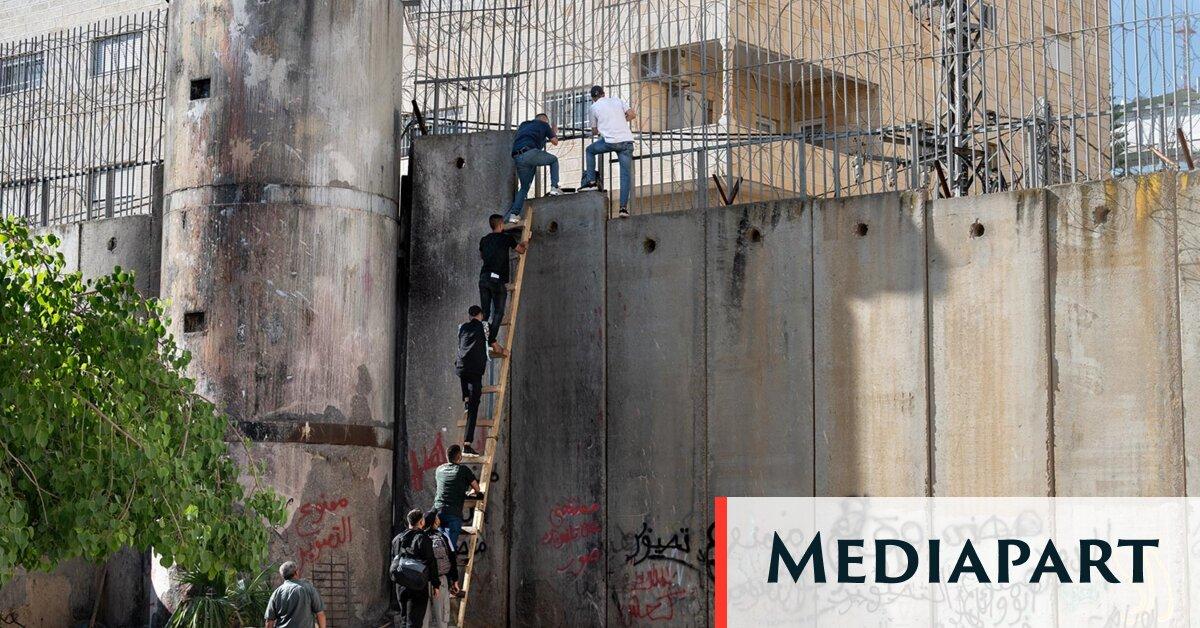
It also states that checkpoints being closed and smugglers fewer in number to transport people by car since October 2023 left many with “only one perilous option: scale the wall,” and that the wall is now closely monitored by “drones, sensors and military patrols.” Another Al Jazeera account in the same set of reporting describes the wall as a “Wall of Death,” and includes a testimony from Raed Issam about climbing the barrier and holding his breath at every moment while fearing detection and shot.
Voices: Humiliation, Death, and Accountability
Palestinian labor leaders and workers described the wall crossings not only as dangerous but as degrading, and they linked the deaths and injuries to the broader impact of the war on Gaza on Palestinian employment. In Al Jazeera Net’s account, Raed Issam said that climbing the barrier was “a major risk,” and that he held his breath at every moment as he waited until late at night with fear of being detected and shot. He also described the operation as humiliating, saying it made him feel “a certain humiliation and violation of dignity, as if they were thieves trying to escape.”
In the same report, Shaher Saad, secretary-general of the Palestinian Federation of Labour Unions, called the killing of Yusri and the injury of eight others “a crime in every sense of the word,” condemning the targeting of Palestinian workers as they struggle to earn livelihoods. Saad said that before October 7, 2023, the number of Palestinian workers inside the 1948 territories stood at about 240,000, including those with work permits and those without, and he described how rising unemployment and lack of compensation and social protection funds forced workers to return to attempts “via evasive routes and without permits.”
Al Jazeera Net also quotes Saad estimating the number of workers attempting to enter the 1948 lands at about 70,000, while adding that daily cases of pursuit, firing, and arrests occur among West Bank cities and inside Israel. In parallel reporting, Al Jazeera’s account of the wall crossings includes the statement by Shaher Saad of the General Federation of Palestinian Trade Unions that “Decades of high unemployment have left thousands with no other choice,” while warning that since the start of the war in Gaza crossings have become more deadly.
Different Reports, Different Numbers
The reporting set also shows how different outlets frame the same underlying reality of Palestinian workers crossing into Israel for work, while emphasizing different figures and mechanisms of risk. WAFA’s May 1, 2026 report says that “in recent months, not a single day has passed” without reports of Palestinian workers being pursued, detained, or injured while attempting to enter Israel by crossing the separation wall adjacent to the town of Al-Ram, north of occupied Jerusalem. WAFA describes these incidents as accompanied by “documented scenes and graphic images of workers bleeding on the wall after being shot,” and it identifies Yousef Aqel from Biddya as one of the workers who lost his life after occupation forces shot him while he attempted to cross the separation wall in Al-Ram.
WAFA states that on December 23, Aqel died in the hospital after spending ten days in intensive care due to severe gunshot wounds to his lower limbs, and it quotes his brother Haitham describing the moment when gunfire started while they were descending from the wall. In contrast, Al Jazeera Net’s account centers on Yusri Abu Qubita’s death and says the incident involved eight others wounded, while also describing a broader pattern of pursuit, firing, arrests, and surveillance camera documentation.
Association France Palestine Solidarité focuses on individual injury cases and the physical hazards of the wall, including the barrier’s “eight meters high in places” and the rope snapping under weight of 140 kg (309 pounds) in Ahed Rizk’s story. That Al Jazeera account says at least 35 Palestinian workers died attempting to cross the border into Israel to go to work in 2025, while WAFA says “More than 50 workers have been killed since October 7, 2023,” and that “18 workers” were killed while trying to reach their jobs in 2025.
What Comes Next for Workers
The sources portray the situation as continuing and intensifying, with labor organizations and solidarity groups describing structural barriers that keep Palestinian workers from authorized routes and push them toward dangerous crossings. WAFA frames the wall crossings as a daily reality tied to the war on Gaza, stating that the incidents have reshaped “their worsening tragedy over the past two and a half years,” and it links the deaths and injuries to a “dangerous gap” between workers worldwide and Palestinian workers who are “demanding the basic right to work and to earn a livelihood—one for which they risk death.” It also describes how Yousef Aqel, a father of two who worked inside Israel for nearly five years, lost his primary source of income when work permits were suspended and remained unemployed for six months before taking the risk of crossing through the wall.
WAFA says Yousef would be away for about a month at work, return home for a few days, and then repeat the journey until he was injured and killed on his final attempt. In the same WAFA report, Abu Mohammad, 52, from Tubas governorate, is quoted describing living conditions over the past two and a half years, including that he has been unemployed for more than two years and cannot provide even “the simplest necessities for his family.”
Solidaires adds a broader institutional context, saying that the “genocidal war waged in Gaza has been accompanied by an intensification of colonial and apartheid policies” in the West Bank, and it states that nearly 850 checkpoints were recorded by OCHA in the West Bank. Taken together, the sources depict a continuing cycle in which revoked permits, tightened security, and restricted movement keep pushing workers toward the separation wall, while deaths and injuries remain part of the immediate stakes.