Israeli Settlers Kill Thaer Hamayel and Farea Hamayel in Abu Falah Near Ramallah
Image: WAFA Agency

Israeli Settlers Kill Thaer Hamayel and Farea Hamayel in Abu Falah Near Ramallah

15 July, 2026.Gaza Genocide.24 sources

The story in 15 seconds

  • Three Palestinians injured in Ramallah-area settler attack.
  • Deir Jarir village east of Ramallah targeted by colonist militias; injuries reported.
  • Incident reflects broader pattern of deadly settler violence in West Bank.

The divide · 1 of 2

WAFA stresses Israeli “protection”, while Courrier reports army condemnation.

Who skipped what

How each outlet frames it

Every outlet we compared, the headline it ran, and a link to the original article.

Source Diversity
24 sources
West Asian
12
Western Mainstream
5
Israeli
4
Local Western
3

West Asian

Al-Jazeera Net
Al-Jazeera Net

Three Israelis were injured in a ramming attack in the West Bank, and the attacker was killed.

31 May, 2026

Read the original →
Al-Manar TV Lebanon
Al-Manar TV Lebanon

Israeli media: A settler was injured in a car-ramming attack south of Bethlehem, and a large-scale search operation is underway after the perpetrator withdrew from the scene

01 June, 2026

Read the original →
Anadolu Ajansı
Anadolu Ajansı

West Bank: 3 Palestinians injured in an attack carried out by Israeli occupiers

31 May, 2026

Read the original →
Anadolu Ajansı
Anadolu Ajansı

The West Bank: a child among three Palestinians injured in attacks by Israeli settlers.

12 June, 2026

Read the original →
News of Bahrain
News of Bahrain

Two Israeli Teens Wounded in West Bank Ramming Attack, Suspect Killed

01 June, 2026

Read the original →
Roya News
Roya News

‘Israel’ says two wounded, suspect killed in car-ramming operation

31 May, 2026

Read the original →
WAFA Agency
WAFA Agency

Four Palestinians injured in colonist attack in Ramallah-governorate village

12 June, 2026

Read the original →
WAFA Agency
WAFA Agency

Several Palestinians injured in Israeli colonist attack east of Ramallah

09 July, 2026

Read the original →
www.saba.ye
www.saba.ye

A Palestinian injures three Israeli settlers who were attempting to assault him in Salfit.

31 May, 2026

Read the original →
وكالة الانباء والمعلومات الفلسطينية

Four Palestinians were injured in a settler attack in a village in the Ramallah Governorate.

12 June, 2026

Read the original →
وكالة سبأ
وكالة سبأ

Settlers are attacking Palestinian homes southeast of Bethlehem; others are attacking Surif, north of Hebron.

03 June, 2026

Read the original →
WAFA Agency
WAFA Agency

Minor sustains injuries in car-ramming attack in Hebron

15 July, 2026

Read the original →

Western Mainstream

Courrier international

In the West Bank, a wave of deadly violence carried out by Israeli settlers.

10 July, 2026

Read the original →
Le Monde.fr
Le Monde.fr

In the West Bank, Jewish settlers are intensifying their strategy of harassment and terror to annex Palestinian lands.

10 July, 2026

Read the original →
Ouest-France
Ouest-France

New attacks by Israeli settlers against several villages in the West Bank.

31 May, 2026

Read the original →
RFI
RFI

Occupied West Bank: two Palestinians killed, including a 14-year-old boy, after settlers opened fire.

10 July, 2026

Read the original →
Ouest-France
Ouest-France

Four members of a family killed by the Israeli army in the West Bank.

15 July, 2026

Read the original →

Israeli

Haaretz
Haaretz

Four People Wounded in Suspected West Bank Ramming Attack, Medics Say

31 May, 2026

Read the original →
Haaretz
Haaretz

Two Israeli teens wounded in West Bank ramming attack, IDF operating in Hebron

31 May, 2026

Read the original →
The Jerusalem Post
The Jerusalem Post

Car ramming attack wounds several at Gush Etzion Junction in West Bank, south of Jerusalem

31 May, 2026

Read the original →
ynetnews
ynetnews

Teen girls wounded in West Bank ramming attack; terrorist neutralized

31 May, 2026

Read the original →

Local Western

La patrie news
La patrie news

Knife and ram-vehicle attack in Palestine: Three dead and six injured.

31 May, 2026

Read the original →
وكالة الأنباء السورية – سانا

Two Palestinians injured in a settler attack south of Nablus.

12 June, 2026

Read the original →
INFO.FR
INFO.FR

On May 3, 2025, Issa Amro's home in Hebron was attacked by Israeli settlers. The Israeli soldiers present did not intervene and threatened Amro with arrest if he filed a complaint. The attack followed the broadcast of the BBC documentary The Settlers by Louis Theroux, in which Amro appears. According to the 2024 European report, less than 3% of settler violence leads to an indictment. Since 2020, no prison sentence has been handed down to a settler responsible for the death of a Palestinian civilian. The May 3 incident, settlers and soldiers burst into Issa Amro's home in the Tel Rumeida neighborhood in Hebron. The scene, filmed and relayed by several international media outlets, shows settlers forcing entry and vandalizing the house. When the Israeli soldiers arrived, they did not intervene. They warned Amro that filing a complaint could lead to his arrest. Amro is a Palestinian human rights defender, founder of the organization Youth Against Settlements. He has lived in Tel Rumeida for nearly twenty years. He was recognized by the Swedish Right Livelihood Award in October 2024, then by the Franco-German Human Rights Prize in December 2024. For the latter award, Israeli soldiers refused entry to Hebron to French and German representatives. Amro accepted the prize on a road, outside a checkpoint. Why don't the soldiers intervene? The May 3 raid is not an isolated incident. Amro reported several attacks in the months that followed, including three in twelve hours. In October, Israeli soldiers forcibly entered his home and arrested a friend who was watching the property in his absence. The friend was subsequently barred from returning. A settler climbed a wall to dismantle a security camera, in the presence of a soldier. After stones were thrown at the house, the soldiers entered and arrested Amro, accusing him of having thrown the stones. Read one after another, these incidents reveal a pattern: military presence does not deviate from its function when settlers attack; it shifts against the victim when she protests or defends herself. The soldier who watches a settler dismantle a camera does not make an individual choice: he follows a chain of command that does not require him to intervene. This is precisely what the International Court of Justice's advisory opinion issued in July 2024 documents: the coexistence, on the same territory, of a civil-law regime for the settlers and a military-law regime for the Palestinians produces a structural asymmetry in the application of the law. The army contradicts itself. By late October, friends and neighbors who came to Amro's house were ordered to leave: the area around his house had just been declared a “closed military zone.” The maps shown to Amro reveal that his residence is now an island in the middle of a military zone. Asked for comment, the Israeli army replied that Amro “is allowed to receive people within the framework of the law.” The statement does not stand up to the facts. If Amro is allowed to receive people, how to explain the arrest of a friend who came to guard the house and his later ban from returning? How to explain the soldiers’ expulsion of friends and neighbors who came to visit him? How to explain that his house was cartographically isolated in the heart of a closed military zone? The army's response is not a denial; it is a legal formula: “within the framework of the law.” Yet the applicable legal framework is not Israeli civil law; it is military law—and it is the same framework that allows declaring a zone closed from one day to the next. The contradiction is therefore not a contradiction: it silently says that the law governing Amro's house authorizes everything he denounces. What triggered the escalation: a BBC documentary. Amro appeared in The Settlers, a BBC documentary produced by the BBC and presented by Louis Theroux. The film investigates the expansion of illegal Israeli settlements in the West Bank and their impact on Palestinians. It was broadcast in May. “They started to hate me more after my appearance in the BBC documentary with Louis Theroux. They hated me a lot more since,” Amro said. Theroux himself was harassed by Israeli soldiers during filming in Hebron, who tried to drive him out of the area. In the same film, Daniella Weiss, a historic figure of the settlers’ movement, lays out the doctrine plainly: “You bring Jewish families to the occupied West Bank, you live there a Jewish life, and that will bring light to the place of darkness. This is how the State of Israel was established, and this is what we want to do in Gaza.” The legal framework: acknowledged illegality, organized impunity All Israeli settlements are considered illegal under international law. According to several sources, Article 49 of the 1949 Fourth Geneva Convention explicitly prohibits an occupying power from transferring parts of its civilian population into the territory it occupies—the legal basis for the illegality cited by international bodies. The United Nations General Assembly last year called on Israel to end its occupation of Palestinian territory. The International Court of Justice ruled that the Israeli presence in Palestinian territory is “illegal.” In July 2024, the ICJ issued an advisory opinion concluding that Israeli occupation, settlements, and annexation of Palestinian territories are contrary to international law. According to several sources, Article 8 of the 1998 Rome Statute, founding the International Criminal Court, defines as a war crime the transfer by an occupying power of part of its civilian population into the occupied territory. On the ground, the figures document what Amro calls legal apartheid: “The settlers live under Israeli civil law; I live under military law. This is apartheid.” The conviction rate in Israeli military courts approaches 100%. Human Rights Watch and Amnesty International have accused Israel of practicing apartheid in the occupied territory. Impunity, in numbers The European External Action Service’s report on Israeli settlements for January–December 2024 documents 991 incidents of settler violence by Israelis against Palestinians in the occupied West Bank. Thirteen Palestinians were killed, 538 injured, 1,229 displaced. In the same year, 1,058 Palestinian structures were demolished or seized, displacing 1,739 people. Twenty-four thousand three hundred housing units were approved in the settlements, 26 new outposts established, more than 1,000 hectares of Palestinian land seized for expansion. Less than 3% of investigations into settler violence led to an indictment. Since October 7, Amro has reported more than 1,400 settler attacks on Palestinian communities. Several Palestinians have been injured or killed. The Israeli government continues to allocate funds to illegal outposts, despite their illegality under international and Israeli law. Since the end of 2020, Israeli courts have not handed down any new prison sentences against settlers found responsible for the deaths of Palestinian civilians. The Trump factor, claimed by the settlers themselves According to Amro, the settlers who attacked him the day before told him that Donald Trump supported them. They felt “bolstered by the Trump administration’s blind support.” The wording matters: it is the settlers themselves who invoke this support, not commentators. Daniella Weiss, in the documentary, states that Israeli Prime Minister Benjamin Netanyahu is “happy” with the expansion of the settlements. Netanyahu opposed Palestinian sovereignty over Gaza, the West Bank, and East Jerusalem. Targeting an international figure: a signal The international status of Amro is not merely biographical. A Right Livelihood Award laureate in October 2024, a Franco-German Human Rights Prize recipient in December 2024, supported in 2017 by Senator Bernie Sanders and 32 members of the US Congress who had written to Secretary of State Rex Tillerson to urge Israeli authorities to reconsider the charges against him, he belongs to a small circle of human rights defenders whom the international community has explicitly backed. In theory, this status should protect him. In practice, the opposite seems to occur. The Franco-German prize ceremony itself was prevented from entering Hebron by the Israeli army, which turned French and German diplomats away at a checkpoint: Amro received his prize on the road. A few months later, his house was attacked and he was threatened with arrest if he filed a complaint. The message sent is not subtle. It says that international distinctions do not create on-the-ground protection zones, and that a activist made visible by a BBC documentary or a European prize does not become untouchable—in fact, his visibility makes him a test target. When a Right Livelihood Award laureate can be assaulted at home in front of the army with no consequences, the threshold of impunity shifts for everyone else. Hebron, a geography of disproportion Hebron is one of the most contested areas in the West Bank. About 800 Israeli settlers live there under heavy military protection in the midst of more than 200,000 Palestinian residents. The army and settlers occupy 20% of the city, designated as Zone H2. Shuhada Street, the main artery, remains largely off limits to Palestinians. Youth Against Settlements’ flagship Open Shuhada Street campaign commemorates the 1994 Ibrahim Mosque massacre, in which a Jewish extremist killed 29 people and wounded 125. This event marked Amro’s commitment. In the broader context of an occupied municipal election, Hebron concentrates tensions in the West Bank: permanent military presence, movement restrictions, and documented settler violence by international organizations. Precedents: Amro is not the first In March, Hamdan Ballal, the Palestinian co-director of the Oscar-winning No Other Land, was attacked by armed and masked Israeli settlers at his home in Susya, a village in the West Bank. They vandalized his house and vehicle and wounded him. While he was receiving care in an ambulance, Israeli soldiers blindfolded him and arrested him. The sequence is almost identical to what Amro experienced: assault by settlers, not intervention to protect the victim but to arrest him. The targeting of an Oscar-winning filmmaker in March, then of a Right Livelihood Award laureate in May, is not statistical chance. The blind spot: what sources document and what no one picks up. The European External Action Service report establishes two facts that, side by side, tell a mechanism. On one hand, 991 incidents of violence in 2024. On the other, less than 3% of inquiries resulting in an indictment. This rate is not a malfunction: it is the statistic of a system that operates as designed. When Amro says that violence is committed “with impunity and without any accountability,” he is not editorializing. He is describing what European figures confirm. Amro has been detained twenty times in 2012 without any charges brought. He is currently facing 18 charges before an Israeli military court. In September 2017, he was arrested by the Palestinian Authority for criticizing on Facebook the arrest of a journalist. Amnesty International asked the Palestinian Authority in March 2019 to drop all prosecutions against him. He is harassed by the two authorities that have control over his life. What the sources do not say None of the sources consulted specify the identity of the settler who led the May 3 attack, nor whether any investigation was opened by Israeli authorities. No public response from the Israeli Prime Minister’s office regarding the settlers’ claim that the Trump administration emboldened them. The soldiers present during the raid who threatened Amro with arrest if he filed a complaint were not identified or sanctioned to the knowledge of sources available at the time of writing. The calendar Between October 7, 2023 and November 13, 2025, Israeli security forces and settlers have killed at least 1,017 Palestinians in the occupied West Bank, including East Jerusalem. Among the victims: 221 children. In October 2025, more than 260 settler attacks were recorded by the UN, the highest monthly total since 2006. The figures speak for themselves. The responsibilities, however, are not established by the courts: less than 3% of investigations lead to an indictment. “This is a story that must be told,” Amro said about his participation in the documentary. The sentence is sober. The price he pays to tell it is not. Sources

15 July, 2026

Read the original →

Full story

Abu Falah raid

In the occupied West Bank, Israeli settlers invaded the village of Abu Falah, northeast of Ramallah, during the night of March 7 to 8, when local authorities said at least 70 settlers from the surrounding area ransacked farms.

Milia Hamayel pleaded with her son not to join residents trying to push the attackers back, but Thaer Hamayel, 30, and his relative Farea Hamayel, 57, were killed by gunfire from settlers while trying to defend the village.

Image from Al-Jazeera Net
Al-Jazeera NetAl-Jazeera Net

A third villager died after inhaling tear gas fired by the Israeli army, and the army told AFP that soldiers had been sent to Abu Falah to disperse the crowd.

Palestinian authorities described the violence as a “golden opportunity,” and Ibrahim Hamayel said, “When the war with Iran began, the settlers saw it as a golden opportunity,” while B’Tselem said the pattern indicates an intensification of Israel’s ethnic cleansing efforts under cover of the war with Iran.

Deaths near school

On Tuesday, April 21, the Palestinian Authority announced that two Palestinians, including a 14-year-old, were killed by gunfire from Israeli settlers in the village of al-Mughayyir in the center of the occupied West Bank.

RFI said the gunshots could be heard clearly as two Palestinians collapsed in front of the village school, and it reported that a 32-year-old man and a 14-year-old were killed by bullets.

Image from Anadolu Ajansı
Anadolu AjansıAnadolu Ajansı

Le Monde described the death of Aous Hamdi Al-Nassan, a 14-year-old boy shot dead on Tuesday in front of his school in Al-Moughaïr, as part of an “unprecedented spiral of violence in the West Bank.”

Le Monde also reported that the Israeli army told it that a reserve soldier had been suspended as part of ongoing investigations after videos shot by residents contradicted the army’s account of who fired.

Ramallah attack and blockade

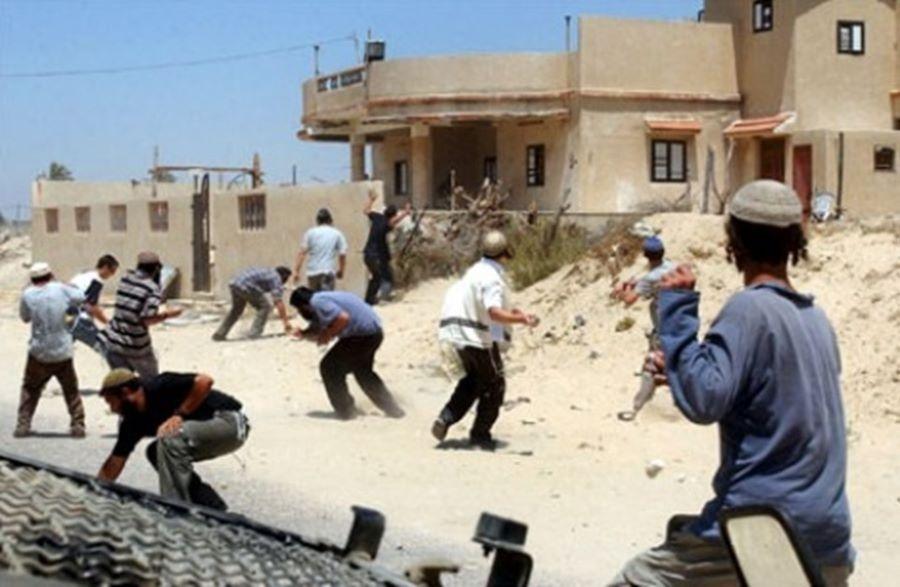
On July 9, 2026, WAFA reported that several Palestinians sustained bruises and other injuries after Israeli colonist militias, under the protection of Israeli forces, launched a large-scale attack on the village of Deir Jarir, east of Ramallah.

WAFA said around 150 Israeli colonists attacked from four different directions while closing its main entrance, and it reported that Israeli forces prevented ambulance crews from reaching the wounded.

WAFA described attackers assaulting homes and vehicles, beating residents who attempted to confront the attack, and attempting to set fire to occupied homes, while surrounding families including women, children and elderly people.

In the same broader context of violence described across the sources, Courrier international reported that UN figures cited 180 Palestinians displaced by these violences since February 28 and 1,500 since the start of 2026, with 90% of the total reached in 2025.

The deep audit

How victims, perpetrators and terms are handled across outlets.

More on Gaza Genocide