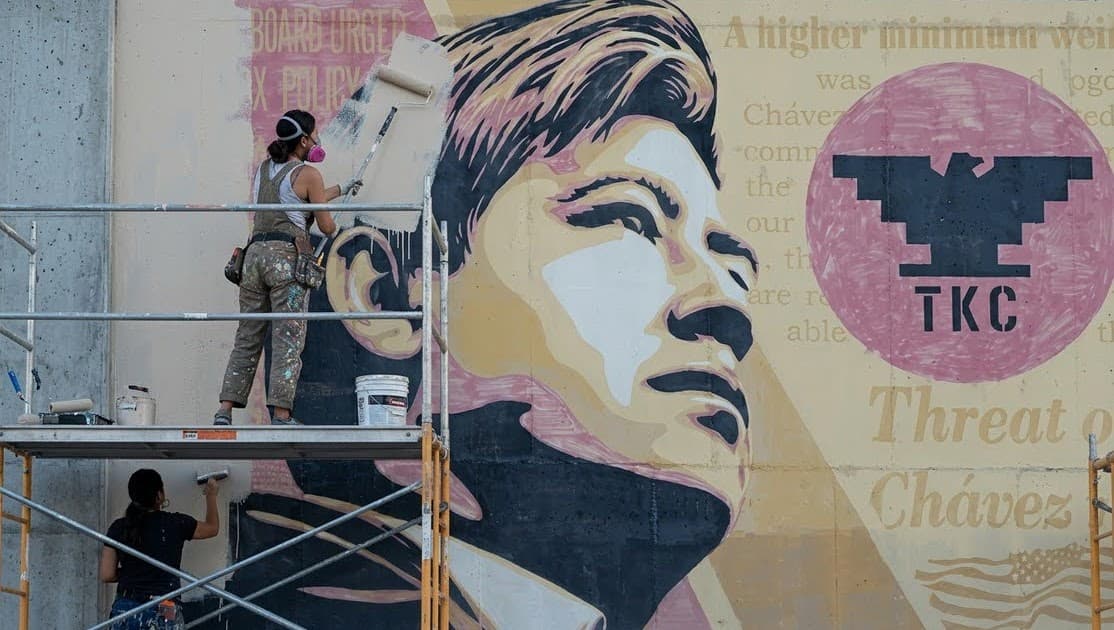
Kansas City council reconsiders César Chávez street name and murals amid abuse allegations.
Key Takeaways
- Kansas City considers renaming Cesar Chavez street and reviewing murals.
- Sexual abuse allegations against Chavez emerged, triggering accountability discussions and name-change debate.
- Local media frame the issue as controversy over honoring Chavez amid allegations.
Reconsidering Honors
Kansas City is reconsidering how it honors civil rights leader César Chávez following bombshell allegations of sexual abuse against him.
“Rebecca Amezcua-Hogan grew up listening to stories about the oppression of Latinos and their fight for civil rights”
The city, which previously celebrated Chávez with a street named Avenida César E Chávez on 23rd Street and a mural in the Westside neighborhood, now faces calls to remove these honors amid disturbing revelations.

Local political figures and community members are grappling with how to reconcile Chávez's historical contributions to labor rights and Latino civil rights movements with the serious accusations against him.
Abuse Allegations
The allegations against Chávez stem from a New York Times investigation that detailed his history of allegedly sexually abusing women within his own movements, including some who were underage.
One prominent accuser is Dolores Huerta, who helped co-found the United Farm Workers (UFW) organization with Chávez in 1962.

The organization, originally called the National Farm Workers Association, became a powerful force defending the rights of farmworkers nationwide.
These revelations have shocked many who previously viewed Chávez as an unblemished icon of the labor rights movement.
Leadership Response
Local political and community leaders have expressed strong reactions to the allegations, with several calling for the removal of Chávez's name from Kansas City landmarks.
Rebecca Amezcua-Hogan, a candidate for Kansas City Council's 4th District who grew up admiring Chávez as an icon, stated that Kansas City 'must begin the process of removing Chávez's name from 23rd Street Trafficway in the Westside.'
Mayor Quinton Lucas has also taken a firm position, declaring that he doesn't think Chávez's name should remain on 23rd Street and expressing grief for the victims.
These responses reflect a significant shift in how the city once viewed its honoring of the civil rights leader.
Renaming Process
The process for potentially renaming the street and addressing the mural will involve extensive procedures and community engagement.
Mayor Lucas acknowledged the 'extensive street renaming process' in Kansas City and emphasized that the city will follow established rules while listening to resident feedback.
Lucas specifically stated that any changes should be 'community-driven, community-led discussion as we go through it.'
This approach suggests that while there is political will to address the issue, the city wants to ensure community participation in determining how to handle Chávez's legacy in the wake of these serious allegations.
Legacy Complexity
The controversy has created a complex legacy discussion in Kansas City's Westside neighborhood, where Chávez's influence was particularly strong.
“Rebecca Amezcua-Hogan grew up listening to stories about the oppression of Latinos and their fight for civil rights”
The area had previously embraced Chávez's legacy prominently, with not only the street naming and mural but also through community storytelling and cultural preservation.
Local residents like Amezcua-Hogan expressed how these honors were part of the neighborhood's identity, making the current situation particularly challenging.
The situation highlights the difficult balance communities face when historical figures' contributions are weighed against serious allegations of misconduct, requiring careful consideration of how to acknowledge past achievements while addressing present-day concerns about accountability and justice.
More on USA
Trump Cheers Mueller's Death, Says 'I'm Glad He's Dead'
20 sources compared

Trump threatens ICE deployment to airports amid DHS funding fight
23 sources compared
Trump threatens to deploy ICE agents to US airports amid DHS funding standoff
46 sources compared

ICE Detainee Royer Perez-Jimenez Dies in Florida Detention Center; Officials Suspect Suicide
10 sources compared