Technology and Science · 06 May, 2026 · 2 min read
Mega Tsunami Hits Tracy Arm Fjord After Rockslide Collapses South Sawyer Glacier in Alaska
Rockslide from a mountain at the glacier's toe triggered the Tracy Arm megatsunami. The wave reached about 481 meters (1,578 feet), second-tallest on record.
How directly climate change causally caused the landslide/tsunami.
4 of 5 outlets skipped it: cruise itineraries were changed to avoid Tracy Arm..
22outlets compared
Same story, two versions
tap a side to read it in full
The Guardian
““without the rapid glacier retreat, the landslide would likely not have resulted””Read the original ↗
One stresses a conditional mechanism; the other states direct linkage.
Tracy Arm mega-tsunami
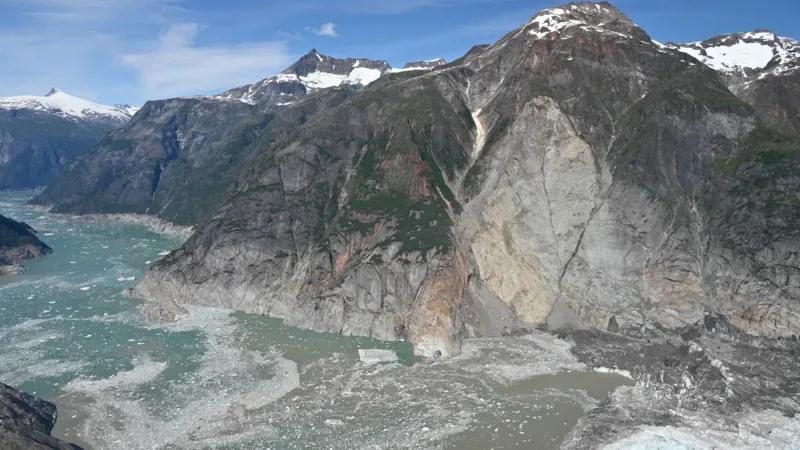
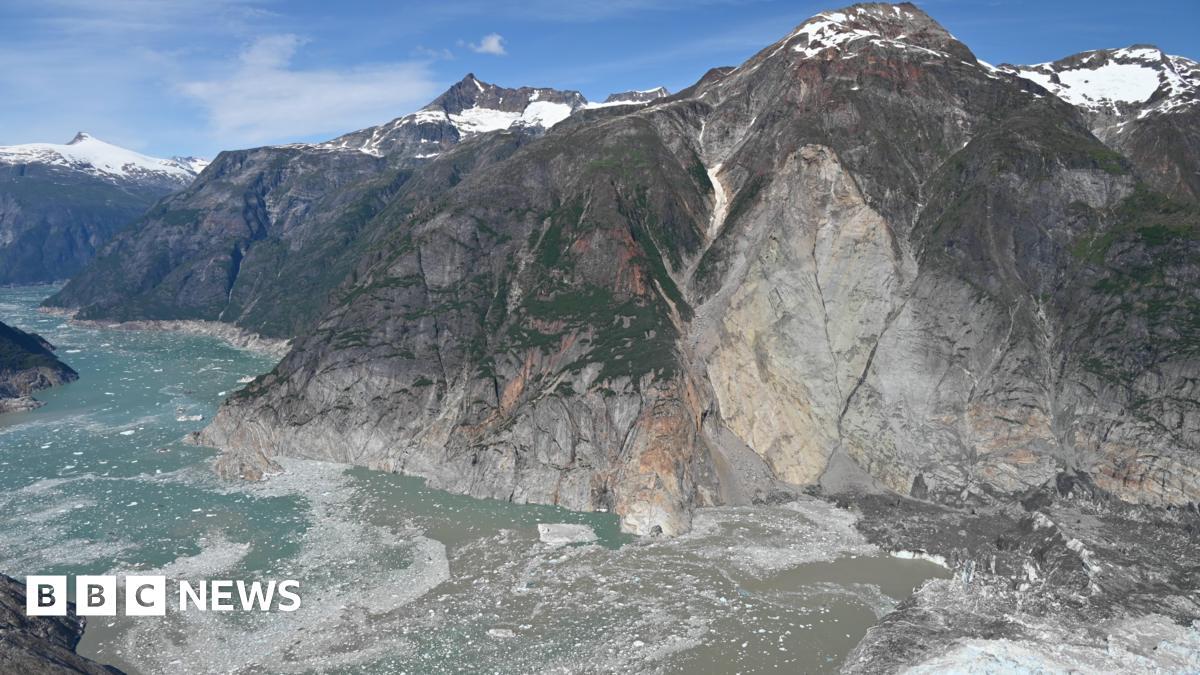
A mega-tsunami struck the Tracy Arm fjord in south-east Alaska last August after a massive rockslide around the toe of a glacier, and scientists recorded the world’s second-tallest tsunami. The Guardian says the tsunami reached 481 metres (1,578ft) in height, and it was triggered when a large landslide collapsed 1km vertically onto the South Sawyer glacier and into the narrow, 48km fjord.T
The sequence began at 5.26am local time on 10 August 2025, and the Guardian reports there were no fatalities at the early hour. TThe event also triggered a 36-hour seiche and generated long-period seismic waves equivalent to those of a 5.4 magnitude earthquake, according to the study described by the paper.
Scientists reconstruct the cascade
RNZ, via CNN, describes how on August 10 at 5:30 in the morning an entire mountainside at the mouth of the receding South Sawyer glacier detached, producing a monster wave. RNZ says the wave raced up over 1,500 feet on the opposing wall of the fjord, and it reports that “a dozen scientists from the US, Canada and Europe” later worked to “re-create this hazards cascade” after the event.
Daniel Shugar, a geomorphologist and professor at the University of Calgary, is quoted by RNZ saying, “As the climate is changing, as glaciers are retreating, we are likely going to see more of these kinds of events in high latitude environments in the Arctic and the sub-Arctic.” RNZ also quotes Patrick Lynett, a professor at the University of Southern California, saying, “I saw it in real life, and I can barely believe it,” after field work at the landslide site.

Risk, mitigation, and tourism
The Guardian reports that the Tracy Arm event is a warning of risks of coastal rockslides and glacier retreat, with researchers calling for stronger risk mitigation measures including systematic monitoring of unstable slopes and more realistic tsunami-modeling scenarios. TIt also notes that annual cruise passenger numbers in Alaska have risen from about 1 million in 2016 to 1.6 million in 2025, and it says the risk of large-scale landslide-generated tsunamis is increasing across the Arctic as glacier retreat and permafrost degradation accelerate.
Mirage News says at least six cruise lines have changed their itineraries in Alaska this year to avoid the Tracy Arm fjord where the tsunami occurred. In Mirage News, Dr Dan Shugar says, “Ultimately what we hope is that coastal municipalities, the cruise ship industry and other stakeholders take these threats seriously,” tying the scientific findings to decisions about where ships go and how communities prepare.