
Gaza Genocide · 03 May, 2026 · 8 min read
Middle East War Triggers Canceled Flights and Tourism Collapse in Jordan, Dubai, and Egypt
Flight cancellations and travel delays surge as war disrupts Jordan, Dubai, and Egypt. Dubai bookings down 91%, Jordan 81%, Egypt 53% amid regional tourism collapse.
Taux d’annulation des réservations en Jordanie (Petra) en mars.
9 of 10 outlets skipped it: impact macroéconomique via l’EBRD: énergie/engrais, inflation, conditions de financement, et mention explicite des canaux tourisme et transferts..
13outlets compared
Same story, two versions
tap a side to read it in full
RMC
“« According to the Orchestra barometer, bookings for Dubai fell 91% in one week. »”Read the original ↗
France 24
“« Leur nombre a progressé de 3% sur un an, et de 39% par rapport à l'avant-pandémie de Covid. »”Read the original ↗
Les chiffres d’impact immédiat (chute en une semaine) ne sont pas comparables aux données de tendance annuelle pré-guerre utilisées par France 24; la différence peut donner une impression soit de stabilisation sur certains indicateurs, soit d’effondrement brutal, selon la fenêtre temporelle choisie.
Tourism shock across the region
The war in the Middle East is reverberating through tourism, triggering canceled flights, postponed trips, and deep uncertainty for travelers and tour operators across the region.
“"Mon dernier groupe de touristes est parti il y a trois jours, et tous les autres groupes prévus pour le mois de mars sont annulés"”
In Jordan, AFP quoted guide Nazih Rawashdeh saying, "Mon dernier groupe de touristes est parti il y a trois jours, et tous les autres groupes prévus pour le mois de mars sont annulés," adding, "C'est le début de la haute saison ici, c'est catastrophique!"

France 24 reported that the disruption is affecting not only people traveling to the region but also those who had planned stays elsewhere, with the Gulf acting as a hub through airports in Dubai, Abou Dhabi, and Doha.F
The same AFP report said German tour operators Alltours, Dertour, and Schauinsland-Reisen announced they would take charge of additional nights for clients stuck in the Middle East, while also canceling trips to the Emirats and Oman at least until 7 mars.
The Jordan Hotels Association said it was monitoring geopolitical developments and the ongoing war, and that the situation has been reflected in Jordan’s tourism sector through a noticeable decrease in tourists coming to the Kingdom and cancellations of flights from global and Arab tourist markets.
It warned that hotel occupancy rates in some destinations fell to very low levels approaching zero due to halted bookings and cancellation of tour programs.
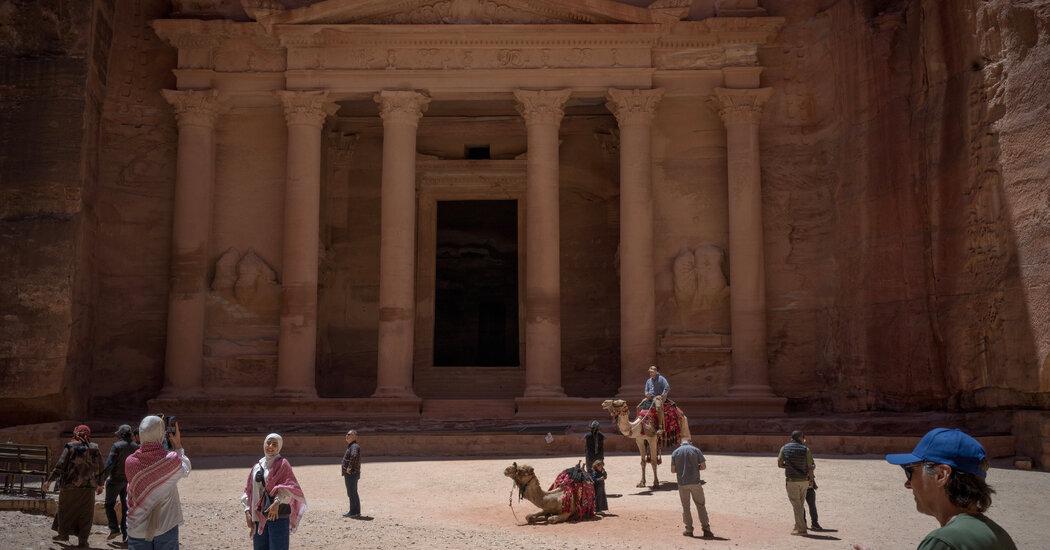
In parallel, a separate report described Petra and Wadi Rum as long-standing draws that are now seeing a sharp drop in visitors and closures of tourist shops, with ForwardKeys reporting that air bookings to Jordan fell by 35% in recent weeks.
Numbers, cancellations, and hotel strain
Across Jordan, multiple reports describe tourism bookings collapsing and hotels cutting costs as the Gaza conflict and broader regional war disrupt travel patterns.
One account said that amid the escalating Gaza conflict between Israel and Hamas, Petra’s hotel and tour operators were forced to take harsh measures to keep businesses open, including cutting employees’ salaries in half and asking some to take unpaid leave.

It cited Abdullah Al-Hassanat, head of the Petra Hotels Association, saying the city’s average hotel occupancy has fallen to just 10%, describing the crisis as the “worst since the discovery of Petra,” and it quoted Nabeel Rial, CEO of Plaza Tours, expecting bookings to fall by as much as 95% next year.
Another report said the Tourism Authority’s head described the war’s effects as reaching the pace of life in Petra, with Adnan Al-Sawaeir, head of the Board of Commissioners of the Petra Development and Tourism Region Authority, stating that the rate of cancellations of tourism bookings in Petra reached 100% in March.
That same report added that cancellations for next April reached 60% and for May stood at 45%, while warning that the rate was expected to rise.
A separate Jordan-focused report said the Jordan Hotels Association stressed that the hotel sector is among the sectors most affected by regional tensions and events because of its direct link to international travel and air transport.
It also said the association had established an emergency operations room to monitor daily developments and their impact on the tourism sector, and it emphasized coordination with the Ministry of Tourism and Antiquities and relevant authorities.
European brands, operators, and economists
Beyond Jordan, the war’s impact is described as spreading through airspace closures, flight cancellations, and financial and commodity channels that affect tourism demand.
“about $600 million a day”
The Financial Times, as quoted in one report, said the war in the Middle East has caused losses to the region's tourism sector amounting to about $600 million a day, citing estimates from the World Travel & Tourism Council.
It quoted WTTC president Gloria Guevara telling the newspaper that "even short periods of disruption can translate into significant economic losses for countries, companies, and workers in the region."
Another report said that after the war with Iran, five days of flight cancellations across countries in the region left about 4 million travelers stranded, with Cirium data cited for that figure.
It also described how the US-Israeli war on Iran led to higher oil prices after an almost complete halt of navigation in the Strait of Hormuz, pushing jet fuel prices higher, and it noted that fuel is the second-largest expense for airlines after labor, typically accounting for between one-fifth and one-quarter of operating costs, citing Reuters.
The European Bank for Reconstruction and Development warned that war in the Middle East will adversely affect economic activity by raising energy and fertilizer prices, disrupting trade and tourism flows, and tightening financing conditions, in a report titled 'Potential Economic Impacts of the Conflict in the Middle East.'
In that report, Beata Javorcik, the bank's chief economist, said the conflict shows how quickly geopolitical shocks transmit through energy markets, supply chains, and financial conditions, and it predicted that higher energy and fertilizer costs would raise inflation and weaken growth.
Voices: operators, ministers, and travelers
The sources include direct voices from tourism operators, industry associations, and travelers, showing how uncertainty is shaping decisions in real time.
In France, Protourisme’s Didier Arino told Le Figaro that "Egypt was the destination winner at the start of the year, with a 25% increase. Since the conflict began, bookings have fallen by two-thirds, or even three-quarters," and he summarized the broader aviation effect by saying, "The most affected corridor is the Europe–Asia axis, with everything in between."
On LCI, TF1 Info cited Arino saying, "1.5 million people are asking themselves the question; they are waiting to see how the situation evolves," and it also quoted Ivanne describing her cancellation: "We had prepared an entire itinerary. Unfortunately, it has fallen through."
At the World Tourism Fair in Paris Expo Porte de Versailles, Laurent Abitbol told lanouvellerepublique.fr that "We are growing by 10 to 15 percent each year, knowing that this year the cards may be redistributed by current events," and he added, "In the very short term, we have halted the distribution of all trips toward Jordan and Oman" while acknowledging, "Today, the impact is quite difficult to measure."
Travelers described fear of being stuck and safety concerns as central to their choices, with Nice-Matin quoting Claire and Mathieu saying, "We won't go to a country where there are bombings" and RMC quoting Emma saying, "We are afraid for our safety. RWe feel a bit lost; it’s scary not to be able to control what is happening."
In the same RMC account, Chloe and her parents explained they canceled a US trip because, "It's a 12-hour flight; it's not nearby. You never know."
Across the Jordan reports, the Jordan Hotels Association expressed confidence in Jordan’s ability to overcome challenges, stating it was led by His Majesty King Abdullah II and national institutions, while also hoping for de-escalation to restore confidence.
Diverging framing and shifting risks
While the sources largely agree that the war is disrupting tourism, they diverge in how they frame the scale, the mechanisms, and the immediate next steps for travelers and the industry.
“"faire rentrer ceux qui sont sur place"”
France 24 emphasizes operational responses and uncertainty, describing how tour operators are trying to "faire rentrer ceux qui sont sur place" and noting that MSC Croisières planned five charter flights to repatriate passengers from Dubai.

In contrast, RMC and Nice-Matin focus on booking drops and traveler psychology, with RMC citing Orchestra barometer figures that bookings for Dubai fell 91% in one week and that "People are afraid for their safety."
Nice-Matin adds a local poll and specific booking declines, stating that since late February, 75% of French people consider the situation dissuasive for travel or transit through the Middle East region, and it reports by mid-March bookings to Egypt fell 34%, Jordan 50%, and the United Arab Emirates 85%.
Le Figaro and TF1 Info emphasize the French renunciation calculus and the fear of being stranded abroad, with Le Figaro describing a Protourisme study that potentially nearly 800,000 French people would have renounced traveling abroad this summer and about 1.3 million could still revise plans if the situation does not improve.
TF1 Info, citing LCI, says more than 800,000 French people are renouncing travel because of the war and includes Ivanne’s quote that her itinerary "has fallen through."
Meanwhile, the EBRD report frames the issue as a macroeconomic shock channeling through energy and fertilizer prices, warning that higher energy and fertilizer costs would raise inflation and weaken growth and that spillovers could persist even after hostilities end.
Economic stakes and what comes next
The stakes described in the sources extend from immediate hotel occupancy to broader economic forecasts, with multiple reports warning that tourism losses could be large and persistent.
France 24 said that in 2025, "quelque 100 millions de touristes" visited the Middle East, representing nearly 7% of the total number of international tourists worldwide, and it reported that the number rose 3% year-on-year and 39% compared with before the Covid-19 pandemic.F
It then cited Oxford Economics warning that a drop in tourist flows would deliver a more severe economic blow than in the past because tourism’s share of GDP and employment in the sector had increased.
Oxford Economics estimated that because of the war, if it ends quickly, arrivals in the Middle East could diminish by 11 to 27% in 2026 compared with an initially predicted 13% growth, translating into between 23 and 38 million fewer international visitors and a loss of 34 to 56 billion dollars in tourist spending.
The EBRD report similarly warned that geopolitical tensions spill over into commodity markets, supply chains, and financial channels, increasing risks to growth, and it predicted that higher energy and fertilizer costs would raise inflation and weaken growth.
In Jordan, the Jordan Hotels Association stressed the importance of intensifying cooperation between the public and private sectors to maintain continuity of operations and protect investments and jobs linked to tourism.
In France, RMC and Le Figaro described how travelers are seeking safer alternatives and how booking shifts toward Europe are already happening, with RMC quoting Camila Gianolio saying, "Europe is doing very well."R