
Minab school bombing: what evidence is there that the US was responsible?
Key Takeaways
- Minab primary school bombing on 28 Feb killed scores, mostly seven- to 12-year-old girls.
- UNESCO described the strike as a "grave violation" of international law.
- The president presented no evidence; US military spokespeople did not repeat his claim.
The strike and claims
The bombing of the Shajareh Tayyebeh primary school in Minab on 28 February killed scores of people, most of them seven- to 12-year-old girls, and has been described by Unesco as a “grave violation” of international law.
“The bombing of a primary school in Minab on 28 February killed scores of people, most of them seven- to 12-year-old girls”
The president presented no evidence for his claim that the US was responsible.
His assertion has not been repeated by spokespeople for the US military, who have said only that they are “investigating” the bombing.
The Guardian frames the strike as the worst mass killing of the US and Israel’s war on Iran so far.
Location and imagery evidence
The school sat adjacent to a cluster of buildings forming the local Islamic Revolutionary Guard Corps (IRGC) naval barracks and support buildings, a location the Guardian verified by cross-referencing videos with satellite imagery.
Historic satellite imagery shows the school has been walled off from the barracks for at least nine years and displayed visual indications of an educational facility, including colourful murals and small sports playing fields, with no indication it was a military-use building at the time of the strike.
Multiple verified videos—at least four—show the same site from different angles; one pans from the school rubble to thick smoke rising over the fence from the direction of the IRGC base.
Satellite imagery released on 4 March shows the destroyed school building and four other destroyed buildings in its immediate vicinity, all within the walls of the IRGC complex.
Tomahawk identification and fragments
On 8 March Iranian state media Mehr news agency released a video of a missile hitting a Minab location that investigative collective Bellingcat geolocated to the IRGC compound next to the school, and munitions experts identified the missile as a Tomahawk.
“The bombing of a primary school in Minab on 28 February killed scores of people, most of them seven- to 12-year-old girls”
NR Jenzen-Jones of Armament Research Services said that identification “indicates it is a US strike, as Israel is not known to possess Tomahawk missiles,” and that the munition was not an Iranian Soumar missile.
On 10 March Iranian state media published photographs of what they said were missile fragments from the site showing labelling including the Globe Motors logo, Ball Aerospace and Technologies, and the words “Made in the USA,” which the Guardian cannot independently verify.
According to analysis by the New York Times, the serial numbers and labelling visible on the remains are consistent with how the Department of Defense and its suppliers label munitions, and munitions expert Trevor Ball identified the fragments as being the remains of a US Tomahawk missile.
US operations and debunks
The US has not explicitly admitted to striking the school or adjacent IRGC barracks, but said it was conducting strikes in the area and the Pentagon briefing led by Pete Hegseth on 4 March showed a graphic marking points of US/Israeli strikes during Operation Epic Fury that include a point corresponding to Minab.
That map also marks where “Iranian strikes” had taken place according to the US military, with none marked in the Minab area, and US/Israeli briefings said the US focused initial strikes along Iran’s southern coastline while Israel focused on the west.
Widely circulated images claiming the school was struck by a misfired Iranian missile were debunked: the photographs used as evidence were geolocated to Zanjan, roughly 994 miles (1,600km) away, with snow-covered mountains and signage inconsistent with Minab.
The president has not directly referenced the circulated image, and has provided no further evidence of a misfire.
More on Iran
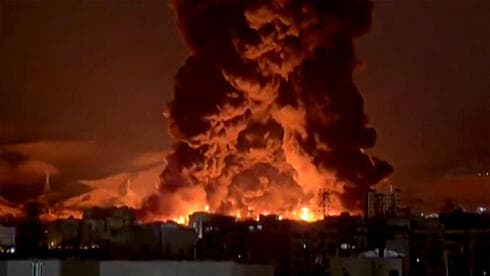
Trump Says U.S. Bombed Military Sites on Kharg Island, Iran's Oil Hub
14 sources compared
FBI Warns of Iranian Drone Plot Based on Unverified Tip; California Says No Credible Threat
10 sources compared

White House Demands ABC Retract Report Claiming Iran Sought To Launch Drone Attacks On California
11 sources compared

Iranian Proxy Claims It Shot Down US Refueling Plane in Iraq; US Military Says Otherwise
17 sources compared