
Modi, UAE Agree Strategic Defense Partnership, Oil Reserves and LPG Supply Framework
Key Takeaways
- India and Iran held high-level security talks in New Delhi.
- Discussions centered on Indian-Iranian relations and regional developments.
- Took place amid BRICS-related discussions.
Defense and energy pact
India and the United Arab Emirates agreed on a framework for a strategic defense partnership during Indian Prime Minister Narendra Modi's visit to Abu Dhabi, with the Indian Foreign Ministry saying on Friday, May 15 that the two countries also signed agreements on strategic oil reserves and securing supply of liquefied petroleum gas (LPG).
“Iranian President Masoud Pezeshkian and Indian Prime Minister Narendra Modi discussed regional peace, bilateral relations, and cooperation within BRICS during a telephone conversation on Tuesday”
The Indian Ministry of External Affairs said the sides agreed to deepen cooperation in defense industries and areas such as innovation and advanced technology, training, military exercises, maritime security, cyber defense, secure communications, and information sharing, while Indian sources told Reuters ahead of the visit that Modi would likely discuss long-term energy security contracts and seek support to expand India's strategic oil reserves.

The strengthening of defense and energy ties between the UAE and India came as Tehran-Abu Dhabi relations have been strained during the recent conflict, with Iran carrying out drone and missile attacks against UAE oil and energy facilities.
The Iran-UAE tension also intersected with energy disruption, as the Indian Foreign Ministry noted that Iran's closure of the Strait of Hormuz has disrupted global energy markets and disrupted shipping and trade in the region.
The same Reuters-linked account said there is a possibility of increasing ADNOC's crude storage in India to 30 million barrels and that ADNOC said it would explore expanding LNG supply and trading with Indian Oil Corporation.
Araghchi’s navigation pledge
Iranian Foreign Minister Abbas Araghchi said on Friday that his country will continue to perform what he described as its 'historic duty' to maintain security in the Strait of Hormuz after meeting Indian counterpart Subrahmanyam Jaishankar in New Delhi.
In a post after the meeting, Araghchi said he had conducted a 'constructive dialogue' with the Indian foreign minister addressing regional developments, noting the emphasis during the talks on Iran's role in protecting the security of navigation in the Strait of Hormuz.
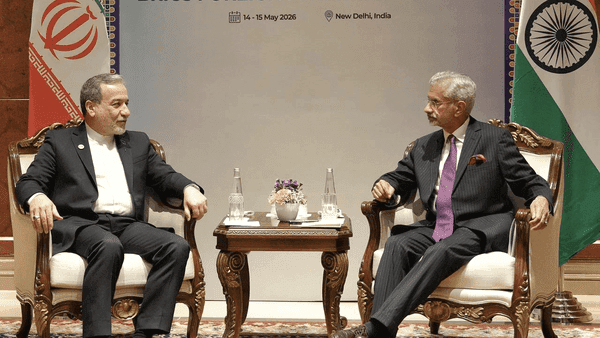
Araghchi added that Iran is 'a trusted partner for all friendly countries', stressing that these countries can rely on the security of their trade and maritime shipping through the region.
On Monday, security officials from India and Iran met in New Delhi on the sidelines of a BRICS meeting that included Chinese Foreign Minister Wang Yi, with India's National Security Advisor Ajit Doval meeting Iran's Deputy Secretary of the Supreme National Security Council, Qadir Nizami.
The Iranian Embassy in New Delhi on X said Nizami also met Wang Yi and discussed the implementation of the peace agreement, while Iran's IRNA news agency reported that Nizami underscored the 'need to strengthen cooperation between the two countries in various political, economic, and security fields.'
BRICS diplomacy and missile talks
Iranian President Masoud Pezeshkian and Indian Prime Minister Narendra Modi discussed regional peace, bilateral relations, and cooperation within BRICS during a telephone conversation on Tuesday, with Press TV saying Pezeshkian praised India for "successful planning and organization" of a recent meeting of energy ministers of the BRICS developing nations.
“Security officials from India and Iran met on Monday in New Delhi on the sidelines of a BRICS meeting that included Chinese Foreign Minister Wang Yi”
Pezeshkian told Modi that Iran will stick to its commitments under the memorandum of understanding signed with the US in mid-June, on the condition that the US also keeps its obligations under the agreement, and he said regional and international powers have a duty to prevent any repetition of the US-Israeli aggression on Iran that endangered shipping routes in the Persian Gulf during the aggression in March and April.
India is conducting discussions to sell the BrahMos supersonic missile to the UAE, according to the account of the New Delhi security talks that also said the BRICS meeting would focus on 'non-traditional security challenges.'
The same report said the Indian Foreign Ministry added that 'participants will discuss the rapid evolution of challenges related to national security, as well as the role of new technologies in facing emerging threats.'
It also placed the diplomacy in a wider BRICS setting, noting that New Delhi hosts other BRICS members including Russia, South Africa, and Brazil, and that Wang Yi's last visit to New Delhi was in August 2025.
More on Iran
Iran and US Set Doha Talks With Qatar Over Frozen Assets and Lebanon Ceasefire
13 sources compared
Syria and Türkiye Sign Disaster Management Cooperation Memorandum in Damascus
14 sources compared
Steve Witkoff and Jared Kushner Arrive in Doha for US-Iran Talks With No Direct Meetings
12 sources compared

South Korea’s National Assembly Approves Han Seong-sook as Prime Minister After Democratic Party Push
13 sources compared