
NOAA Predicts Possible Super El Niño With 25% Chance To Hit By Fall
Key Takeaways
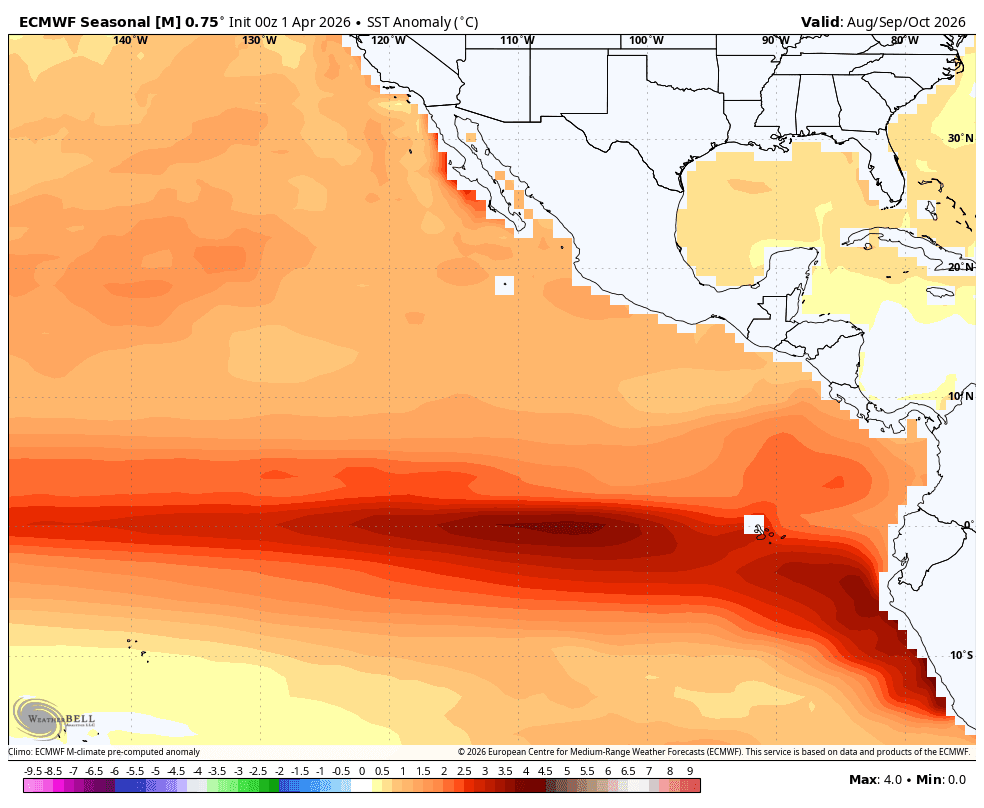
- NOAA forecasts El Niño development, potentially reaching 'super' strength by fall 2026.
- Strong El Niño expected to dominate, likely suppressing Atlantic hurricane activity in 2026.
- Global weather could shift with increased rainfall and flood risk in some regions.
Super El Niño Emerges
NOAA announced that La Niña has officially ended and an El Niño is expected to develop later this year.
“A meteorological event causing weakened winds in the Pacific Ocean could increase rainfall and flood risk in some parts of the world this year, according to predictions from the National Oceanic and Atmospheric Administration (NOAA)”
NOAA calculated a 61% chance of El Niño developing from May through July.
There is a roughly 50% chance it would become strong and a 1 in 4 chance it could intensify into a super El Niño.
The Weather Channel reported the strength of a westerly wind burst is likely the strongest in over 50 years.
This rare event has occurred only five times since 1950.
Hurricane Season Impact
The emerging El Niño is expected to increase upper-level wind shear across the tropical Atlantic.
Colorado State University forecasted a slightly below-average season with 13 named storms.

FOX Weather reported that El Niño is expected to become the dominant factor.
Warmer-than-average sea surface temperatures could provide fuel for storms.
CNN cautioned that even in seasons with fewer storms, it only takes one to create major impacts.
Global Weather Consequences
A super El Niño could reshape weather patterns worldwide.
“The 2026 Atlantic hurricane season is expected to be slightly less active than average, according to the April seasonal forecast issued on Thursday by Colorado State University (CSU) — which pioneered hurricane season forecasts in 1984”
The pattern generally favors more tropical cyclone activity in the Pacific.
The Washington Post noted the chances for a planet-warming super El Niño are rising.
The State reported it will likely lead to a wetter and cooler season for the U.S. Gulf Coast and Southeast.
Events of this magnitude can contribute to higher global temperatures.
Forecast Uncertainty
NOAA scientists cautioned that the possibility of a very strong El Niño depends on westerly wind anomalies continuing.
The spring predictability barrier occurs when forecasts made in spring are less reliable.
The planet is in an intermediate stage known as ENSO-neutral.
The timing of El Niño formation will play an almost equal role in how much of the hurricane season is suppressed.
Forecasters stressed that every El Niño is different.
More on Technology and Science

Iran-Linked Hackers Leak 19,000 Files From Ex-IDF Chief Herzi Halevi's Phone
12 sources compared

Colorado State University Predicts Slightly Below-Average 2026 Atlantic Hurricane Season
26 sources compared
US Birth Rate Declines 1 Percent In 2025, Teen Births Hit Historic Low
13 sources compared

Artemis II Completes 10-Day Moon Mission, Safely Returns to Earth
16 sources compared