Technology and Science03 May, 20267 min read
Ouster Launches Rev8 Native Color Lidar To Replace Cameras
This article is an automated aggregation of coverage from news outlets. Our editorials offer in-depth analysis curated by the NewsCord team.
Rev8 provides native color lidar, merging color imaging with 3D depth in one sensor. Double range and resolution versus previous generation; ASIL-B functional safety under ISO 26262.

Rev8’s single-sensor pitch
Ouster, a lidar manufacturer based in San Francisco, introduced a new lineup of digital lidar sensors called “Rev8,” positioning them as a way to merge color imaging with three-dimensional depth sensing in a single device. In a TechCrunch interview, Ouster CEO Angus Pacala said the company’s goal is to “obviate cameras” and argued that “There’s no reason that one sensor can’t do both.” TechCrunch described Rev8 as “native color lidar,” capable of capturing “color imagery and three-dimensional depth information at the same time,” so customers do “the work of two sensors in one.”
The Benzatine Infotech report similarly framed Rev8 as combining “color imaging with three-dimensional depth sensing,” and quoted Pacala describing the effort as the “holy grail” for roboticists. Ouster’s own materials, carried by PA Media and Automotive World, emphasized that Rev8 is “the world’s first native color lidar,” and that it unifies “structure and color” so that “a single lidar sensor can understand road signs” and “interpret brake lights.”
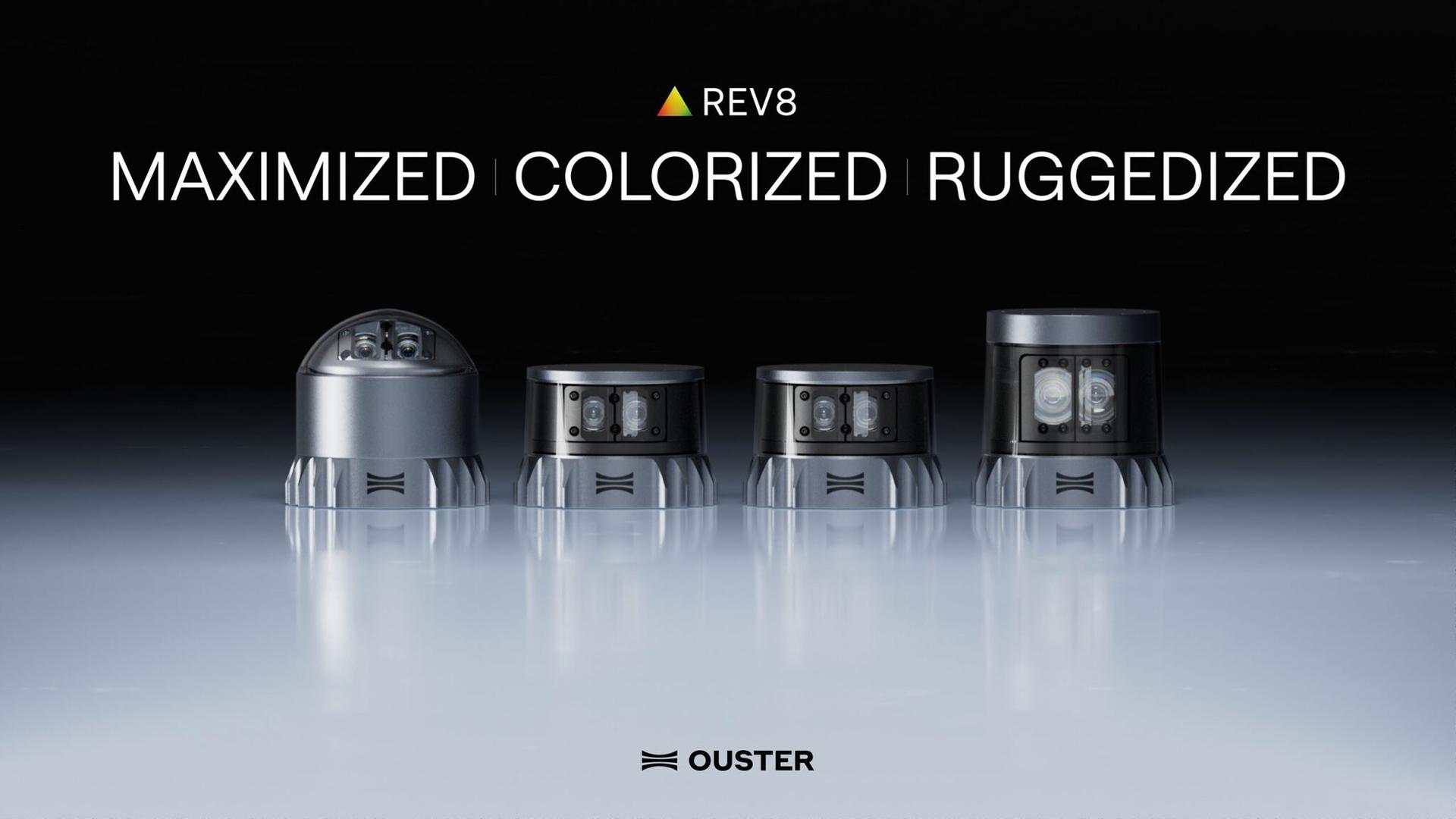
The launch is also tied to Ouster’s “digital lidar” architecture, where the company says it captures lidar information directly on a custom chip using “single photon avalanche diode (SPAD) detectors,” and applies the same SPAD technology to capture the color image data. In TechStock²’s market coverage, the Rev8 launch was linked to investor expectations, with shares jumping roughly 8% in late Nasdaq action and first-quarter results expected Tuesday, while Ouster said Rev8 sensors can be ordered immediately and “shipping this quarter.”
Performance, range, and specs
Ouster’s Rev8 pitch is built around a detailed set of performance and safety specifications that the company says are embedded in its L4 architecture and Rev8 OS family. PA Media’s press-release text says the L4 architecture “doubles the range and resolution of its lidar over the prior generation,” adds “native-color sensing,” and is “designed for functional safety,” while also listing processing and sensing figures including “42.9 GMACs of processing power,” “detection of up to 20 trillion photons per second,” and a “40 kHz measurement rate with picosecond timing precision.” The same PA Media material says the L4 architecture can process “up to 10.4 million points per second” and move “22.4 gigabits per second of data bandwidth off-chip,” and it describes the Rev8 sensors as delivering “48-bit color depth and 116 dB of dynamic range.”
For the flagship OS1 Max, PA Media states it “sees up to 200 meters at 10% reflectivity” and has a “maximum detection range of 500 meters,” with a “45° field-of-view.” Automotive World’s coverage repeats the OS1 Max headline numbers, saying the flagship delivers “up to 200 metres of detection range at 10% reflectivity and 500 metres maximum,” and it adds that the sensors target autonomous vehicle and industrial applications with “256 channels and a 45-degree field of view.”

TechCrunch also highlights the OS1 Max long-range claim, quoting Pacala that it can see “500 meters in all directions” and describing it as “the industry’s best long-range lidar.” Across the coverage, Rev8’s “native color” is described as point-by-point colorized 3D output, with PA Media saying “Every point is ‘born’ with color” and that Rev8 “fuse[s] data through physics rather than software,” while TechCrunch says the system can be used as “a pre-fused data stream as a 3D colorized point cloud.”
Safety, cybersecurity, and certification
Beyond raw sensing performance, Ouster’s Rev8 materials emphasize functional safety, cybersecurity, and long-term reliability as part of the company’s case for adoption. PA Media says “Every sensor is auto-grade, cybersecure to ISO 21434,” and it specifies functional-safety certifications including “ASIL-B to ISO 26262,” “SIL-2 to IEC 61508,” and “PLd to ISO 13849.” The same PA Media text describes the Rev8 OS family as “designed for ASIL-B to ISO 26262, SIL-2 to IEC 61508, and PLd to ISO 13849 functional-safety certifications,” and it also states the sensors are “designed for functional-safety” in the context of the L4 architecture.
Automotive World likewise says the sensors “meet ASIL-B functional safety to ISO 26262,” and it adds that “every Rev8 sensor is rated to ISO 21434 cybersecurity, SIL-2 to IEC 61508, and PLd to ISO 13849.” In TechCrunch’s reporting, Pacala’s interview frames the product as a way to reduce the complexity of calibrating and fusing multiple streams, with his quote that “you buy a lidar sensor, you buy a camera, and you try to make sense of the combination” and that “waste an enormous amount of time doing this.”
TechCrunch also quotes Pacala directly on the calibration burden, saying “And companies only get really halfway there in terms of calibrating and fusing the data streams.” Separately, PA Media states Rev8 is “built for affordability and scale” with “a planned 10-year production life,” while TechStock² ties the launch to near-term investor scrutiny of whether orders scale beyond trials.
Customers, shipping, and adoption
Ouster’s Rev8 launch is presented not only as a technical product release but also as a near-term adoption plan, with multiple outlets listing companies that intend to use the sensors and with Ouster saying the sensors are available to order and shipping in the current quarter.
PA Media says “Rev8 OS sensors are available to order today and shipping this quarter,” and it describes “Dozens of technology leaders” intending to adopt Rev8 OS sensors, naming Google, Volvo Autonomous Solutions, Liebherr, Epiroc, Field AI, Flyability, Skydio, PlusAI, Constellis, Bedrock, Kässbohrer, Third Wave Automation, Burro, Seegrid, Gecko Robotics, Pratt Miller, AIM Intelligent Machines, Cyngn, Freefly Systems, ATI Robotics, and SwarmFarm.

Automotive World similarly says early adopters include Google, Volvo Autonomous Solutions, Liebherr, Epiroc, PlusAI, and Skydio, and it states sensors are “available to order now and shipping this quarter.”
TechStock² reports that Ouster said Google, Volvo Autonomous Solutions, and several other customers plan to use its Rev8 sensors, and it ties the launch to the company’s earnings timing, saying Ouster drops its first-quarter numbers after Tuesday’s close and that the earnings call kicks off at “5 p.m. ET on May 5.”
TechCrunch says Pacala told the outlet that Ouster has “already shipped samples to existing customers and that it’s now taking orders,” and it adds that the Rev8 lineup includes OS0, OS1, and OSDome according to a press release.
Benzatine Infotech says Ouster is “beginning shipping samples and accepting orders,” and it notes that customers can use the sensor data “in various forms—pure lidar, pure camera, or a pre-fused data stream.”
In the same TechCrunch piece, Pacala argues that the color lidar could be valuable to robotics players, saying “A color lidar that combines pinpoint depth information with camera-quality image data could be especially valuable to the robotics players,” while also describing the company’s work with Fujifilm and DXOMARK to understand “what it means to build a great camera.”
Market reaction and what’s next
The Rev8 launch arrived alongside a broader narrative about lidar consolidation and investor attention, with TechCrunch and TechStock² both tying the product release to market dynamics and near-term financial scrutiny. TechCrunch said the Rev8 lineup arrives “at a dynamic moment for lidar companies,” citing “a years-long wave of consolidation happening, with Ouster buying Velodyne,” and noting that “Luminar’s assets recently getting acquired in bankruptcy.” TechStock² reported that Ouster shares jumped roughly 8% in late Nasdaq action, and it provided specific trading figures, saying the stock was last seen at “$28.55,” a gain of “$2.10, or 7.9%,” versus its previous close, and that it hit an intraday high of “$30.94.”
The same TechStock² report said roughly “5.36 million shares changed hands,” putting the company’s market cap around “$1.65 billion,” and it described Ouster’s recent financial baseline, including fourth-quarter revenue at “$62 million,” a “107%” year-over-year jump, and “roughly $21 million” coming mainly from “one-off royalties.” It also stated Ouster shipped “upwards of 8,100 lidar sensors,” and it gave a forward-looking range for first-quarter 2026 revenue of “between $45 million and $48 million,” while noting that the figure factors in “about seven weeks of Stereolabs operations.”
In TechCrunch, Pacala’s ambition is framed as a decade in the making, with him calling Rev8 “the ‘holy grail of what a roboticist has always wanted,’” and he argued that the company’s digital lidar approach captures data directly on its custom chip using SPAD detectors. Across the coverage, Ouster’s Rev8 is also positioned as competing with other color lidar efforts, with Benzatine Infotech naming rival companies “Hesai and Innoviz” exploring the color lidar space, and with TechStock² referencing Hesai’s color lidar platform and Innoviz’s “own spin on color lidar too.”