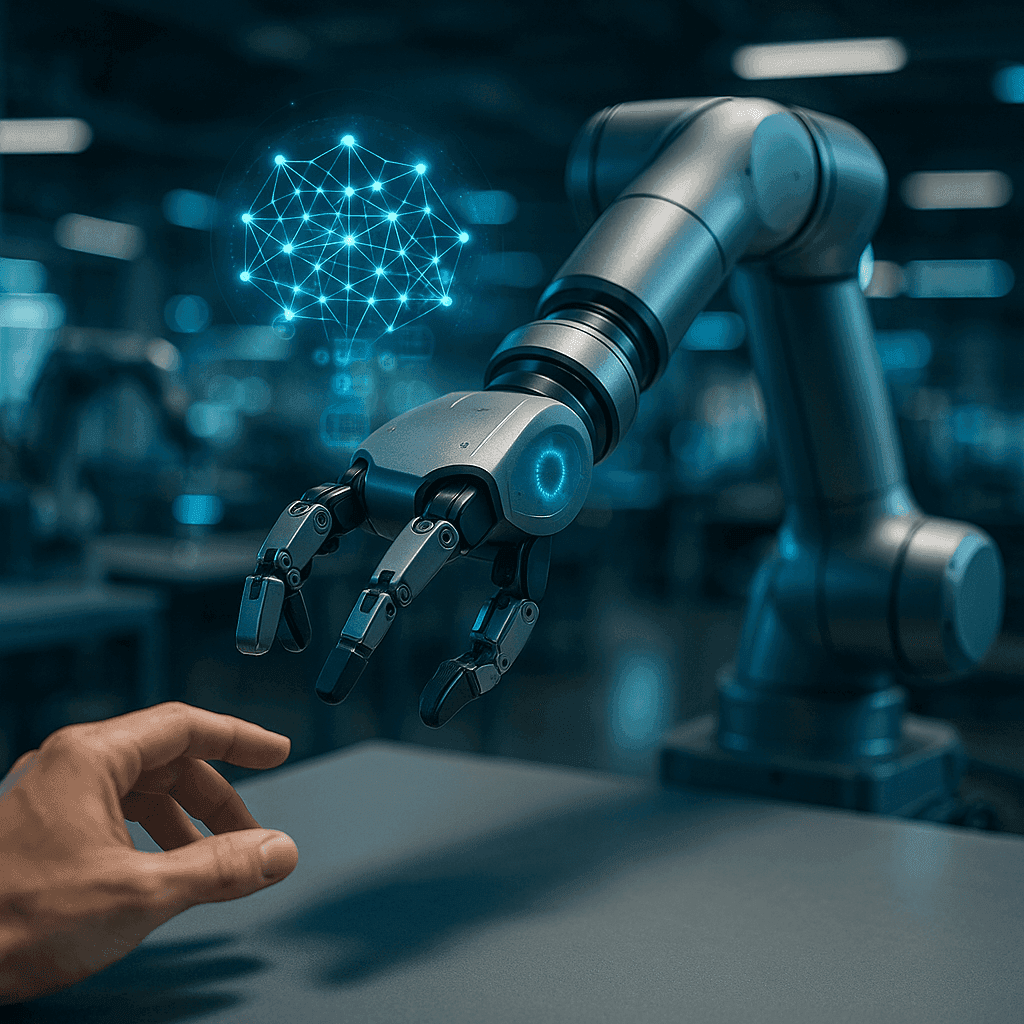
Physical Intelligence Says π0.7 Robot Brain Can Perform Untaught Tasks Through Zero-Shot Learning
Key Takeaways
- π0.7 enables robots to perform tasks never explicitly trained.
- The model is named π0.7.
- The capability relies on zero-shot learning without explicit training.
π0.7 and the new claim
Physical Intelligence, the San Francisco-based robotics startup, says its latest robot model can direct robots to perform tasks it was never explicitly trained on, a capability the company’s own researchers say caught them off guard.
“BitcoinWorld Robot Brain Breakthrough: Physical Intelligence’s Stunning New Model Teaches Itself Unseen Tasks In a development that has quietly electrified the robotics community, San Francisco-based startup Physical Intelligence announced on April 30, 2025, that its latest AI model can direct robots to perform tasks they were never explicitly trained to complete”
TechCrunch reports that the new model, called π0.7, was published in new research Thursday and is framed as “an early but meaningful step toward the long-sought goal of a general-purpose robot brain.”

The company describes that goal as a robot brain “One that can be pointed at an unfamiliar task, coached through it in plain language, and actually pull it off,” according to TechCrunch.
The Tech Buzz alternative outlet adds that Physical Intelligence announced π0.7 and describes it as a foundation model enabling robots to perform tasks through zero-shot learning without specific training.
In TechCrunch’s account, the core technical concept is compositional generalization, defined as “the ability to combine skills learned in different contexts to solve problems the model has never encountered.”
The reporting also places the work in a broader AI trajectory, saying that if the findings hold up, robotic AI may be approaching an inflection point similar to what the field saw with large language models.
TechCrunch contrasts this with what it calls the standard robot training approach, which it says has been “essentially rote memorization” where teams collect data on a specific task, train a specialist model, and then repeat for each new task.
Across the coverage, the central question is whether π0.7 can generalize beyond what it was taught, and the sources emphasize that the researchers were surprised by what the model could do.
How the model learned
TechCrunch describes π0.7’s most striking demonstration as an air fryer experiment where the model had “essentially never seen” the appliance in training, and it details what the team found when they investigated.
The article says researchers discovered only two relevant episodes in the training dataset: one where “a different robot merely pushed the air fryer closed,” and another from “an open source dataset” where “yet another robot placed a plastic bottle inside one on someone’s instructions.”

Despite that limited evidence, TechCrunch reports that the model synthesized those fragments “plus broader web-based pretraining data” into “a functional understanding of how the appliance works.”
The Tech Buzz alternative outlet similarly frames the air fryer as “an experiment involving a common kitchen appliance: an air fryer,” and it emphasizes that the model had “virtually no direct training data on this device.”
The MEXC alternative outlet also states that Physical Intelligence announced π0.7 on April 30, 2025, and it repeats the two-episode description, including the bottle placement and the pushing action.
In TechCrunch’s telling, the model’s first attempt required no coaching and still produced “a passable attempt at using the appliance to cook a sweet potato.”
When step-by-step verbal instructions were provided, TechCrunch says the model performed successfully, and it connects that coaching to real-world deployment in new environments without additional data collection or model retraining.
The sources also include a caution about tracing knowledge, with TechCrunch quoting Lucy Shi saying, “It’s very hard to track down where the knowledge is coming from, or where it will succeed or fail.”
Scaling, prompts, and limits
Beyond the air fryer case, TechCrunch argues that π0.7’s compositional generalization could change how capabilities scale with data, and it quotes Sergey Levine on why that matters.
“Physical Intelligence launches π0”
Levine is described as a co-founder of Physical Intelligence and a UC Berkeley professor focused on AI for robotics, and TechCrunch quotes him saying, “Once it crosses that threshold where it goes from only doing exactly the stuff that you collect the data for to actually remixing things in new ways,” adding that “the capabilities are going up more than linearly with the amount of data.”
TechCrunch links that scaling property to other domains, stating that it is “something we’ve seen in other domains, like language and vision.”
The article also includes Lucy Shi’s perspective on failure modes, quoting her: “Sometimes the failure mode is not on the robot or on the model,” and continuing, “It’s on us. Not being good at prompt engineering.”
TechCrunch provides a specific example of how prompt refinement affected outcomes, saying Shi describes an early air fryer experiment that produced a 5% success rate and that after “spending about half an hour refining how the task was explained to the model, it jumped to 95%.”
The Tech Buzz alternative outlet echoes the idea that π0.7 is designed to reason through physical tasks it was never explicitly trained to perform, and it frames the model as enabling robots to adapt across factories, warehouses, or homes without extensive reprogramming.
Still, TechCrunch draws a boundary around what π0.7 can do autonomously, quoting Levine: “You can’t tell it, ‘Hey, go make me some toast’,” and then adding, “But if you walk it through — ‘for the toaster, open this part, push that button, do this’ — then it actually tends to work pretty well.”
The sources also emphasize that standardized robotics benchmarks don’t really exist, which TechCrunch says makes external validation difficult, and it describes how the company instead measured π0.7 against its own previous specialist models.
What surprised the researchers
A recurring theme in TechCrunch is that the most notable aspect of the research is not just the demonstration, but the degree to which it surprised the people who know the training data best.
TechCrunch quotes Ashwin Balakrishna, a research scientist at Physical Intelligence, saying, “My experience has always been that when I deeply know what’s in the data, I can kind of just guess what the model will be able to do,” and it adds, “I’m rarely surprised.”
The article then states that “the last few months have been the” first time the researchers felt genuinely surprised, and it frames that as a break from Balakrishna’s usual expectations.
The MEXC alternative outlet makes the surprise explicit by quoting Balakrishna’s unpredictability and describing that “the last few months have been the first time where I’m genuinely surprised.”
TechCrunch also includes Lucy Shi’s quote about the difficulty of tracking where knowledge comes from, reinforcing that even the team cannot easily explain the model’s internal sourcing of capability.
In the same vein, TechCrunch says the researchers are careful not to get ahead of themselves, and it emphasizes that the team acknowledges limitations and points to their own prompt engineering as a factor in failure modes.
The Tech Buzz alternative outlet adds a broader framing by comparing the moment to the early days of large language models, quoting Levine about criticism and “the tasks are kind of boring” and that “The robot is not doing a backflip.”
Across the sources, the surprise is treated as evidence that π0.7 is doing more than rote memorization, even though the team still stresses that external validation is hard without standardized robotics benchmarks.
Validation, benchmarks, and industry stakes
TechCrunch reports that standardized robotics benchmarks “don’t really exist,” which it says makes external validation of π0.7’s claims difficult, and it describes how Physical Intelligence instead measured π0.7 against its own previous specialist models.
“Physical Intelligence, the two-year-old, San Francisco-based robotics startup that has quietly become one of the most closely watched AI companies in the Bay Area, published new research Thursday showing that its latest model can direct robots to perform tasks they were never explicitly trained on — a capability the company’s own researchers say caught them off guard”
It says the company found that the generalist model matched performance across a range of complex work, including “making coffee, folding laundry, and assembling boxes.”
The Tech Buzz alternative outlet extends the stakes by arguing that success could reshape manufacturing, logistics, and home automation by creating adaptable robots that “don’t require task-specific programming,” and it frames π0.7 as a foundation model that can reason through physical tasks.
The MEXC alternative outlet similarly emphasizes that the model represents “a significant leap toward creating a true general-purpose robot brain” and says it suggests the field may be approaching a transformative inflection point similar to the rise of large language models.
TechCrunch also notes that Physical Intelligence’s research is positioned as compositional generalization and that it compares the scaling property to language and vision, but it still highlights the need for scrutiny and cautions against overstating results.
In the same TechCrunch piece, the company’s internal evaluation is presented as a substitute for missing benchmarks, and it underscores that the team measured π0.7 against specialist models rather than relying on a shared external yardstick.
The Tech Buzz alternative outlet adds that robotics has lagged behind other AI applications partly because physical tasks are harder to simulate and require real-world data collection, and it states that most industrial robots still operate on rigid, pre-programmed routines.
Taken together, the sources portray π0.7 as a potential step toward general-purpose robotics, while simultaneously showing why verification, benchmarking, and real-world deployment remain central questions.
More on Technology and Science

UK Covid Vaccine Rollout Was Extraordinary Feat But Trust Must Be Rebuilt
13 sources compared

Two EF-1 Tornadoes Strike Ann Arbor And Lincoln Park In Southeast Michigan
12 sources compared

Hackers Access Booking.com Customer Data Including Personal Details, Company Updates PINs
13 sources compared

NASA's Artemis II Astronauts Complete Historic 10-Day Lunar Mission Safely
16 sources compared