Africa18 April, 20267 min read
Pope Leo XIV Opens Angola Worship at Shrine Linked to African Slave Trade
This article is an automated aggregation of coverage from news outlets. Our editorials offer in-depth analysis curated by the NewsCord team.
Pope Leo XIV visited the Muxima shrine in Angola, linked to the African slave trade. He celebrated Mass during the visit and urged Angolans to fight corruption with justice.

Mass in Kilamba, Angola
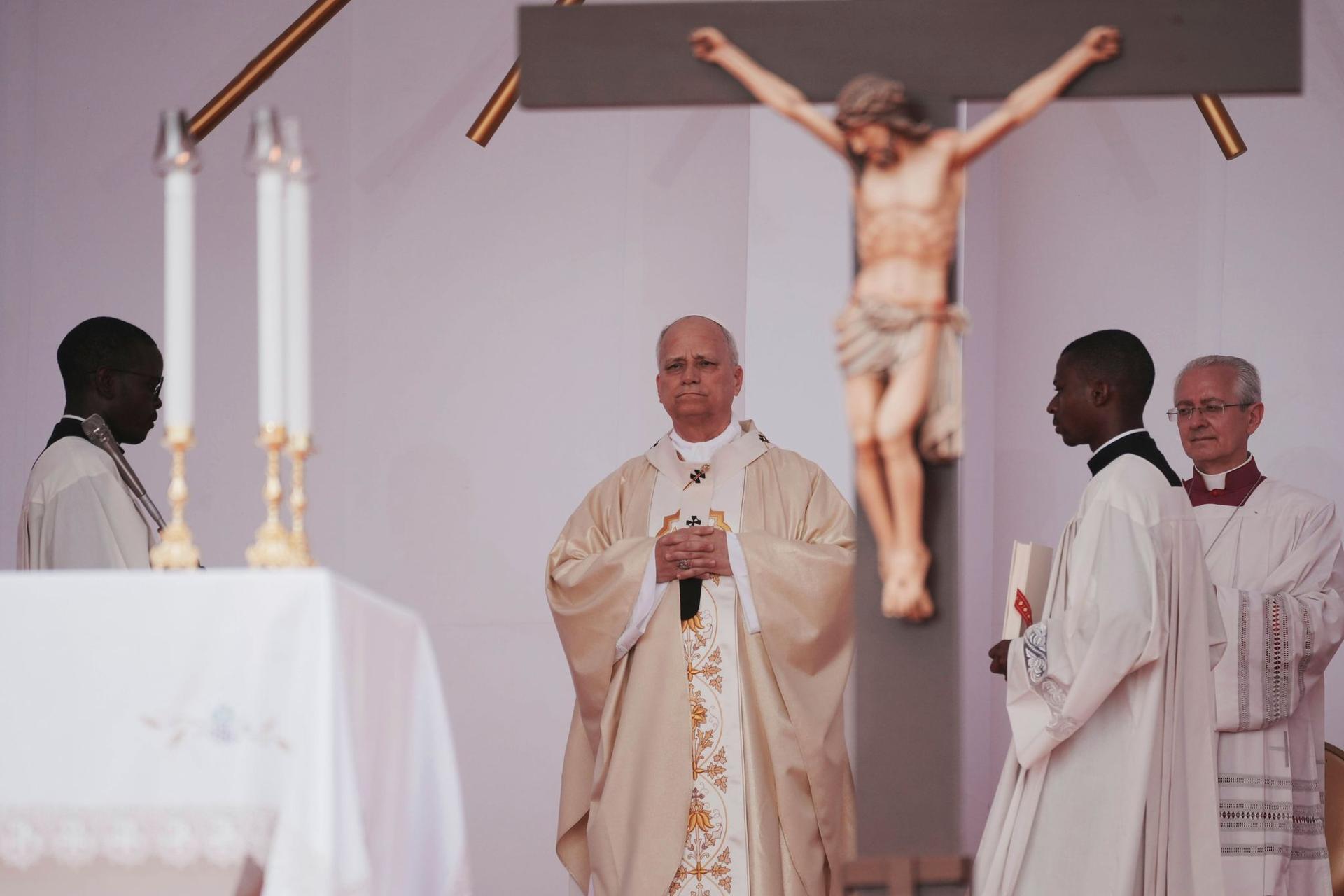
Pope Leo XIV opened a day of worship in Angola that he framed as part of an “African odyssey” reaching an “epicenter of the African slave trade,” calling Sunday for Angolans to fight the “scourge of corruption” with “a culture of justice.” The Associated Press reported that Leo celebrated Mass before an estimated 100,000 people outside Luanda and again sought to encourage Angolans as he denounced the exploitation of their “mineral-rich land and people,” who “still bear the scars of a brutal, post-independence civil war.” In Kilamba, a Chinese-built development about 25 kilometers (15 miles) outside the capital, Leo said, “We wish to build a country where old divisions are overcome once and for all, where hatred and violence disappear, and where the scourge of corruption is healed by a new culture of justice and sharing,” according to the AP account.
The Inquirer similarly placed Leo’s remarks in Kilamba, describing it as “a Chinese-built development about 15 miles outside the capital,” and repeated the same quoted language about justice and sharing. Il Sole 24 ORE, writing from Luanda, described the pope’s Angola stop as the third leg after Algeria and Cameroon and focused on his effort to “stimolare l’attenzione sull’Africa,” while also recounting his decision not to debate Donald Trump.

The Italian outlet said Leo addressed the controversy by calling it “una ‘narrazione, non del tutto accurata’ e di ‘commenti sui commenti’,” and it tied the pope’s remarks to a broader trip that included “quattro Paesi e 11 città.” Across the coverage, the pope’s Angola agenda combined Mass, public exhortation, and a later visit to the Sanctuary of Mama Muxima, described as “on the edge of the Kwanza River about 110 kilometers (70 miles) south of Luanda” by the AP and as “about 70 miles south of Luanda” by the Inquirer.
Muxima and the slave trade
The pope’s Angola day turned toward the Sanctuary of Mama Muxima, which multiple outlets described as a Catholic shrine tied to the trans-Atlantic slave trade. The AP said the Sanctuary of Mama Muxima is “an important Catholic shrine on the edge of the Kwanza River about 110 kilometers (70 miles) south of Luanda,” and it described the Church of Our Lady of Muxima as “built by Portuguese colonizers at the end of the 16th century as part of a fortress complex.” The AP reported that the site “became a hub in the slave trade,” where “enslaved Africans were gathered to be baptized by Portuguese priests before being forced to walk to the port of Luanda to be put on ships to the Americas.”
The Inquirer repeated the same core description, saying the church “became a hub in the slave trade” and that it was “where enslaved Africans were gathered to be baptized by Portuguese priests before being forced to walk to the port of Luanda to be put on ships to the Americas.” Devdiscourse framed the visit as a “poignant visit to the Sanctuary of Mama Muxima,” describing it as “a shrine with a troubling past linked to the slave trade” and saying the site was “once a hub where enslaved Africans were baptized before being shipped to the Americas.”
The Greenwich Time/AP account also connected the shrine’s history to the Catholic Church’s role in slavery, saying it is “emblematic of the Catholic Church’s role in the slave trade, the forced baptisms of enslaved people and what some scholars say is the Holy See’s continued refusal to fully acknowledge it and atone for it.” The New York Times coverage, though partially inaccessible, placed the shrine visit within a broader challenge of colonial legacy and described the trip as including “a trip to a shrine where enslaved Africans were baptized before being forced into the treacherous voyage across the Atlantic Ocean.”
Justice, healing, and papal lineage
The coverage tied the pope’s Angola remarks to a call for justice and healing, with named scholars and specific historical claims about Catholic involvement in slavery.
Anthea Butler, described by the AP as “senior fellow at the Koch Center, Oxford University,” told the Associated Press that “For Black Catholics, Pope Leo’s visit to the Muxima shrine is an important moment of healing.”
The AP added that Butler said many Black Catholics are Catholic because of slavery and the “Code Noir,” which she said required slaves purchased by Catholic owners to be baptized in the church.
Butler also said, “Others were already Catholic when they were trafficked from Angola to slave holding colonies,” and the AP identified her as “a Black Catholic scholar whose maternal family hails from Louisiana, where the pope’s ancestors also had their roots.”
The Inquirer carried the same Butler quotes and the same framing of the “Code Noir,” including the line that “Others were already Catholic when they were trafficked from Angola to slave holding colonies.”
The AP and Inquirer both linked the shrine’s history to papal permissions, saying Angola’s Portuguese colonizers were emboldened by “15th-century directives from the Vatican that authorized them to enslave non-Christians.”
The AP quoted Rev. Christopher J. Kellerman, a Jesuit priest and author of “All Oppression Shall Cease: A History of Slavery, Abolitionism, and the Catholic Church,” describing Pope Nicholas V’s 1452 bull Dum Diversas as giving the Portuguese king the right “to invade, conquer, fight and subjugate” and take possessions including land of “Saracens, and pagans, and other infidels, and enemies of the name of Christ.”
Bulls, Doctrine of Discovery, and Vatican response
The AP and Inquirer laid out a detailed chain of papal documents that, in their telling, helped authorize Portuguese enslavement and colonial seizure, while also describing the Vatican’s later repudiation of the Doctrine of Discovery. The AP said that “Angola’s Portuguese colonizers were emboldened by 15th-century directives from the Vatican that authorized them to enslave non-Christians,” and it cited Pope Nicholas V’s 1452 bull Dum Diversas as granting the Portuguese king and successors the right “to invade, conquer, fight and subjugate” and take possessions including land of “Saracens, and pagans, and other infidels, and enemies of the name of Christ.” The AP added that the bull also gave Portuguese permission “to reduce their persons to perpetual slavery,” and it said that bull and another issued three years later, Romanus Pontifex, “formed the basis of the Doctrine of Discovery.”
The report then stated that “The Vatican in 2023 formally repudiated the Doctrine of Discovery,” but “it never formally rescinded, abrogated or rejected the bulls themselves,” while the Vatican “insists that a later bull, Sublimis Deus in 1537, reaffirmed that Indigenous peoples shouldn’t be deprived of their liberty or the possession of their property, and were not to be enslaved.” Kellerman, quoted by the AP, also addressed the trans-Atlantic slave trade’s mechanics, saying “most of the 12.5 million Africans who were direct victims of the trans-Atlantic slave trade were sold into slavery by other Africans and were not captured by Europeans.”

He further said, “at the time of the building of Muxima, the Portuguese were doing both — buying enslaved people and colonizing/slave raiding,” and he said they were “fully using their papal permissions during this time.” Kellerman argued that later popes perpetuated a “false narrative,” telling the AP that “pope and others since have continued to perpetuate the “false narrative” that the Holy See was always against slavery, when the historical record says otherwise.”
European brands, Vatican scrutiny, and stakes
The New York Times framed the Angola visit as confronting a structural challenge for the Roman Catholic Church in Africa, while other outlets emphasized the personal and institutional stakes of the shrine visit. The New York Times reported that Angola has “more than 20 million Catholics, but not a single cardinal,” and it described the country as “a stark example of Africa’s lack of representation in Vatican leadership.” It also stated that “Only 14 of the 121 cardinals eligible to elect a pope are from Africa,” and it gave a ratio figure: “There are 365,000 Catholics for every bishop in Africa, a ratio higher than any other continent.”
Meanwhile, Devdiscourse described the pope’s journey as “urging the Vatican to reconsider its past actions,” and it said the pilgrimage “challenges the Vatican to reconsider its past actions” while “urges the Vatican to address its historical involvement in slavery.” The AP and Inquirer both described the pope’s visit as a moment of healing for Black Catholics, quoting Anthea Butler’s “important moment of healing,” and they tied that healing to the “Code Noir” and forced baptisms described in the shrine history.
Il Sole 24 ORE, in contrast, emphasized the pope’s broader agenda in Africa, writing that he “ha ribadito la condanna del cortocircuito fra ricchezza naturale, disuguaglianze radicali e un tasso di povertà stimato sopra il 40% dalla Banca africana di sviluppo,” and it described his focus on “la ‘logica estrattivistica’.” Taken together, the reporting shows the visit’s stakes as both moral and institutional: the shrine’s slave-trade history, the Vatican’s handling of papal documents, and the church’s representation in Vatican leadership all sit in the same Angola itinerary.