
President Trump and Israel Brought War to Iran, Misjudged Tehran's Resilience
Key Takeaways
- The United States and Israel launched attacks that started a war with Iran
- U.S. leaders assumed Tehran’s theocratic government was brittle and near collapse
- Combat persisted beyond a week despite expectations of Tehran's rapid collapse
Trump on Iran claims
President Trump publicly framed the U.S. and Israeli campaign as having 'militarily weakened' Iran, asserting that Tehran had 'essentially lost its navy, air force, communications and most missiles' and that Iranian drones were being shot down.
“Putin presented Trump, according to Russian statements, with proposals for a rapid settlement of the Iran war during a one-hour phone call”
He scheduled a Truth Social press conference about Iran timed after a day of market disruption, with the White House noting the event would come 'after a day of rising oil and gasoline prices.'
At the same time, reporting argues that this strategy rested on a false expectation that the theocratic regime was on the verge of collapse—an expectation that has not been borne out by subsequent developments.
Iran institutional resilience
The New York Times reports that the campaign — including the assassination of senior officials (the piece explicitly mentions 'including Ayatollah Khamenei') — failed to trigger the anticipated internal collapse because Iran's institutions are designed for continuity.
The paper highlights the Islamic Revolutionary Guard Corps (IRGC), 'multiple layers of succession, empowered provincial governors and local military commanders' as redundancies that have kept state functions intact despite leadership losses.
Regional escalation and risks
Rather than producing mass revolt, the NYT warns the violence risks a 'rally‑round‑the‑flag effect' that could strengthen nationalist sentiment and complicate external efforts to destabilize Tehran.
“Putin presented Trump, according to Russian statements, with proposals for a rapid settlement of the Iran war during a one-hour phone call”
The paper concludes that 'the government appears to have reasserted control, raising the risk that the U.S.-Israeli campaign becomes a costly quagmire.'
On the wider regional front, DIE WELT documents immediate spillovers.
NATO air defenses intercepted a ballistic missile over Turkish territory, prompting Ankara to summon Iran's ambassador.
Kuwait's leader condemned strikes that have already killed civilians.
DIE WELT presents these incidents as signs of escalating regional tensions and humanitarian cost.
Human and economic costs
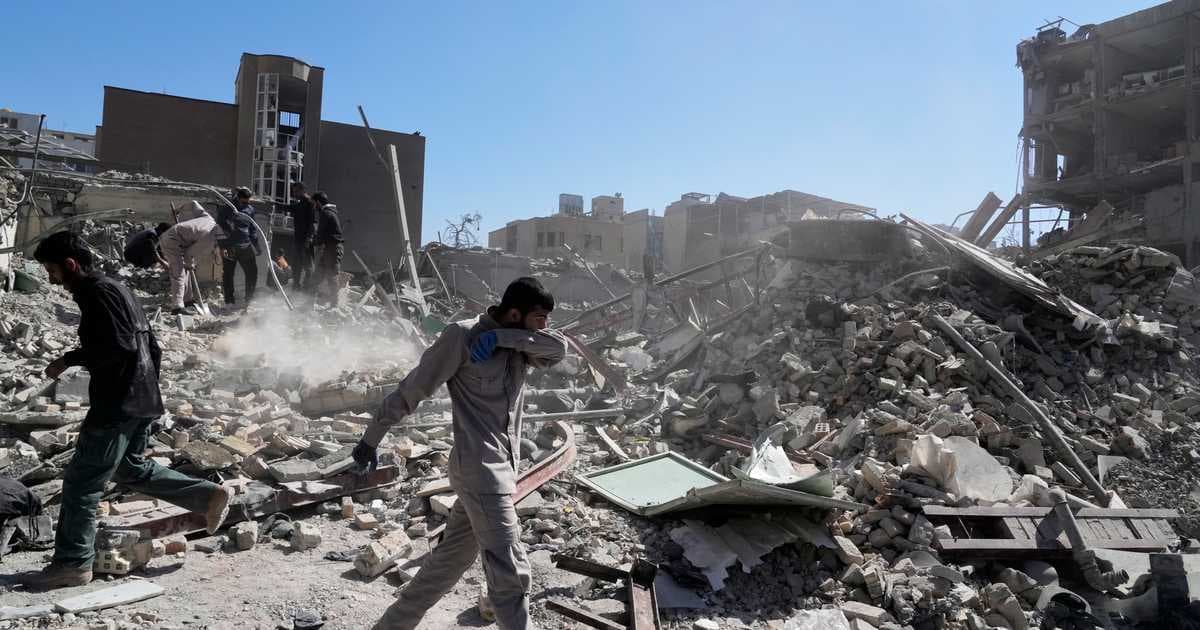
DIE WELT records civilian casualties tied to cross-border strikes and increased regional violence, including '12 deaths' in Kuwait from Iranian strikes and dozens of Lebanese casualties amid intensified Israeli shelling.
DIE WELT links the escalatory episode to market effects like rising oil and gasoline prices.
Taken together with the NYT’s assessment of Iranian durability, these sources portray a mismatch between U.S.-Israeli aims and on-the-ground effects.
They underline the danger of a prolonged, costly conflict rather than a quick strategic victory.
More on Iran-Israel

Escalation in Iran Pushes Oil Near $120, Sparks Gas Price Surge in Los Angeles
10 sources compared
U.S. Intercepts Iran Message Activating Sleeper Cells After U.S.-Israel Strike Kills Khamenei
14 sources compared

Iran Threatens To Confiscate Property Of Iranians Abroad Who Support US And Israel
14 sources compared
Ukraine Sends Drones, Experts to Shield U.S. Bases in Jordan From Iran
16 sources compared