
Protesters in Cuba Attack Communist Party Office Over Blackouts, Stoked by US Oil Blockade
Key Takeaways
- Protesters in Morón attacked and vandalized the Communist Party office.
- Hourslong blackouts and food shortages fueled by a US oil blockade.
- Five people were arrested in Morón amid the unrest.
Cuba Protest Overview
Anti-government protesters attacked a Communist Party office in central Cuba early Saturday, marking a rare outburst of public dissent triggered by severe blackouts exacerbated by a US oil blockade.
“Protesters in central Cuba have torched a local communist party office, as conditions on the island continue to deteriorate under severe restrictions from the United States meant to squeeze the economy”
The protest occurred in the city of Moron, located on Cuba's northern coast approximately 250-400 miles east of Havana near the tourist resort of Cayo Coco.

Demonstrators expressed their anger over prolonged power cuts and food shortages that have become increasingly severe.
This incident represents one of the most significant acts of public unrest in Cuba in recent years.
Social media videos captured the intensity of the demonstrators' actions as they targeted a symbol of the ruling Communist Party's authority.
The protest highlights the growing desperation among Cubans facing daily blackouts that can last for the majority of the day.
Economic conditions have been deteriorating rapidly due to the ongoing US pressure on the island nation.
Protest Escalation
The protest initially began peacefully as a rally against power cuts and food shortages late on Friday.
It escalated into violence during the early hours of Saturday morning.
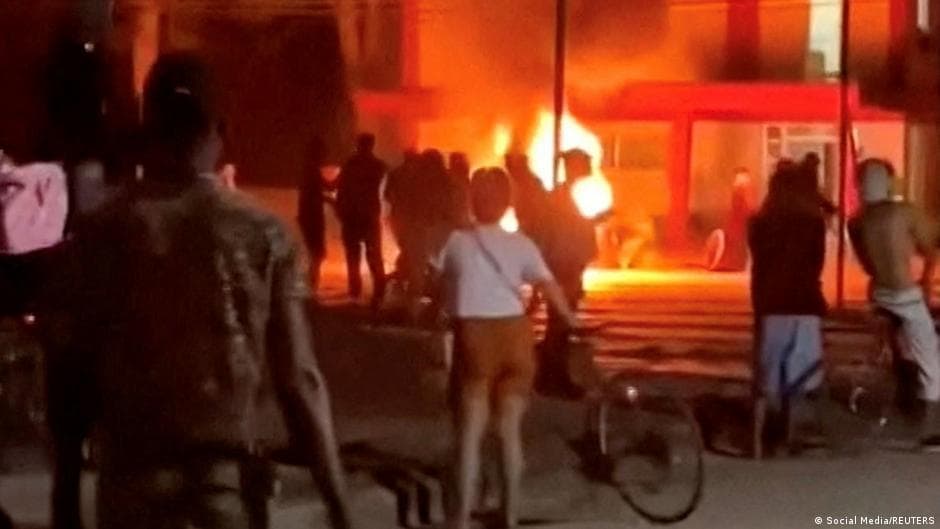
According to state-run newspaper Invasor, what started as a legitimate expression of public frustration 'degenerated into vandalism against the headquarters of the municipal committee of the Communist Party.'
Videos on social media documented the transformation of the demonstration.
They showed protesters throwing rocks through windows while shouting 'liberty' in the background.
The violence included the ransacking of the Communist Party office.
Demonstrators removed documents, computers, and furniture before setting it ablaze in the street.
A Moron resident speaking to AFP emphasized the economic desperation.
They noted that hotels in the town have been shuttered amid the energy crisis, exacerbating residents' economic woes.
US Blockade Context
The underlying cause of Cuba's severe energy crisis stems from the US oil blockade.
“Protesters in central Cuba attacked early Saturday an office of the ruling Communist Party, amid growing discontent over hourslong blackouts fueled by a US oil blockade”
This blockade has intensified since the capture of Venezuelan President Nicolas Maduro in January by US forces.
Maduro had been Cuba's most important foreign benefactor, providing crucial oil supplies.
These supplies sustained the island's economy and electrical grid.
Following Maduro's capture, President Trump openly expressed hopes for regime change.
Trump stated that Havana was on the verge of collapse.
The Trump administration subsequently halted Venezuelan oil shipments to Cuba.
They have threatened to impose tariffs on any country selling oil to the island.
This creates an economic chokepoint for Cuba's already faltering electrical grid.
The US policy has translated into severe fuel, food, and medicine shortages.
These shortages have pushed residents to the breaking point.
They prompted unprecedented public demonstrations against the government.
Government Response
Cuban President Miguel Diaz-Canel acknowledged the understandable anger over prolonged blackouts.
He firmly warned against violence, stating that 'there will be no impunity for vandalism and violence.'

In a post on social media, he emphasized that 'what will never be comprehensible, justified or admitted is violence.'
This reflects the government's attempt to balance acknowledging public frustration with maintaining political control.
State media reported that police detained five people during the protests.
Authorities are investigating the 'vandalism' while noting that other state-run establishments were also impacted.
These included a pharmacy and a store that were damaged during the unrest.
The government has disputed online reports that a person had been shot by police.
State media outlet Vanguardia de Cuba claimed that 'media manipulation seeks to sow fear and confusion among our people.'
This indicates official concern about the narrative surrounding the unrest.
Unprecedented Nature
The protest in Moron represents a significant departure from the norm in Cuba.
“Ruling Communist Party's office vandalised in Cuba during riot over blackouts A rally against power cuts and food shortages began peacefully in the city of Moron late on Friday then turned violent in the early hours of Saturday morning, a state-run newspaper reported”
Public demonstrations, especially violent ones, are extremely rare under the communist regime.
The 2019 Cuban Constitution technically guarantees citizens the right to protest.
However, a law defining that right more precisely remains blocked in the legislature.
This leaves those who take to the streets in a legal gray area.
This rarity makes the Moron incident particularly noteworthy.
It follows other expressions of discontent including residents in Havana chanting 'down with communism'.
They were banging pots and pans over extended blackouts earlier in the week.
Students also staged a sit-in at the University of Havana after the government canceled classes.
This further indicates the depth of public frustration.
The Cuban government confirmed on Friday that it had begun talks with Washington.
They are trying to defuse the crisis, suggesting the regime recognizes the seriousness.
The regime is seeking diplomatic solutions to address mounting economic pressure.
More on Protests
Cuba protesters attack Communist Party office amid outages; five arrested
11 sources compared

President Diaz-Canel Confirms Cuba-US Talks to Settle Bilateral Disputes
159 sources compared
Naturalized US citizen Ayman Mohamad Ghazali rams vehicle into West Bloomfield synagogue, dies
129 sources compared

Artist Secret Handsake Installs Titanic-Pose Statue of President Trump With Jeffrey Epstein on National Mall
15 sources compared