Redistricting Battles Make 2026 Midterms Less Competitive, New York Times Says
Key Takeaways
- All 435 House seats are on the ballot in November 2026.
- Redistricting battles reduce competitiveness by creating more safe seats.
- Midterms are highly consequential, framed by district maps.
Fewer competitive seats
All 435 seats in the House of Representatives are up for election in November, but fewer than a tenth of those races are likely to be competitive, with the New York Times pointing to nationwide redistricting battles as one culprit.
“The United States is heading into one of its most consequential midterm elections in decades”
The Times says competitive districts—where a candidate leads a challenger by fewer than 10 percentage points—are increasingly rare, and it cites a shift from presidential candidates winning about 28 percent of congressional districts with fewer than 10 percentage points in 2008 to 20 percent in 2024.

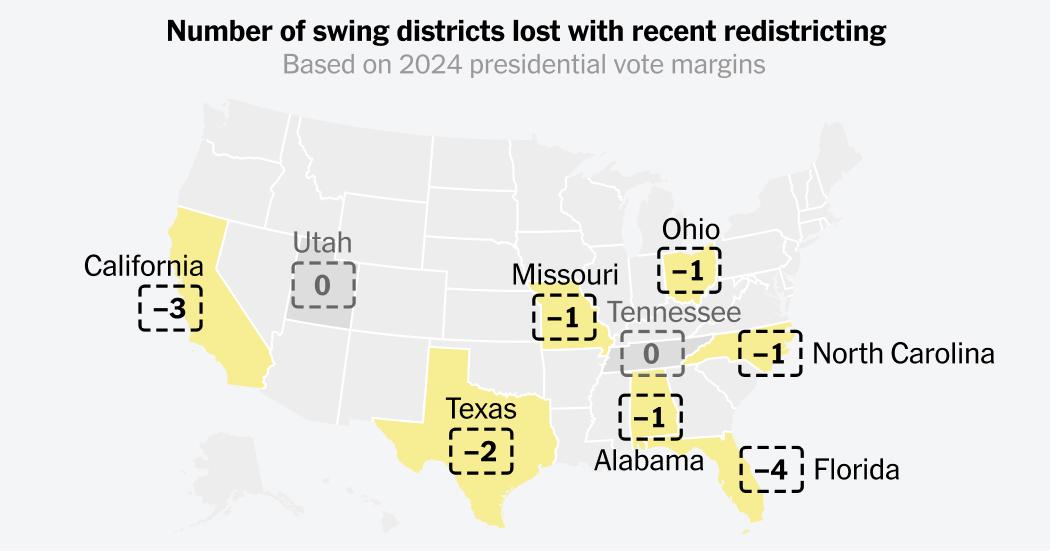
Eric Schickler, a political science professor at U.C. Berkeley, told the Times, “It’s a mutually reinforcing process,” as Florida’s latest round of redistricting in April reduced the state to only one competitive district from 5.
The Times adds that Texas’ new maps wiped out the only two districts that would have been considered competitive in 2024, while California’s redrawn map left 11 competitive districts instead of 14.
Voices warn of democracy
The New York Times frames the lack of competition as bad for democracy, saying voters have less of a reason to participate if races are not close and fewer ways to force out leaders they are unhappy with.
Asher Hildebrand, a professor of public policy at Duke University, warned the Times, “And we’re only going to see more of that as swing districts disappear.”

The Times also describes North Carolina’s two rounds of mid-decade redistricting within two years, including a 2023 map that left just two competitive districts and a latest map passed in October that shifts one district represented by Don Davis.
In the Al Jazeera explainer, the stakes are tied to the November 3 election calendar, saying “On November 3, every seat in the House of Representatives and a third of the Senate will be up for grabs” in what it calls “the country's first major verdict on Donald Trump's second term as president.”
Maps, primaries, and turnout
Al Jazeera says the midterms are not to elect a new president but to vote for 35 US Senate seats and all 435 House seats, while also electing 39 state governors and state legislators.
“All 435 seats in the House of Representatives are up for election in November, but fewer than a tenth of those races are likely to be competitive”
It adds that “nearly 244 million voters are eligible to cast ballots in the US midterms,” and it describes how primaries begin as early as March and run through the summer, state by state.
The explainer says every 10 years after the US census, the country’s 435 House seats are reapportioned based on population shifts, triggering a nationwide redrawing of congressional districts called redistricting.
The New York Times, meanwhile, highlights how presidential election results are used as a lens for 2026 competitiveness, noting that in 2024 presidential vote margin terms, four swing districts vanished after Florida’s latest round of redistricting in April.
More on USA

Analyses Link Donald Trump’s Greenland Push to U.S. Expansionism From the Monroe Doctrine
11 sources compared

Aspen Acres Fire Forces Evacuations Near Denver, Destroys 160 Structures in Colorado
11 sources compared

Trump Uses July 4 250th Birthday for Political Rallies in Washington
14 sources compared

New York Harbor Welcomes More Than 40 Tall Ships for Sail4th 250 Anniversary Parade
13 sources compared