Russia and Ukraine Shift to Ground Drones, Including Malvina-M and Droid TW 12.7
Key Takeaways
- Ground drones Malvina-M and Droid TW 12.7 gain prominence on front lines.
- Ukraine launches first domestically produced guided glide bomb, Vyrivniuvach, for combat.
- Front-line drone activity reshapes tactics; drones threaten rotation and disrupt logistics.
Drones and new weapons
France 24 describes how, after an intense aerial drone war between Russia and Ukraine, attention is shifting to ground vehicles and remotely operated systems, including Russian Malvina-M and Ukrainian Droid TW 12.7.
France 24 says the Malvina-M is equipped with an thermobarique weapon, and quotes Marianne Hanson, a specialist at the University of Queensland, saying the munitions are "dévastatrices, car elles créent des boules de feu dévoreuses d'oxygène".

France 24 also reports that Ukrainian media depicted the DevDroid TW 12.7 as a wartime hero after it helped push back enemy assaults for 45 days, and it adds that another Ukrainian wheeled drone carried more than 300 kg of munitions and supplies to troops on the front.
In the same account, Will Kingston-Cox of the International Team for the Study of Security (ITSS) Verona is quoted saying there has been "une hausse du recours à ces véhicules téléopérés ces derniers temps" by both Russian and Ukrainian armies.
France 24 cautions that the battlefield is not simply a contest between robot killers, quoting Veronika Hinman of the University of Portsmouth that there is "un aspect de propagande évident" in such narratives.
Brave1 and domestic production
RSI Radiotelevisione svizzera reports that, outside Kiev, developers and engineers meet in a secret test area for Brave1, a platform developed by the Ukrainian government that connects defense projects directly with soldiers at the front.
RSI says the Brave1 cluster in two years has brought together "più di 1’500 aziende" of Ukrainian defense companies, and it describes an event dedicated to kamikaze drone aircraft that can operate at a distance of "oltre 40 km".
RSI quotes Denis, a Brave1 spokesperson, saying "L’evento di oggi est dédié al tema dei velivoli sans pilota kamikaze che possono operare a una distance de oltre 40 km".
Business Insider reports that Ukraine revealed its first domestically made glide bomb, called Vyrivniuvach, and says Brave1 shared that the bomb is designed to be carried by a range of aircraft.
Business Insider adds that the Vyrivniuvach includes a 250kg warhead and that Ukrainian Defense Minister Mykhailo Fedorov said on social media, "Soon, Ukrainian glide bombs will be striking enemy targets."
Anti-drone nets and the front
Le Parisien reports that Ukraine’s Defense Minister Mykhailo Fedorov announced in a Telegram post the deployment of anti-drone nets on frontline roads, aiming to cover 4,000 km of roads by the end of the year.
“- Ukraine revealed its first domestically made glide bomb, announcing it's ready for combat deployment”
Le Parisien quotes Fedorov describing the purpose of the nets, writing that "la mesh traps the enemy drones' propellers" to prevent them from reaching targets.
Le Parisien says the deployment pace accelerated from 5 km per day in January to 12 km in February, and it reports that an additional $37 million budget was allocated for the nets.
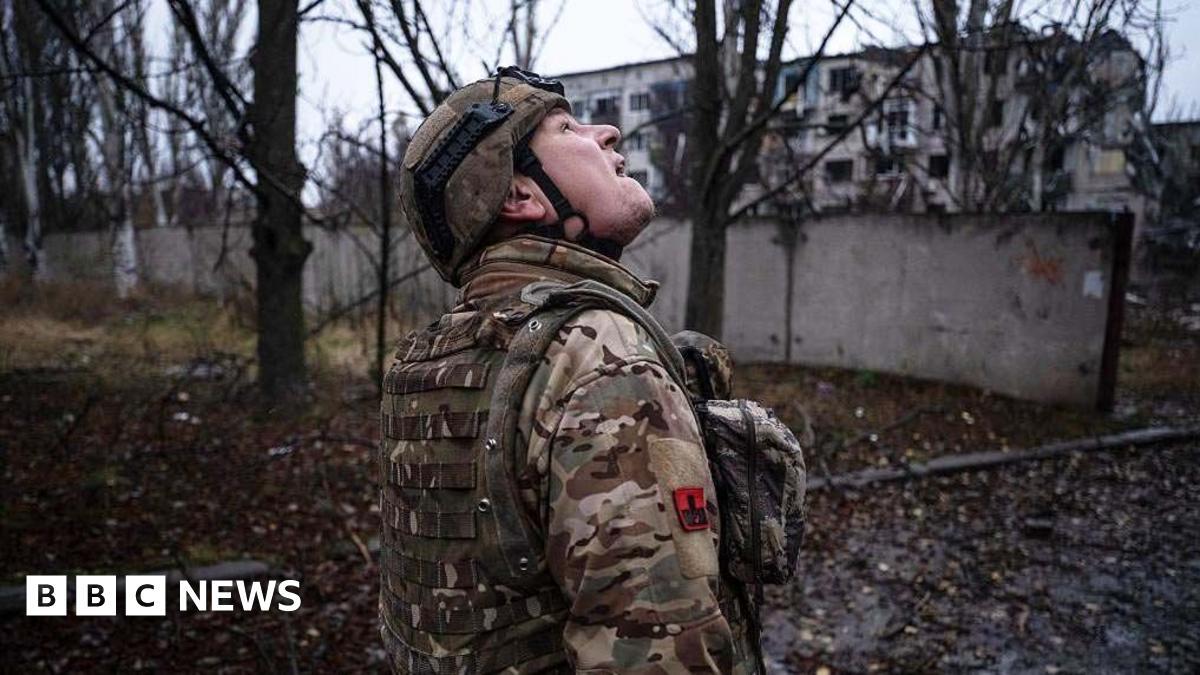
BBC describes the impact of drones on infantry rotations near Kostyantynivka, where the Ukrainian military says Russian forces have reached its outskirts and where a soldier known as Kenya said, "Most fighting was done by drones."
BBC also reports that, in the kill-zone, soldiers use anti-drone cloaks and that Kenya said, "Every time when we had to come out of our positions, we prayed we would come back alive."
More on Ukraine War

Russia Bombards Kyiv With 500 Drones, Killing At Least 21 Civilians
31 sources compared
Russian Drone Strike Kills One in Zaporizhzhia, Injures Seven as Drones Reach 11 Localities
12 sources compared
Putin-Linked Graceful Sails Past Denmark With Russian Naval Escort on June 29
10 sources compared
Putin Admits Fuel Shortage After Ukrainian Drone Strikes Target Oil Terminals
18 sources compared