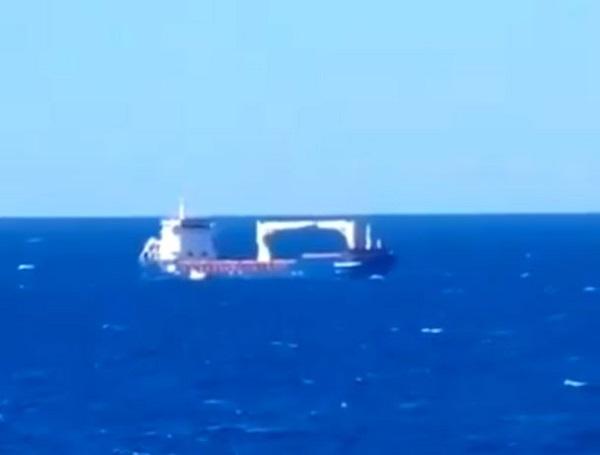
Russian Ship Ursa Major Sinks in Mediterranean Carrying Nuclear Reactors for North Korea
Key Takeaways
- Ursa Major sank in the Mediterranean off Spain after explosions in December 2024.
- It carried two nuclear reactors intended for North Korea's submarines.
- Owned by Oboronlogistika, a Russian state-linked company tied to military operations.
Ursa Major sinks
A Russian cargo ship, the Ursa Major, sank in international waters of the Mediterranean Sea after a series of explosions, and Spanish authorities’ investigation says the freighter carried two nuclear reactors for submarine propulsion and was en route to a North Korean port of Rason.
“01:11 01:12 02:38 02:19 05:39 23:17 05:09 20 Minutes Published on December 31, 2025 at 3:15 PM One year ago, the Russian ship 'Ursa Major' sank in international waters of the Mediterranean Sea”
The Le Figaro account says the Ursa Major sank during the night of December 23–24, 2024, after explosions in the engine room that its owner described as a "terrorist attack," and it reports that the vessel had a crew of 16 with two sailors reported missing.
Le Figaro also describes how Spanish investigators found the cargo included two VM-4SG-type nuclear reactors, and it says the ship departed on December 11 from Saint Petersburg and was officially due to arrive on January 22 in Vladivostok.
In the same investigation, Le Figaro reports that the Almería Maritime Rescue and Coordination Center observed erratic navigation of the 142-meter vessel, including unexplained slowdowns, changes in course, and a progressive loss of speed.
20 Minutes adds that the Russian Foreign Ministry said two crew members disappeared at sea, and it reports that the freighter departed from Saint Petersburg toward the port of Vladivostok, about 100 kilometers from the North Korean border.
Torpedo and denials
Spanish authorities, as relayed by Le Figaro and La Verdad, propose that an intervention by a Western submarine could have aimed to prevent the clandestine shipment of two nuclear reactors to North Korea.
Le Figaro reports that the Russian Ministry of Foreign Affairs claimed the sinking occurred after "an explosion that occurred in its engine room," while the ship’s captain described a hole in the hull about 50 cm in diameter with edges turned inward.

Le Figaro also says Spanish experts consider the damage more closely matches a supercavitating torpedo than a conventional explosive device, and it notes that this type of torpedo is today possessed only by Russia, China, and some NATO member states.
In a separate account, Formiche.net says Spanish authorities stated that on board the vessel sunk off Cartagena on December 22, 2024 there were two large containers identified as casings for Vm-4Sg nuclear reactors, and it says investigators shared suspicions that the cargo’s final destination was the North Korean port of Rason.
Formiche.net further describes a scenario involving the Russian ship Ivan Gren at the site and the presence of the oceanographic vessel Yantar with deep-sea recovery capabilities, framing it as an attempt to recover or destroy sensitive equipment.
Aftermath and stakes
The sinking has been tied by multiple outlets to Russia-North Korea military cooperation, with Le Parisien reporting that the ship was under U.S. sanctions since 2022 and that Spanish authorities’ investigation says the vessel was not bound for Vladivostok but to Rason, North Korea.
“A Russian "shadow fleet" vessel carrying submarine nuclear reactors sank in the Mediterranean Sea”
Le Parisien also says the North Korean port of Rason is located a few kilometers from Vladivostok and that its infrastructure is "precarious," while it reports that Spanish authorities suspect the Liebherr cranes carried by the Ursa Major would be used to unload the reactors.
In the same vein, Il Fatto Quotidiano reports that the Russian Foreign Ministry crisis unit said 14 of the 16 crew members were rescued and taken to the port of Cartagena in the region of Murcia, while two were missing.
20 Minutes adds that the investigation describes the hull as perforated from the outside in, probably by a torpedo that only Russia, China, and NATO member states possess, and it says a Western submarine could have attacked to prevent the nuclear reactors from reaching North Korea.
Across the accounts, the immediate consequence described is that the Ursa Major’s cargo of reactor components—identified as VM-4SG or Vm-4Sg casings—did not reach North Korea, with Le Figaro and 20 Minutes both linking the shipment to a potential transfer of submarine propulsion nuclear technology.
More on Russia

Iran-Linked Harakat Ashab al-Yamin al-Islamiya Claims Attacks on Jewish Sites Across Europe
10 sources compared
U.S. Navy USS Alaska Docks in Gibraltar as Trump Says Iran Ceasefire Is on Life Support
11 sources compared
Medvedev Warns Germany Remilitarization Aims to Repeat June 22, 1941
10 sources compared

Vladimir Putin Presides Over Scaled-Down Victory Day Parade on Moscow’s Red Square After Ceasefire
21 sources compared