Other16 April, 20268 min read
Scientists Measure Cygnus X-1 Black Hole Jets’ Instantaneous Power Of 10,000 Suns
This article is an automated aggregation of coverage from news outlets. Our editorials offer in-depth analysis curated by the NewsCord team.
Jets from Cygnus X-1 deliver instantaneous power equivalent to 10,000 suns. First-ever instantaneous power measurement achieved via 18 years of global radio telescope array data.

First Instant Jet Measurement
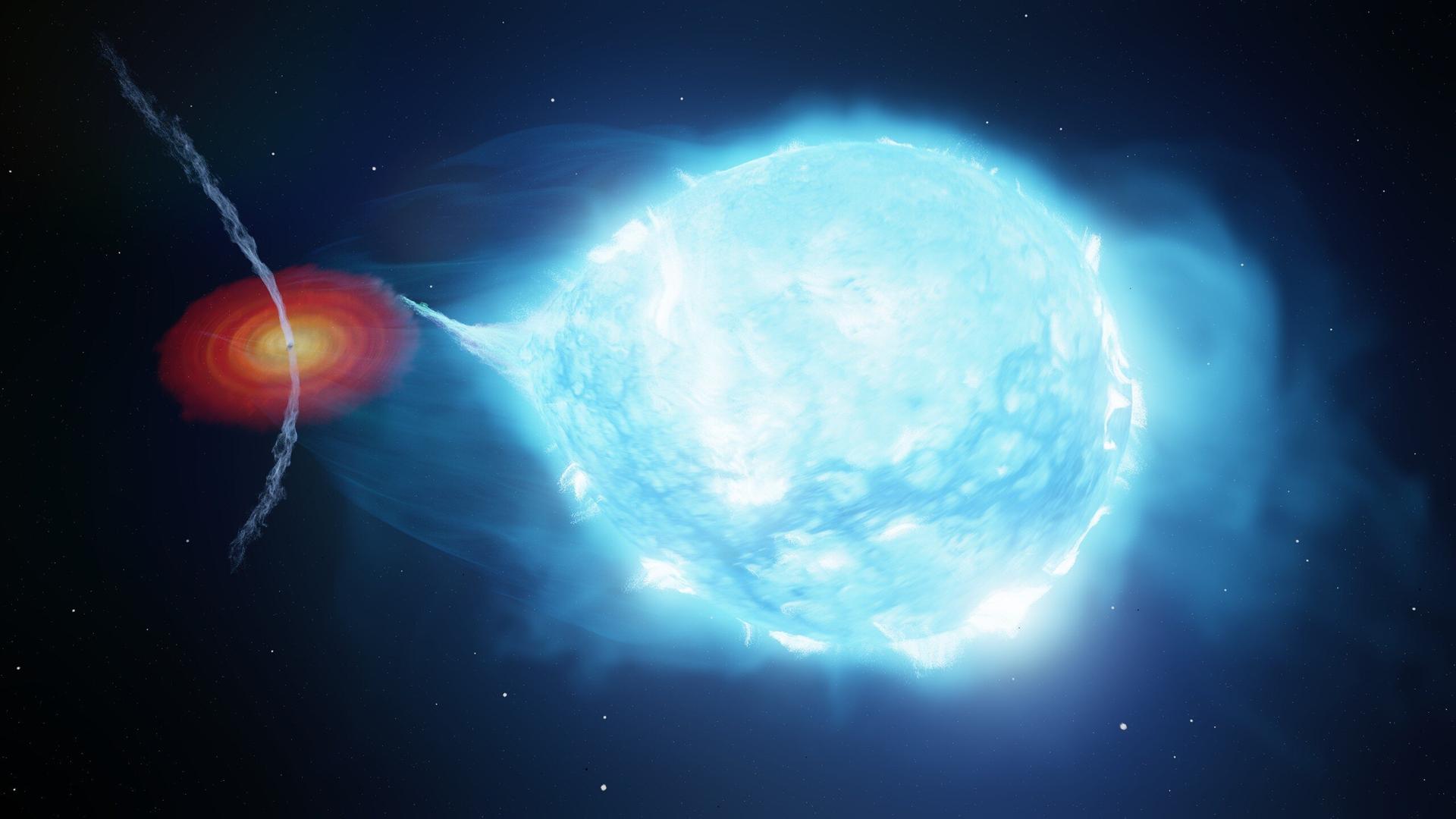
For the first time, scientists measured the instantaneous power and speed of jets blasting from a black hole in the Cygnus X-1 system, an international research team reported on Thursday. The jet power was found to be equivalent to 10,000 suns, and the jet speed was tracked at roughly 540 million km/h (355 million mph), described as about half the speed of light. The system is located 7,200 light-years away and features not only a black hole but a blue supergiant star as its constant companion, according to reporting that also notes Cygnus X-1 was the first black hole identified more than a half-century ago.
The work was led by the University of Oxford’s Steve Prabu and his team, who based their findings on 18 years of high-resolution radio imaging obtained by a global telescope network. Prabu conducted the research while still at Australia’s Curtin University, which led the study published in Nature Astronomy, and the team used how the jets were bent by the star’s wind as part of their calculations.

ABC News’ coverage from Cape Canaveral, Fla. likewise described the same core measurements—10,000 suns and roughly 355 million mph—while emphasizing that the power was instantaneous rather than averaged. The Scientific American account framed the discovery as a first for science because “Until now, no one had ever managed to directly measure the might of these jets,” using radio-telescope data from two international networks to reconstruct high-resolution images of the jets over time.
The System and the Method
The measurements centered on Cygnus X-1, described across outlets as a black hole-star system in the Milky Way’s Cygnus constellation, with a blue supergiant star serving as the companion. ABC News reported that Cygnus X-1 “features not only a black hole — the first one ever identified more than a half-century ago — but a blue supergiant star, its constant companion,” and it tied the system’s location to “7,200 light-years away.” Scientific American similarly placed the system “some 7,200 light-years from Earth” and described the jets as twin outflows launched near the black hole’s poles as matter funnels in.
The method depended on radio imaging over long time spans and on reconstructing how the jets moved as they were buffeted by the companion star’s wind. Scientific American said the researchers “were able to reconstruct high-resolution images of the jets over time, watching as they were buffeted to and fro by intense stellar winds from the nearby star,” and it described the jets’ motion as “dancing.”
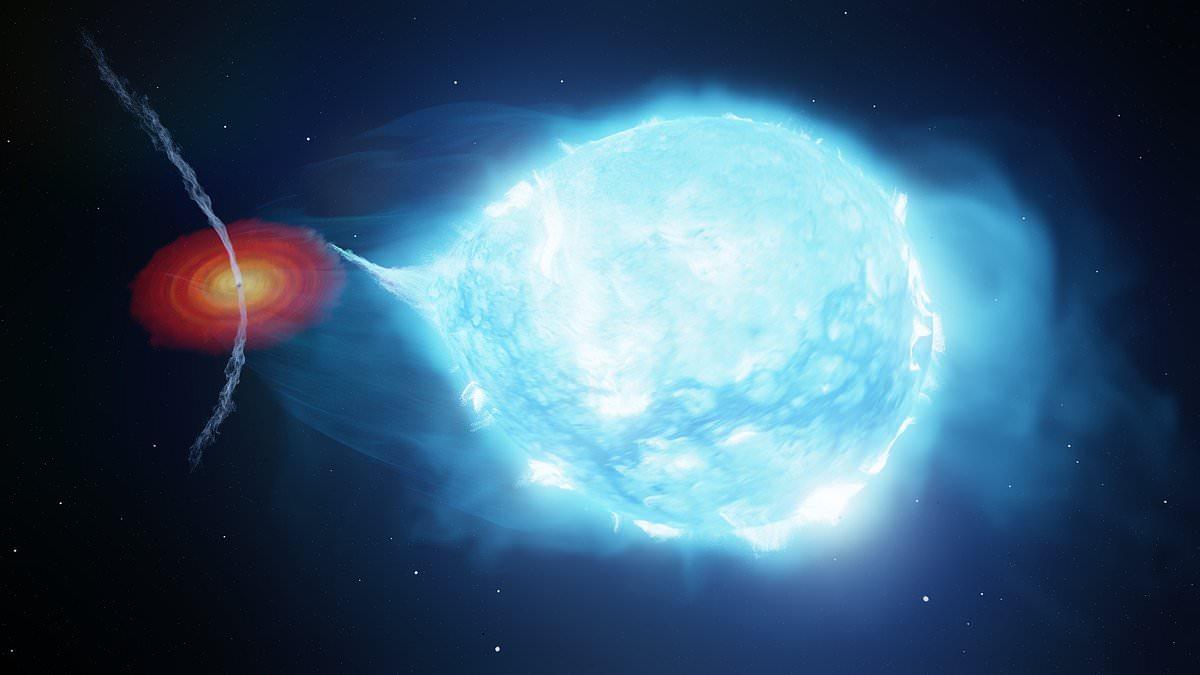
The Conversation’s account added that the team made “very high resolution images of the jets by combining telescopes separated by thousands of kilometres,” and it described the wind as strong enough to bend the jets as the black hole orbits. IFLScience likewise described the observational logic as using the way the jets were warped by the star’s wind to confirm that the jets release 10 percent of the energy from the mass falling into the black hole.
Energy Budget and “10%”
Beyond the headline numbers for power and speed, the reporting highlighted a specific energy relationship between the infalling matter and the jets. ABC News said Prabu identified “a key finding” that “10% of all the energy released as matter falls toward the black hole is carried away by the jets.” Scientific American likewise described the jets as carrying about “10 percent of the total energy released by infalling matter—equivalent to the power output of 10,000 suns,” and it connected that fraction to how jets can influence cosmic evolution.
The Phys.org report quoted Prabu saying, “A key finding from this research is that about 10% of the energy released as matter falls in towards the black hole is carried away by the jets,” and it added that the result was “what scientists usually assume in large-scale simulated models of the universe, but it has been hard to confirm by observation until now.” The Conversation framed the measurement as a way to “balance the energy budget” by comparing how fast the black hole is feeding from X-rays with how much energy is carried away by the jets.
IFLScience similarly emphasized the ratio, stating that “A key finding from this research is that about 10 percent of the energy released as matter falls in towards the black hole is carried away by the jets,” and it described the earlier uncertainty as coming from the difficulty of measuring jet power relative to the energy source. Scientific American also described why the new measurement mattered: previously, researchers inferred jet strength by observing how jets affected their surroundings over “thousands or even millions of years,” which informed simulations but left key assumptions untested.
Voices From the Study
The reporting repeatedly returned to the study’s lead author Steve Prabu and to co-author James Miller-Jones, using their statements to explain both the significance of the measurement and the observational challenge it overcame. ABC News quoted Prabu describing the system’s feeding and jet-launching mechanism, saying the supergiant star gives the black hole “something to ‘eat’ and launch as jets,” and it also included Prabu’s plan to extend the technique, with his line: “It would be exciting to measure jet power in many more systems.” Scientific American quoted Prabu describing the new capability, saying, “By combining all of these observations, we were able to piece together the ‘dancing’ motion of the jet and measure its properties in a way that hadn’t been possible before,” and it added that the team’s “black hole jet bending” gave “a unique way to measure the jets’ power directly.”
Phys.org quoted Prabu again on the 10% result, and it also described how the measurement allowed scientists to understand “what fraction of the energy released around black holes could be deposited into the surrounding environment.” For Miller-Jones, Scientific American said he noted that the result likely applies broadly, because “Because our theories suggest that the physics around [all] black holes is very similar, we can now use this measurement to anchor our understanding of jets, whether they are from black holes 10 or 10 million times the mass of the sun.”

The Daily Mail included Miller-Jones’s analogy about the “energy budget,” quoting him as saying it was “a bit like counting calories, only for a black hole.” IFLScience added Miller-Jones’s explanation of the wind-bending logic, including the statement, “If the jet is very powerful, it will not notice the wind.”
How Outlets Framed the Breakthrough
While the underlying measurements were consistent across coverage, the outlets emphasized different implications and details, creating visible divergence in framing. ABC News foregrounded the novelty of measuring “instantaneous mind-blowing power” and repeatedly tied the result to the system’s location and observational basis, including the statement that the team based findings on “18 years of high-resolution radio imaging obtained by a global telescope network.” The South China Morning Post similarly led with the first-time measurement and stressed that “Until now, a black hole’s jet power had to be averaged over tens of thousands of years,” while also describing the jets as “dancing jets” pushed in opposite directions by the star’s wind.
Scientific American, by contrast, embedded the measurement in a broader explanation of cosmic evolution, describing how jet shock waves can “ripple across hundreds of thousands of light-years” and influence whether galaxies form stars or extinguish star formation. The Conversation framed the discovery as a challenge to intuition, stating that “something as seemingly ordinary as the ‘wind’ from a star can rival – and even shape – the behaviour of these powerful jets,” and it used the “cosmic waltz” language to describe the orbital dance between black hole and companion star.
Phys.org emphasized the research leadership and instrumentation, describing the “array of linked-up telescopes separated by large distances” and noting that the research was led by Curtin Institute of Radio Astronomy (CIRA) and the Curtin node of ICRAR. IFLScience leaned into the technical reasoning, including a specific angular deflection claim that “the O-type star’s wind induced a 5.2 degree bend in the angle of the black hole's jets,” and it described the study as “open access in Nature Astronomy.”
What Comes Next
The sources also pointed to what the measurement could enable next, tying the new calibration to future observations and to upcoming radio-telescope capabilities.
ABC News reported that Prabu planned to apply similar techniques to other black holes, saying, “Prabu plans to apply similar techniques to other black holes,” and it quoted him: “It would be exciting to measure jet power in many more systems.”
Phys.org connected the measurement to the Square Kilometer Array Observatory, stating that “With radio telescope projects such as the Square Kilometer Array Observatory currently under construction in Western Australia and South Africa, we expect to detect jets from black holes in millions of distant galaxies,” and it said the “anchor point” would help calibrate their overall power output.
The Scientific American piece also included a perspective from outside the study, quoting Rob Fender as saying, “Calibrating the power in black hole jets is really the key measurement for understanding how these objects have helped shape the cosmos, near and far,” and it added that the results depend on assumptions that are “notoriously hard to do.”
In the same Scientific American coverage, Fender said the assumptions are minimized in Cygnus X-1 because “of just how much is already known about the black hole’s companion star and its winds,” and it described the system as uniquely suitable.
The Conversation framed the measurement as a way to fine-tune computer simulations by comparing feeding rates from X-rays with jet energy carried away, stating that “we can fine-tune computer simulations of the universe.”
IFLScience similarly emphasized that the ratio may be “scale-invariant,” and it quoted Miller-Jones saying, “SMBH Jets are the most powerful things in the universe. The energy liberated by matter falling on SMBHs has a major effect on the evolution of the galaxy itself and on the entire universe.”