USA · 05 May, 2026 · 8 min read
Senate Republicans Propose $1 Billion for White House Security Upgrades for Trump Ballroom
Senate Republicans propose one billion dollars for Trump White House ballroom security upgrades. The funding is included in a broader seventy-two billion dollar GOP enforcement package.
2 of 3 outlets skipped it: the Washington Post reports construction visuals showing crews had erected a concrete structure topped with exposed rebar as part of reinforcing pillars..
13outlets compared
Same story, two versions
tap a side to read it in full
The Hill
“The bill’s text does not specifically say the $1 billion will go to the ballroom, but that it will go toward “the purposes of security adjustments and upgrades, including within the perimeter fence of the White House compound to support enhancements by the United States Secret Service relating to the East Wing Modernization Project, including above-ground and below-ground security features.””Read the original ↗
Politico
“However, Georgetown law professor David Super said in an interview that funding only security improvements could hurt the Trump administration’s arguments in court for forging ahead with construction of the ballroom. “In some ways, it makes their case worse,” said Super, whose research focuses on administrative law and legislation.”Read the original ↗
Some outlets emphasize the statutory distinction (“security” only), while others highlight that the practical/legal meaning may undercut the administration’s court position—shifting reader interpretation from compliance/intent to effect.
$1B Security Fight
Senate Republicans have proposed $1 billion to pay for new White House security measures tied to President Donald Trump’s planned ballroom, a move that has triggered a dispute over whether the money covers only security or also ballroom construction.
“Senate Republicans late Monday proposed $1 billion to pay for new White House security measures”
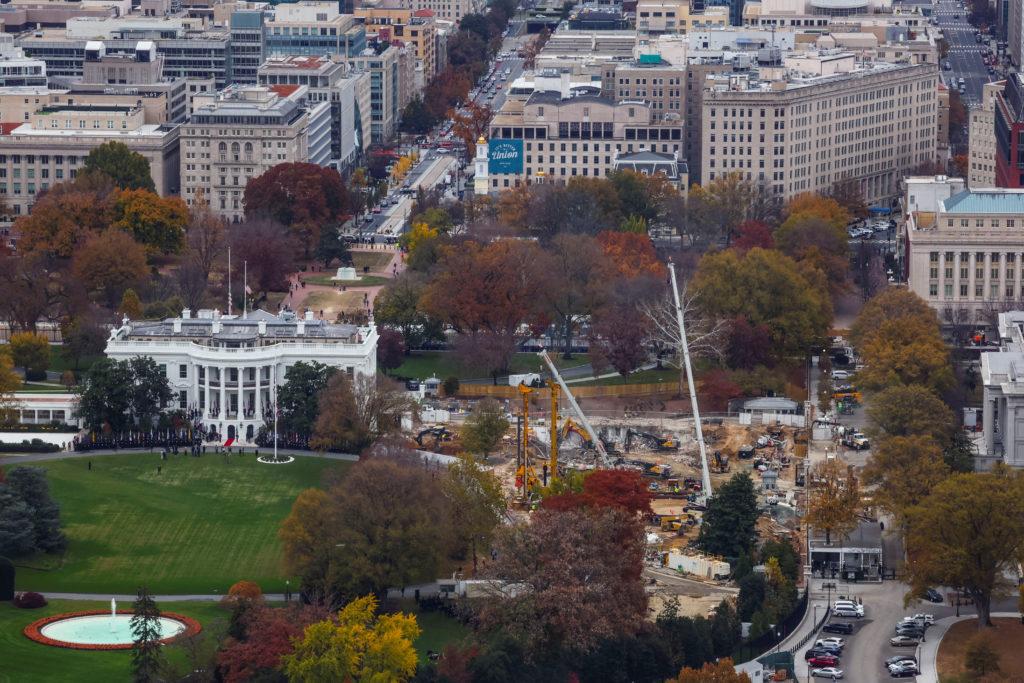
The Washington Post reports that Senate Republicans late Monday proposed $1 billion for security upgrades related to the “East Wing Modernization Project,” the Trump administration’s name for its planned 90,000-square-foot project to rebuild the East Wing that Trump demolished last year.

The proposed legislative text explicitly says the money could not be used for “non-security elements” of the project, a reference to Trump’s planned ballroom, and Grassley spokeswoman Clare Slattery said in a statement, “This bill does not fund ballroom construction.”
The Washington Post also reports that White House spokesman Davis Ingle said Tuesday that the legislation, if enacted, would authorize the entire project — including the aboveground ballroom — and that “Congress has rightly recognized the need for these funds.”
The Hill similarly reports that the bill’s text does not specifically say the $1 billion will go to the ballroom, but it would go toward “the purposes of security adjustments and upgrades,” including “within the perimeter fence of the White House compound” to support enhancements by the United States Secret Service relating to the East Wing Modernization Project.T
NBC News adds that the $1 billion is earmarked for “security adjustments and upgrades” and includes “including within the perimeter fence of the White House Compound to support enhancements by the United States Secret Service relating to the East Wing Modernization Project, including above-ground and below-ground security features.”
Multiple outlets also tie the proposal to the April 25 White House Correspondents’ Association dinner incident, when a man was charged with trying to assassinate Trump at the Washington Hilton with guns and knives, according to the Santa Fe New Mexican and PBS.
Ballroom, Security, and Courts
The security funding proposal is being advanced through a budget reconciliation strategy, and the legal and procedural context is central to how different sides frame what Congress is doing.
The Washington Post says the legislation would be included in the Senate’s planned budget reconciliation bill, which “can be enacted with a simple majority,” bypassing any potential filibuster, and that “the Senate parliamentarian will review the White House security proposal to ensure it complies with rules limiting what can be included in reconciliation bills.”

It also reports that only provisions related to spending or generating revenue can be included, and that the larger proposed reconciliation bill includes $38.2 billion for Immigration and Customs Enforcement, $26 billion for Customs and Border Protection, $1.5 billion for the Department of Justice, and $5 billion for other border security, immigration and law enforcement efforts.
The Washington Post further reports that the money could be used through the end of September 2029, ensuring agencies are funded through the end of Trump’s term.
Politico adds that the proposal is part of a nearly $72 billion package and that the $1 billion would be directed to the Secret Service for “security adjustments and upgrades,” including at the White House, while noting it is “on track to be enacted by the end of the month.”P
PBS reports that “The National Trust for Historic Preservation has sued to block construction of the project,” and that “a federal appeals court said last month that it can continue in the meantime.”
The White House argues that the security rationale justifies the broader project, with Ingle telling The Hill that the legislative branch “has rightly recognized the needs for these funds,” and with the White House saying the proposal would provide the U.S. TSecret Service resources to “fully and completely harden the White House complex.”
Competing Voices
The debate over the $1 billion security measure has produced sharply contrasting statements from White House officials, Senate Republicans, and Democrats, with the assassination attempt at the White House Correspondents’ Association dinner repeatedly invoked as justification.
““has rightly recognized the needs for these funds.””
White House spokesperson Davis Ingle praised the inclusion of the funds, telling The Hill that the legislative branch “has rightly recognized the needs for these funds,” and saying in a statement, “The White House applauds Congress’s latest proposal in its reconciliation package which includes additional funding for security infrastructure upgrades in relation to the long overdue East Wing Modernization Project.”
Ingle also tied the proposal directly to the recent attempt on Trump, saying, “Due in part to the recent assassination attempt on President Trump at the White House Correspondents’ Dinner, the proposal would provide the United States Secret Service with the resources they need to fully and completely harden the White House complex.”
Senate Judiciary Committee Chair Chuck Grassley, R-Iowa, insisted the funds are for security upgrades only, and Clare Slattery said, “It provides funds for Secret Service enhancements that will ensure all presidents, their families and their staffs are adequately protected.”
Democrats attacked the proposal as a workaround for ballroom construction, with Senate Minority Leader Chuck Schumer writing, “Republicans are on a different planet than American families,” and adding, “Republicans looked at families drowning in bills and decided what they really needed was more raids and a Trump ballroom.”
NBC News quotes Sen. Richard Blumenthal saying, “This has been a bait and switch: promising it would be privately funded and now, apparently, taxpayers will be on the hook for it,” while Sen. Chris Coons said, “This is tragically another example of President Trump promising one thing and doing another.”
Republicans and some supporters framed the security argument around the April 25 breach, with Sen. Lindsey Graham telling NBC News, “It would be insane” to hold the dinner at a hotel again, and with Sen. Kevin Cramer defending the project by saying, “I’m fine with it.”
How Outlets Frame It
Different outlets describe the same $1 billion security provision with varying emphasis, particularly around whether it is a direct ballroom subsidy or a narrowly defined security upgrade.
The Washington Post foregrounds the internal disagreement, writing that “lawmakers and White House officials disagreeing over whether the legislation would cover” the ballroom, and it highlights the explicit prohibition that the money could not be used for “non-security elements,” while also reporting that White House officials said Tuesday that the legislation would authorize the entire project — including the aboveground ballroom.

Politico, by contrast, stresses the legislative mechanics and litigation context, describing the proposal as “security funding included in $72B GOP enforcement bill” and noting that it is “on track to be enacted by the end of the month,” while also quoting Georgetown law professor David Super warning that “funding only security improvements could hurt the Trump administration’s arguments in court.”P
NBC News emphasizes the contrast between Trump’s earlier claims and the new security-linked funding, quoting Trump’s Oval Office statement from last November: “And by the way, no government funds,” and “Not one penny is being used from the federal government.”
The Hill focuses on the bill’s text language, reporting that the $1 billion “makes up part of a $72 billion budget reconciliation bill” and that the bill’s text does not specifically say the $1 billion will go to the ballroom, but it will go toward security purposes “including within the perimeter fence of the White House compound.”T
PBS uses a more procedural framing, describing how Republicans are using reconciliation to push ICE and Border Patrol dollars while adding the Secret Service security money, and it states that “It is unclear exactly how the $1 billion would be used,” while also noting that the amount “far exceeds the proposed $400 million for construction of the ballroom.”
International Business Times UK centers the taxpayer row and cites a $1 billion (£752 million) security figure attached to an immigration package, describing it as “at the centre of a taxpayer row” and emphasizing that the money is earmarked for the Secret Service for “security adjustments and upgrades.”
What Comes Next
The proposal’s next steps and potential consequences are framed differently across outlets, but the reporting converges on the idea that the $1 billion security measure is part of a fast-moving reconciliation effort and that it will face political and legal scrutiny.
“the Senate parliamentarian will review the White House security proposal”
The Washington Post reports that the legislation would be included in the Senate’s planned budget reconciliation bill and that before it advances, “the Senate parliamentarian will review the White House security proposal to ensure it complies with rules limiting what can be included in reconciliation bills.”
It also reports that the larger reconciliation package can be enacted with a simple majority, bypassing any potential filibuster, and that the money could be used through the end of September 2029.
Politico says Republicans are aiming to clear the party-line package for Trump’s signature by month’s end, and it notes that Democrats “quickly seized on the Secret Service provision and hinted they will force a vote on the Senate floor later this month when Republicans try to pass the overall package.”P
PBS reports that the House has not released its bill yet, but that the Senate is expected to start voting on its version next week, and it states that “the Senate is expected to start voting on its version of the legislation next week.”
NBC News adds that Senate Democrats hope to derail the $1 billion proposal and plan to force a vote to strip the provision out of the bill when it comes to the Senate floor later this month.
As the reconciliation process advances, the dispute over what counts as “security” versus “non-security elements” remains unresolved in the reporting, with People noting that neither Grassley’s staff nor the White House offered clarifications on what defines a “security feature” vs. a “non-security” feature of the ballroom.