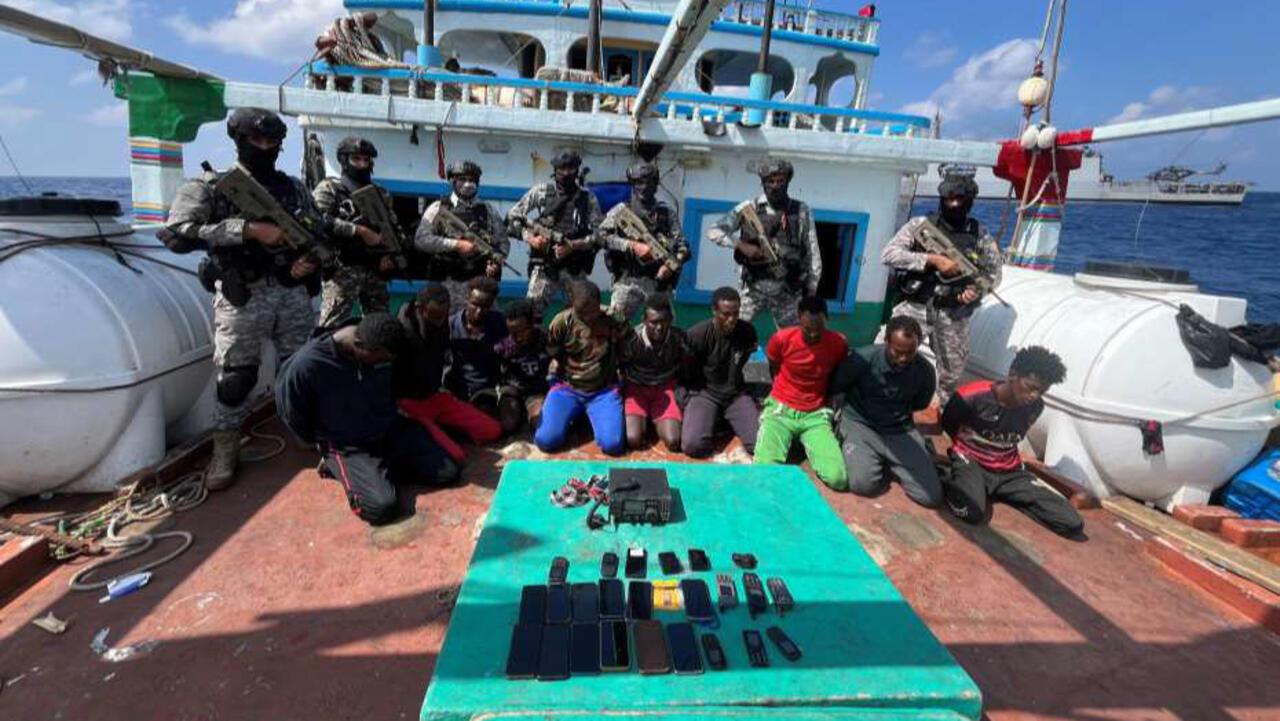
Somali Pirates Hijack MV Sward Off Somalia, UKMTO Reports
Key Takeaways
- Piracy incidents off Somalia have risen amid regional Gulf crises.
- Somali pirates hijacked multiple vessels in recent days.
- International navies and coast guards conducted rescue or release operations.
Hijackings off Somalia
Armed Somali pirates have carried out a rapid succession of attacks on vessels sailing off the coast of Somalia, reviving concerns about a possible reactivation of piracy in the region.
“In recent days there have been several attacks against vessels sailing off the coast of Somalia, including four hijackings, which have raised alarms”
El País reports that last Sunday, about six nautical miles from the port city of Garacad, a group of armed individuals boarded and took control of the cargo vessel MV Sward, which was sailing under the flag of Saint Kitts and Nevis, according to the British Royal Navy center responsible for commercial security in the area (UKMTO).

El País adds that just five days earlier, another armed group hijacked the tanker Honour 25m while it was sailing off the coast of the Somali town of Durdura under the flag of Palau, also according to UKMTO.
The same El País account says a group of pirates took control of a traditional fishing vessel 10 nautical miles off the coast of Somalia on Saturday, and that on Thursday two other small fishing boats with armed individuals aboard attempted to hijack another vessel but withdrew after some warning shots, according to UKMTO.
El País further states that on Monday, a group of pirates hijacked another fishing vessel that is believed to have later been used to take the Honour 25, according to MSCIO.
In parallel, RFI frames the broader pattern as “increasing incidents off the coast of Somalia, amid a crisis in the Gulf of Aden,” describing rescues and arrests tied to pirate attacks in the Indian Ocean and Gulf of Aden.
RFI says the Indian Navy launched a rescue operation on January 29, 2024 in the Gulf of Aden off the coast of Somalia to free a fishing boat with 19 Pakistani sailors aboard and to arrest around ten pirates.
What changed in the region
The renewed pirate activity is unfolding while maritime transport is dealing with overlapping disruptions in nearby sea lanes, according to El País and RFI.
El País links the uptick to “the repercussions of the closure of the nearby Strait of Hormuz in the Persian Gulf by the United States and Iran,” and also notes that shipping has “not yet recovered from disruption in the Red Sea” caused by “the threat of attacks by Houthi rebels in Yemen.”
It adds that the closure and the Red Sea disruption have left naval resources “stretched to the limit across the region,” and that the security gaps created by those stretched resources are again being scrutinized.
El País says that in response to the incidents, the coordination center of the European Union naval mission against piracy in the area (MSCIO) recommended ships navigating its waters to maintain “a high level of vigilance,” while UKMTO urged “caution” and to report any suspicious activity.
RFI similarly places the pirate rescues in the context of Yemen’s Houthi rebels, describing that the Indian Navy said on January 29, 2024 it had rescued an Iranian fishing vessel hijacked by Somali pirates “at a time when Yemen's Houthi rebels, backed by Iran, are conducting their own attacks in the Red Sea and in the Gulf of Aden.”
RFI says that “International forces patrolling the Gulf of Aden and the Indian Ocean have moved up into the Red Sea, reducing surveillance in the southern zones, raising fears of a resurgence of piracy,” even though it also states that the number of attacks had “fallen sharply since 2011 and the establishment of international monitoring.”
El País provides a longer historical frame, saying that at the peak of activity in 2011, pirate groups were contained through “a broad deployment of international naval forces” and onboard security measures, and that the activity “ceased to be profitable.”
Rescues and arrests
Multiple reports describe naval and coast-guard operations that either freed hijacked vessels or responded to distress signals in the same wider period of heightened pirate activity.
“Piracy: increasing incidents off the coast of Somalia, amid a crisis in the Gulf of Aden The Indian Navy said on January 29, 2024, that it had rescued an Iranian fishing vessel hijacked by Somali pirates, the latest such attack in the Indian Ocean, at a time when Yemen's Houthi rebels, backed by Iran, are conducting their own attacks in the Red Sea and in the Gulf of Aden”
RFI says that on January 29, 2024, an Indian Navy vessel in the Gulf of Aden launched a rescue operation “to free a fishing boat with 19 Pakistani sailors aboard, and to arrest around ten pirates,” and it adds that on January 27 Indian forces intercepted “another hijacked fishing boat” to come to the aid of an Iranian crew taken hostage.
RFI also states that “Seychelles' special forces and coast guard also responded to a distress signal further south, off Mogadishu this time, where pirates had taken control of a Sri Lankan vessel.”
Le marin reports that special forces and the Seychelles Coast Guard regained control of a Sri Lankan-flagged vessel hijacked by armed Somali pirates in the Indian Ocean, with the archipelago’s presidency announcing the operation in a statement on Monday, January 29.
Le marin says the day before, the Sri Lankan navy had announced that a trawler named Lorenzo Putha-4, with six crew on board, had been captured by Somali pirates about 840 miles southeast of the Somali capital Mogadishu.
Le marin describes the Seychelles operation as an effort to “take full control of the ship and rescue our Sri Lankan brothers,” quoting the presidency statement as saying the Seychelles’ special forces boarded “with the greatest courage.”
In the same Le marin account, the Indian Navy is described as having freed an Iranian fishing boat raided by pirates off the coast of Somalia “with 17 crew members on board” after one of its patrol ships in the Gulf of Aden received a distress message.
Guidance and vigilance
Alongside the rescue operations, the sources describe explicit guidance for ships operating in the affected waters and highlight how coordination bodies are responding to the renewed threat.
El País says the coordination center of the European Union naval mission against piracy in the area (MSCIO) recommended ships navigating its waters to maintain “a high level of vigilance,” while UKMTO urged “caution” and to report any suspicious activity.
El País also details how UKMTO’s reporting is tied to specific incidents, including the attempted hijackings by armed individuals aboard small fishing boats on Thursday that withdrew after warning shots.
It further notes that MSCIO attributed the Saturday hijacking of a traditional fishing vessel 10 nautical miles off the coast of Somalia to a possible role in a later attack on the MV Sward.
El País also describes the pattern of hijackings as occurring “after a period of relative calm,” and says the uptick has “revived concerns about a possible reactivation of piracy in the region.”
RFI, in turn, frames the risk as tied to reduced surveillance, stating that “International forces patrolling the Gulf of Aden and the Indian Ocean have moved up into the Red Sea, reducing surveillance in the southern zones.”
RFI’s account also emphasizes that the pirate incidents are occurring while Houthi attacks are multiplying, describing that “several ships have been targeted in the Gulf of Aden” following the Gaza war-related attacks.
Risk of a broader resurgence
The sources portray the situation as a renewed but not historically comparable piracy threat, while still warning of possible expansion in the region.
“Special forces and the Seychelles Coast Guard have regained control of a Sri Lankan-flagged vessel hijacked by armed Somali pirates in the Indian Ocean, the archipelago’s presidency announced in a statement on Monday, January 29”
El País says that “All told, Somali piracy currently remains far from posing a threat comparable to that of more than a decade ago,” and it points to 2011 as the peak when pirate groups were contained through international naval deployment and onboard security.
It also states that the current uptick comes after a “mild resurgence of piracy earlier in 2024,” after Yemen’s Houthi attacks on ships navigating the strategic Red Sea disrupted traffic and “many shipping lines opted to sail around Africa.”
El País describes how experts and monitoring groups noted that it was “most likely that there were between two and four active pirate groups in the area based in the Somali federal state of Puntland.”
It also includes a warning sign from earlier in the year, saying that at least in early November of last year, an armed group boarded a Maltese-flagged merchant ship with 24 crew about 700 nautical miles from Mogadishu, and that forces of Operation Atalanta freed the vessel the following day.
RFI likewise describes the risk of resurgence in the southern zones, stating that international forces moving into the Red Sea has raised fears of a resurgence of piracy “even though their number had fallen sharply since 2011 and the establishment of international monitoring.”
Le marin adds that piracy acts have increased in recent weeks in the Indian Ocean and the Gulf of Aden, and it says a Somali pirate attack was reported in December for the first time since 2017.
More on Crime
Judge José Luis Calama Opens Probe Into Zapatero Over Tax Fraud, Smuggling Jewellery
11 sources compared

2nd U.S. Circuit Court Upholds Sam Bankman-Fried’s FTX Fraud Conviction, Rejects Appeal
13 sources compared

Vance Boelter Pleads Guilty to Murdering Melissa Hortman, Mark, and Attacking John Hoffman
22 sources compared
Mexico City World Cup Opener Turns Violent as Hooded Protesters Clash With Police Outside Azteca Stadium
12 sources compared