Europe · 01 May, 2025 · 6 min read
Spain, Portugal, and France Blackout Sparks False Cyberattack Claims, Euroverify Says
Widespread blackout hit Spain, Portugal, and parts of southern France. Online false cyberattack theories spread amid the outage.
Editorial correction / misattribution around the quoted cause.
2 of 3 outlets skipped it: ipsos Mori (the polling firm) is referred to by its former name, Ipsos Mori, in relation to UK/UK economy forecasts mentioned by The Guardian..
3outlets compared
Same story, two versions
tap a side to read it in full
Newsweek
“Spain and parts of Portugal and France on Monday were hit by a widespread power outage caused by a ‘rare atmospheric phenomenon,’ according to Redes Energéticas Nacionais (REN), Portugal's grid operator.”Read the original ↗
Euronews
“Spain's partly state-owned grid operator Red Eléctrica dismissed the possibility of a cyberattack, human error or a meteorological phenomenon.”Read the original ↗
Shows the dramatic difference in initial cause framing: one outlet cites REN's atmospheric-phenomenon explanation, while another reports the official grid operator dismissing cyberattack or meteorological explanations.
Iberian blackout and misinformation
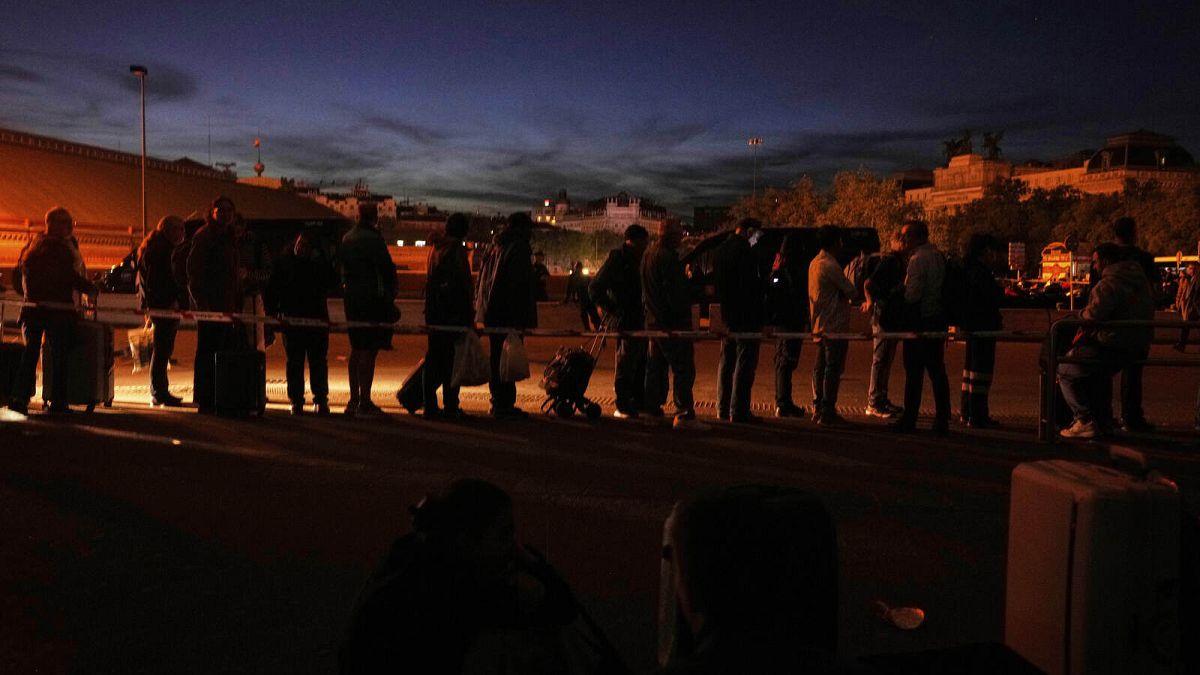
A widespread power outage hit Spain and parts of Portugal and France on Monday, leaving passengers stranded in trains and elevators, forcing businesses to shutter their doors, and disrupting public life across the Iberian Peninsula. Euronews reported that Euroverify fact-checks false claims that circulated after the outage, including narratives about cyberattacks and terrorist attacks. ESpain’s Prime Minister Pedro Sánchez said these crisis situations set "the perfect conditions for misinformation and hoaxes," urging people "not to spread information from dubious sources."
“With the lights now coming back on in the Iberian Peninsula, Euroverify fact-checks some of the false claims that circulated during Monday's unprecedented blackout.”
Euronews also said EU sources distanced themselves from speculation of a cyber attack, with European Commission vice-president Teresa Ribera telling reporters outside the European Parliament in Brussels on Monday that "there is nothing that allows us to confirm that there has been some kind of boycott or cyberattack." EIn parallel, Newsweek described the outage as caused by a "rare atmospheric phenomenon" according to Redes Energéticas Nacionais (REN), Portugal’s grid operator, and said REN told Sky News on Monday that the outage was caused by a fault in the Spanish electricity grid. NNewsweek further said the disruption impacted millions of people, with matches for the Madrid Open tennis tournament suspended, Portuguese banks and schools closed, and hospitals in Spain forced to run on generators.N
REN’s explanation and timing
Euronews said the blackout began around 12:33 pm (11:33 am Portuguese time) on Monday, and it described how false narratives spread quickly after that point. EIt reported that Euroverify identified claims that the European energy grid had suffered a cyberattack at the hands of Russia, Morocco or North Korea, and it also noted false theories suggesting a terrorist attack. Euronews then laid out the technical account that emerged from the grid operators, stating that Red Eléctrica dismissed the possibility of a cyberattack, human error or a meteorological phenomenon and signalled the likely cause as a sudden disconnection between two electricity generation plants in the south-west of the Iberian Peninsula.
Euronews also said a Portuguese government spokesperson ruled out a cyberattack, citing "an issue in the power transmission network" in Spain. EIn the same reporting stream, Newsweek said REN told Sky News on Monday that the outage was caused by a fault in the Spanish electricity grid, which REN attributed to a "rare atmospheric phenomenon" involving extreme temperature variations in Spain.N

Newsweek described REN’s mechanism as "anomalous oscillations" in extremely high-voltage lines, known as "induced atmospheric variation," which could lead to synchronization failures between systems and successive disturbances across the interconnected European network. NNewsweek added that, given the complexity, it could take as long as a week for the network to return to normal.N
Cyberattack claims and corrections
Euronews reported that a false narrative began to circulate shortly after the blackout hit, claiming that European Commission President Ursula von der Leyen had accused Russia of a "cyberattack." EIt said the Commission’s chief spokesperson Paula Pinho swiftly shot down the claims, saying that the "statement circulated in the press does not come from the president." Euronews also described how anti-system politician Alvise Pérez, elected as an MEP last year, was one of those responsible for spreading the bogus statement, and it quoted his Telegram post: "According to CNN, the president of the European Commission, Ursula von der Leyen, has said in a press conference that this is a 'direct attack on European sovereignty', signalling Russia."E
“Paula Pinho swiftly shot down the claims, saying that the ‘statement circulated in the press does not come from the president.’”
Euronews added that von der Leyen did not appear in the news conference described and that her statement released on social media does not speculate over the cause of the outage. EEuronews then addressed another correction cycle involving REN itself, saying several media outlets—including Reuters, CNN and the Guardian—reported on Monday that Portugal’s grid operator REN had said in a statement that a "rare atmospheric phenomenon," namely extreme temperature variations in Spain's interior, was to blame for the massive outage.E
It said those claims were echoed by Portuguese Prime Minister Luís Montenegro, who said on Monday that the issue "originated in Spain," but REN later said it had not released such a statement, prompting Reuters and other major outlets to rectify their reporting. Euronews quoted REN spokesman Bruno Silva telling AFP on Tuesday: "REN confirms we did not put out this statement," and it said the operator’s later explanation pointed to a sudden disconnection between two generation plants rather than the earlier “rare atmospheric phenomenon” attribution.E
Political responses and investigations
As the outage unfolded, political leaders and institutions responded both to the disruption itself and to the competing explanations circulating online. Euronews said Spain’s Interior Minister Fernando Grande-Marlaska hit back after Vox accused the Spanish government on Tuesday of hiding the causes of the power outage, with Grande-Marlaska saying the Spanish government has been "transparent" in the information it provided. EEuronews reported that on Tuesday Sánchez said his government would request an "independent investigation" to determine the causes of the outage and that he refused to rule out any hypotheses, including that of a cyberattack.E
It also said Spain’s high court, the Audiencia Nacional, is investigating whether the outage could have been caused by an "IT sabotage on Spanish critical infrastructure." In parallel, Newsweek reported that authorities in Spain requested people minimize their movements and stay off the roads, and it said police in Portugal warned against taking unnecessary journeys due to concerns about traffic and streetlights failing.N
Newsweek also described how Red Eléctrica said "all resources" are being dedicated to solving the issue, and it quoted Eduardo Prieto, director of services for system operation at Spain's Red Eléctrica, telling La Sexta that "we could be talking about six to ten hours, if everything goes well, until we reestablish supply to every last customer." NNewsweek further reported that Ursula von der Leyen wrote on X that she spoke with Pedro Sánchez and reaffirmed the EU Commission’s support in monitoring the situation and coordinating efforts through its Electricity Coordination Group.N
Restoration, cross-border impact
The outage’s effects crossed borders and prompted operational statements from multiple electricity operators, while officials and media outlets continued to clarify what had and had not been said. Euronews reported that the blackout hit Spain, Portugal and parts of southern France, and it said some false claims were amplified in the mainstream media, causing confusion and unfounded speculation as to the cause of the blackout. EIt said the disruption left passengers stranded in trains and elevators and forced businesses to shutter their doors, and it described Euroverify’s role in checking claims.
Newsweek said the disruption brought public transport to a standstill, caused significant traffic jams and delayed flights, and it listed additional impacts including suspended Madrid Open tennis tournament matches and hospitals in Spain running on generators. NFor France, Newsweek reported that a spokesperson for France’s electricity transmission operator RTE told CNN that they had experienced a "small power cut" and that electricity was "restored very quickly," adding that its main focus is now helping Spain to restore their power.N
Newsweek also said E-Redes, the national energy supplier of Portugal, shared a statement that the interruption was due to a problem in the European electricity grid, and it said Spain’s electricity grid operator Red Eléctrica said that "all resources" are being dedicated to solving the issue. NEuronews, meanwhile, said Red Eléctrica signalled the likely cause as a sudden disconnection between two electricity generation plants in the south-west of the Iberian Peninsula, and it said a Portuguese government spokesperson ruled out a cyberattack by citing "an issue in the power transmission network" in Spain.E