Europe27 June, 20263 min read
Trump Meets Egypt, UAE, and Qatar at G7 Summit in Evian Over Iran and Gaza Plan
This article is an automated aggregation of coverage from news outlets. Our editorials offer in-depth analysis curated by the NewsCord team.
Egypt, UAE, and Qatar participated in the Evian G7 summit. Regional issues, including Middle East escalation and US–Iran, dominated talks.
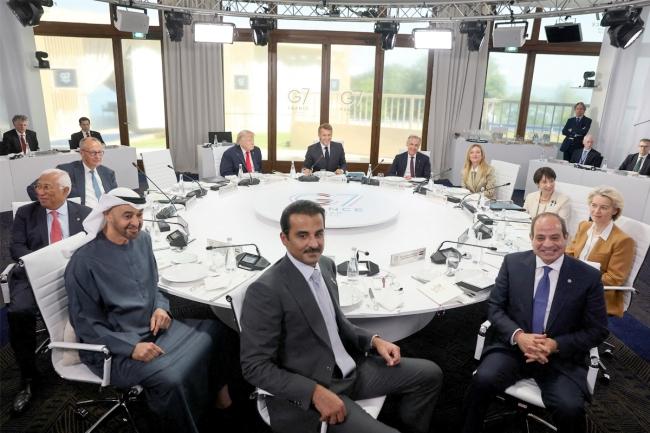
G7 in Évian
Regional issues dominated the G7 summit held in Evian, France, as U.S. President Donald Trump met with the UAE’s Sheikh Mohamed bin Zayed, Egyptian Abdel Fattah al-Sisi, and Qatar’s Emir Sheikh Tamim bin Hamad to address developments in Iran’s issue and the Gaza plan.
French President Emmanuel Macron welcomed the Arab leaders taking part in the summit before a session devoted to discussing Middle East developments, with interest focused on the future of the US–Iran deal and its implications for regional security and freedom of navigation in the Strait of Hormuz.

In the opening session, the war in Ukraine topped the agenda with President Volodymyr Zelenskiy calling for a firm response to Russia’s recent attacks and urging the G7 to increase pressure on Moscow and bolster military support for Kyiv.
Zelenskiy revealed that he proposed holding a meeting with Russian President Vladimir Putin on the sidelines of the summit, but Moscow rejected the idea, inviting him to come if he wished, while Trump said he spoke with both sides and that both are open to new efforts toward a political settlement.
To bolster Western support for Ukraine, British Prime Minister Keir Starmer said London would supply Kyiv with enriched uranium to operate its nuclear facilities and would also impose a new package of sanctions on Russia.
Europe, uranium, and accountability
In a session titled Overcoming Crises and Ensuring Stability in the Middle East, Egypt’s President Abdel Fattah el-Sisi reviewed Egypt's vision regarding developments in regional issues and stressed the need to accelerate the implementation of the US President Donald Trump's peace plan for the Gaza Strip. The Egyptian presidential spokesperson said Sisi expressed appreciation for President Trump's efforts that led to the agreement to stop the war in Gaza and more recently to an agreement to stop the war with Iran, and confirmed his readiness for Egypt to cooperate with regional and international partners to reach sustainable solutions. Labour Minister Tahmina Akhter said the government would launch an immediate investigation into the Narayanganj garment factory fire and pledged, "We will hold the owners fully accountable," while Reuters and the BBC both described the blaze as killing dozens of workers near Dhaka.
In the same Reuters account, fire service chief Mahmud Iqbal said, "We found most of the victims near the stairwells on the third and fourth floors," as the building lacked functioning fire escapes. The BBC reported that witnesses said the factory's main exit was locked when the fire broke out, and Al Jazeera said Rahman Textile owners welded shut the building's fire exits, leaving survivors describing workers pounding on locked metal doors as smoke filled the stairwells.

What Europe is watching
European fashion retailers faced fresh questions over supply chain oversight after the Narayanganj fire at Rahman Textile killed at least 33 garment workers, with the Guardian naming the German retailer Hessen and the Dutch chain BrandBox as suppliers according to shipping records reviewed by the outlet.
The Guardian reported that both companies said they were "deeply saddened" by the deaths and would review their Bangladesh operations, while Clean Clothes Campaign spokesperson Ineke Zeldenrust said the audit system was "fundamentally broken" because "audits consistently miss the most dangerous conditions because they are announced in advance".
In Kuwait’s Arabic-language account of the G7, Trump sent messages to Israel regarding Lebanon and urged Israeli Prime Minister Benjamin Netanyahu to be more responsible toward Lebanon, while also saying he suggested Israel let Syria take charge of dealing with Hezbollah.
That same account said Trump praised his Syrian counterpart, Ahmad al-Sharaa, as having succeeded in unifying Syria and possessing the ability to deal with Hezbollah, and it added that Syria could take on a larger role if Israel failed to do so without widening the circle of human losses.
As the G7 discussions continued, the Egyptian economist Dr. Mohammed Hamza Al-Husseini said Europe distanced itself from the US–Iran conflict as a "very wise move," and he argued that Europe diverged from the compass of its American ally by declaring that the US–Israeli–Iranian war is none of their business.