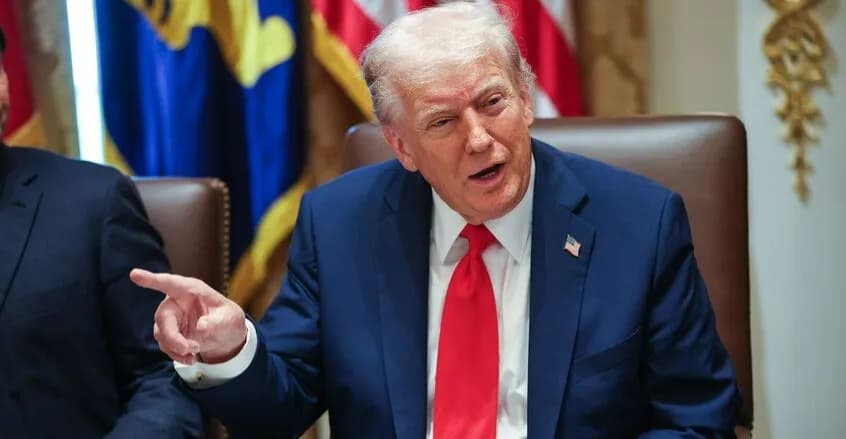
Trump Mulls Winding Down Iran War as Marines Head to the Middle East.
Key Takeaways
- Trump mulls winding down Iran war.
- Thousands more Marines head to the Middle East.
- Strait of Hormuz remains closed; policing duties to be taken by others.
Trump's Mixed Signals
President Trump has sent conflicting signals about the future of the US-Israeli war against Iran.
“Also read 01:10 01:00 01:10 01:00 01:02 01:02 01:09 01:09 01:17 01:17 03:38 03:38 02:40 02:40 01:09 01:09 01:01 01:01 01:16 01:16 01:34 01:34 20 Minutes with AFP Published March 20, 2026 at 5:55 PM • Updated March 20, 2026 at 5:55 PM Donald Trump is not happy at all, and he makes that known”
Trump posted on Truth Social that 'we are getting very close to meeting our objectives as we consider winding down our great Military efforts in the Middle East with respect to the Terrorist Regime of Iran.'
He listed goals including degrading Iran's missile capabilities, destroying its defense industrial base, and eliminating its navy and air force.
However, NPR confirmed that another group of U.S. Marines is headed to the Persian Gulf.
The USS Boxer group of three ships carries thousands of Marines from the 11th Marine Expeditionary Unit departing California.
This comes in addition to the USS Tripoli group with more than 2,000 Marines expected to arrive soon from Japan.
Trump previously claimed that 'we don't need any help' from allies.
The Pentagon has requested an additional $200 billion to fund the war effort.
NATO Allies Conflict
Trump has launched furious attacks on NATO allies, branding them 'cowards' for refusing to join military efforts to reopen the Strait of Hormuz.
He declared that 'without the U.S.A., NATO IS A PAPER TIGER!'

European leaders including France's Emmanuel Macron, Germany's Friedrich Merz, and Britain's Keir Starmer resisted sending warships to the Gulf.
Macron stated 'we are not party to the conflict and therefore France will never take part in operations to open or liberate the Strait of Hormuz in the current context.'
Six major international powers including Britain, France, Germany, Italy, Japan and Canada issued a joint statement saying they were ready to 'contribute to appropriate efforts' to secure the Strait of Hormuz.
However, they specified that any intervention could only take place once hostilities cease.
Trump complained that allies 'complain about the high oil prices they are forced to pay, but don't want to help open the Strait of Hormuz.'
Iran's Response
Iran has effectively closed the Strait of Hormuz, the critical waterway through which 20% of global energy supplies normally pass.
“On September 9, 2025, Israel struck a residential area of Qatar’s capital, Doha, targeting senior leaders of Hamas including negotiators for a ceasefire in Israel’s genocidal war in Gaza”
The International Energy Agency chief called this 'the most severe energy crisis in history'.
Iranian Supreme Leader Mojtaba Khamenei marked Nowruz, the Persian New Year, with a message claiming enemies were being defeated.
He stated that 'your vigilance and sacrifices delivered a 'crippling blow' to 'the enemy,' which had thought Iranians 'would overthrow the Islamic system' after a day or two.'
Iran has continued striking Gulf countries, with Kuwait reporting Iranian drones hit the Mina Al-Ahmadi oil refinery again overnight.
These attacks sparked fires at several operational units.
UAE authorities said their air defenses responded to missile and drone threats with explosions echoing across Dubai.
Israel continued attacking the Iranian capital of Tehran, with reports of an Iranian missile hitting near the Old City of Jerusalem.
Global Economic Impact
The war has triggered a sharp rise in global energy prices.
Brent crude oil settled at $112.19 per barrel on Friday, its highest level since the start of the conflict.

Goldman Sachs suggested that higher prices could last through 2027.
The United States has temporarily lifted sanctions on 140 million barrels of Iranian oil in an attempt to ease the market.
Treasury Secretary Scott Bessent also indicated plans to do the same with Iranian oil tankers at sea.
Former Indian foreign secretary Kanwal Sibal said Trump had effectively admitted to unprovoked aggression.
He compared the situation to Japan's 1941 Pearl Harbor attack.
Over 350 Iranians settled in Pandaveswar for generations are now watching their ancestral homeland burn.
Spanish prime minister Pedro Sánchez announced a temporary freeze on rents nationwide in response to the war.
Military Developments
Military developments continue to unfold despite Trump's mixed signals.
“President Donald Trump, on Friday, launched a sharp attack on NATO leaders, describing them as "cowards" and insisting that the United States "will not forget" their positions”
The Pentagon is deploying a second three-ship expeditionary unit with about 2,500 Marines aboard to the Middle East.

This follows the first similar dispatch reported sailing to the region.
NATO has pulled its advisory mission out of Iraq and relocated personnel to Europe.
The last personnel left Iraq on Friday, ending a non-combat mission launched in 2018.
Ukraine has sent military units to multiple Middle Eastern countries to help intercept drones.
Ukrainian defense secretary Rustem Umerov confirmed 'interception units have been deployed to protect civilian and critical infrastructure'.
These units are deployed in countries including the UAE, Saudi Arabia, Qatar, Kuwait and Jordan.
Iran's Islamic Revolutionary Guard Corps reported their spokesman Ali Mohammad Naini was killed in US and Israeli strikes.
Israel's military confirmed killing the head of intelligence for Iran's Basij paramilitary, Esmail Ahmadi.
More on Iran

Italy's Prime Minister Meloni Rules Out Military Mission in Strait of Hormuz, EU Favors Diplomacy.
10 sources compared

Trump Administration to Seize Iran's Kharg Island to Reopen Strait of Hormuz
16 sources compared

Iran Attacks Kuwaiti Oil Refinery as Tehran Steps Up Gulf Attacks
21 sources compared
Switzerland Halts Arms Exports to US Over Attacks on Iran, Citing Neutrality
16 sources compared