South America08 March, 20262 min read
Trump Offers U.S. Missile Strikes to Latin Leaders to Target Drug Cartels
This article is an automated aggregation of coverage from news outlets. Our editorials offer in-depth analysis curated by the NewsCord team.
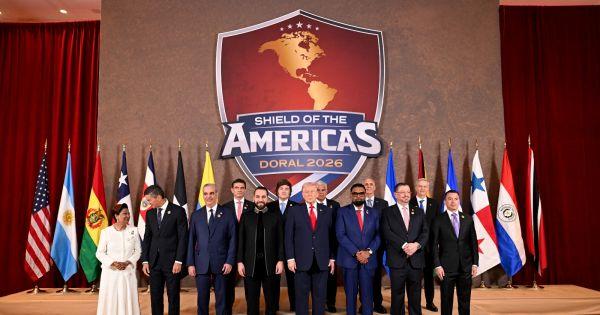
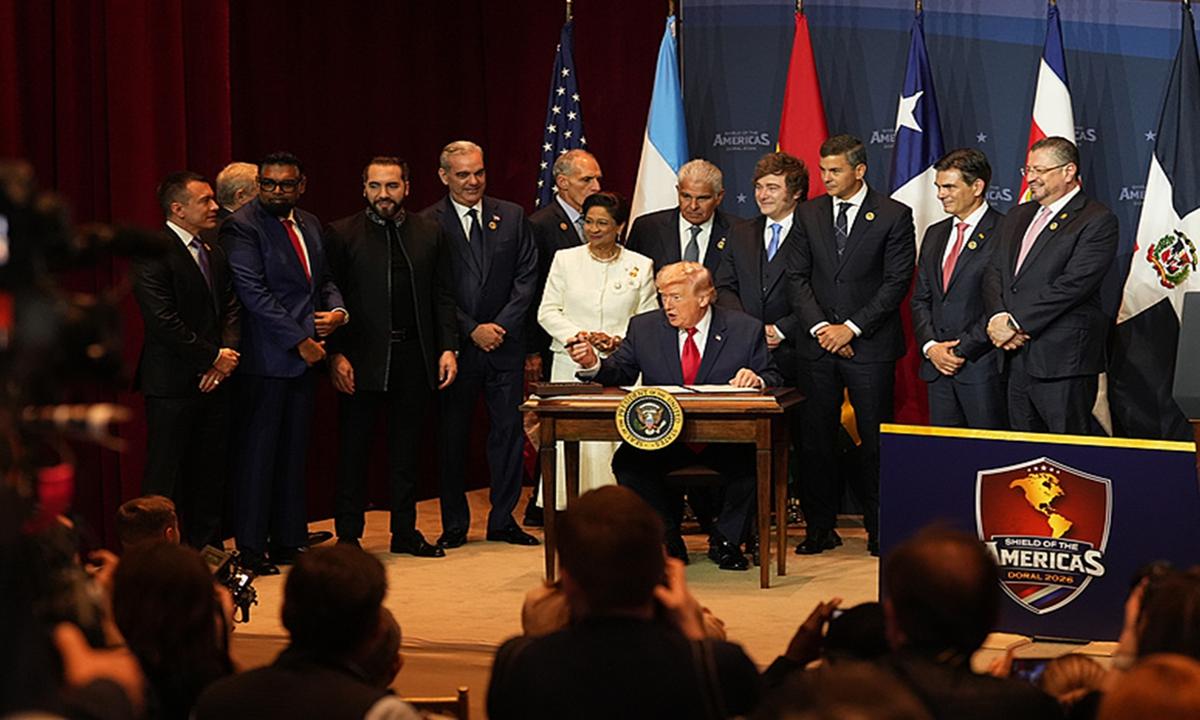
President Donald Trump hosted a summit in Doral, Florida with Latin American and Caribbean leaders. Trump announced a coalition of Latin American and Caribbean countries against drug cartels.
America's Counter Cartel Coalition
At a South Florida summit billed as 'Shield of the Americas' on March 7, 2026, President Donald J. Trump announced a new U.S.-led initiative to directly target drug cartels.
“US President Donald Trump on March 7, 2026 hosted a ‘Shield of the Americas’ summit in South Florida with leaders from a dozen Latin American and Caribbean countries to push a harder, even military, approach against drug cartels.”
He presented it as an 'action coalition' that could include kinetic military measures.
Coverage named the initiative as America's Counter Cartel Coalition.
Trump framed the effort as intended to 'eradicate the criminal cartels plaguing our region'.
He explicitly suggested partners could use combined capabilities and even lethal force to dismantle networks.
Reporting said a proclamation tied to the summit was characterized by other outlets as committing the U.S. to use lethal military force against cartels and 'terrorist networks'.
Coalition strikes against cartels
Trump publicly offered U.S. missile strikes and urged allied governments to share intelligence and 'precise locations of cartel operatives,' framing the coalition as an operational partnership that could include deployment of partner militaries. The President described cartels in stark terms and pressed for coordinated action, explicitly saying some countries might deploy their militaries in coordination with the U.S. Coverage of the summit emphasizes the operational focus — not merely diplomatic cooperation — with a call for partners to provide locations and intelligence to enable direct strikes or military operations.
Coalition attendance discrepancies
There is some inconsistency in reporting over how many countries are formally involved. One account cited by the President described the coalition as including representatives from 17 nations, while summit reporting listed a roughly dozen attendees from Latin America and the Caribbean and explicitly named several governments that were present. Notably, some major regional powers — Brazil, Mexico and Colombia — were reported as not attending, underscoring regional divisions over Washington’s proposed military approach to cartel violence.
“At a Western Hemisphere leaders summit, President Donald J. Trump announced the launch of ‘America's Counter Cartel Coalition,’ a U.S.-led partnership he said includes representatives from 17 nations and is intended to ‘eradicate the criminal cartels plaguing our region.’”
Coverage of U.S. regional actions
The summit followed and was reported alongside controversial U.S. actions that critics say signal coercive regional policy. Coverage linked the meeting to an alleged earlier U.S. order to seize Venezuela’s Nicolás Maduro and to reported U.S. intelligence cooperation in the Jalisco raid that arrested cartel leader Nemesio Oseguera Cervantes. Analysts quoted in the coverage described the moves as coercive and potentially reflective of broader strategic aims by Washington in the region.
Unclear operational and legal details
Key operational and legal details remain unclear in the available coverage. Reporting shows a public pledge and proclamation but provides limited specifics on rules of engagement, legal authorization for cross-border strikes, or which partner governments have agreed to let U.S. forces (or their militaries) conduct kinetic strikes on their territory.
“He also asserted recent enforcement has cut maritime smuggling and fentanyl flows, claiming ‘drugs coming in through water is down 96 percent’ and fentanyl across the border is down 67 percent.”
Observers and regional governments were divided — some attended and endorsed a harder line, while others stayed away. Analysts raised concerns about coercion, sovereignty and the practical implications of a U.S.-led military campaign against transnational criminal groups.