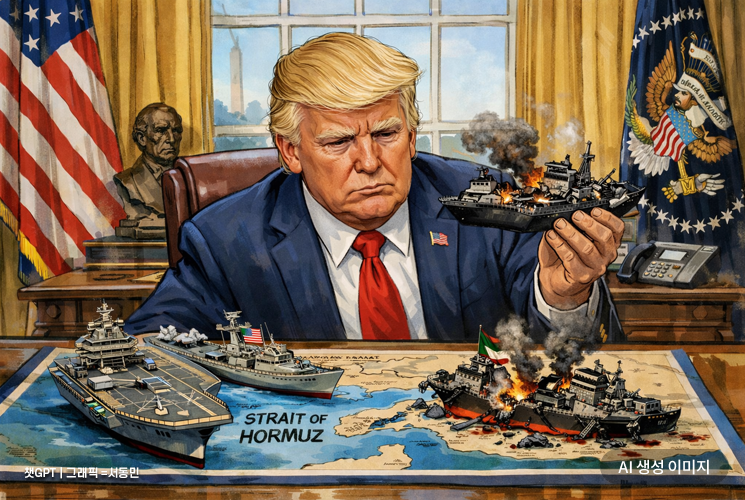
Trump says U.S. obliterated Iran's Kharg Island military targets.
Key Takeaways
- US strikes targeted military assets on Kharg Island, Iran's main oil-export hub
- Trump says Kharg Island's military targets were obliterated; oil infrastructure spared for now
- Iran warned of retaliation and potential strikes on oil infrastructure if Hormuz shipping disrupted
U.S. Strike Announcement
President Donald Trump announced on Friday that the United States had conducted a major bombing raid on Iran's strategically vital Kharg Island.
“He was also more measured about the prospect of opponents toppling the Islamic government”
Trump claimed U.S. forces had 'totally obliterated every military target' on the island in what he described as 'one of the most powerful bombing raids in the history of the Middle East.'

In a Truth Social post, Trump detailed that U.S. Central Command executed the operation under his direct orders, specifically targeting military facilities while deliberately sparing the island's oil infrastructure.
'For reasons of decency, I have chosen NOT to wipe out the Oil Infrastructure on the Island,' Trump stated, though he immediately warned that this decision could be reversed should Iran interfere with shipping through the Strait of Hormuz.
The announcement came as U.S. defense officials confirmed the strikes had destroyed naval mine storage facilities, missile storage bunkers, and multiple other military sites.
CENTCOM reported that over 90 Iranian military targets were successfully struck while preserving the oil infrastructure.
Strategic Importance
Kharg Island holds immense strategic and economic significance as Iran's primary oil export hub, responsible for approximately 90% of the country's crude oil exports and handling roughly 7 million barrels per day.
Located about 25-30 kilometers off Iran's southwestern coast in the Persian Gulf, the island serves as the backbone of Iran's oil export network and is often described as the 'beating heart of Iran's oil industry.'

The strike represents a significant escalation in the ongoing conflict between the U.S. and Iran, particularly given the island's critical role in Iran's economy and its potential impact on global energy markets.
Analysts have warned that any direct attack on the island's oil infrastructure would immediately halt the bulk of Iran's crude exports, likely triggering severe retaliation and intensifying global energy shocks.
Despite its modest size of about 20 square kilometers, the island's strategic importance has made it a potential flashpoint in regional conflicts, having been previously attacked during the Iran-Iraq war in the 1980s.
Iranian Response
Iranian officials and media responded to the U.S. strikes with defiant rhetoric, with the Islamic Revolutionary Guard Corps warning that U.S. 'hideouts' in the United Arab Emirates were now 'legitimate targets' for retaliation.
Iranian state media reported that despite the intensity of the blasts, none of Kharg Island's oil infrastructure was damaged, with authorities maintaining that oil exports continue 'fully under way' and activities 'continue without interruption.'
Iran's parliament speaker, Mohammad Bagher Qalibaf, had previously warned that attacks on the islands on Iran's southern maritime frontier would cause Iran to 'abandon all restraint,' underscoring how central they are to the country's economy and security.
The IRGC issued a statement declaring that 'the Islamic Republic of Iran considers it its legitimate right, in defence of its national sovereignty and territory, to strike the source of American enemy missile launches at the ports, docks, and hideouts of US military personnel in some of the cities of the Emirates.'
Meanwhile, Iran's new Supreme Leader Mojtaba Khamenei vowed to continue attacks and keep the Strait of Hormuz closed in his first public statement since succeeding his father who was killed in the opening day of the war.
Military Escalation
The U.S. military has significantly escalated its presence in the Middle East in response to the intensifying conflict, with an American official confirming that 2,500 more Marines and an amphibious assault ship are being sent to the region.
The deployment includes elements of the 31st Marine Expeditionary Unit and the USS Tripoli, capable of conducting amphibious landings and specializing in bolstering security at embassies, evacuating civilians, and disaster relief.

While the deployment does not necessarily indicate that a ground operation is imminent, it represents a major increase in American military readiness in the region.
Trump had earlier warned Iran's military forces that they 'would be wise to lay down their arms and save what's left of their country, which isn't much,' and claimed that Iran 'had plans of taking over the entire Middle East, and completely obliterating Israel' but that 'those plans are now dead.'
The U.S. also announced plans to soon begin escorting oil tankers through the Strait of Hormuz, with Trump telling reporters 'It will happen soon' when asked about the timing.
Economic Impact
The strike on Kharg Island has had significant economic implications, with global oil prices spiking and creating the largest supply disruption in the history of the global oil market according to the International Energy Agency.
“The island hosts key energy facilities linked to Iran’s oil export system, including storage tanks, loading terminals and pipelines”
The Paris-based agency reported that global supplies have plunged by 8 million barrels a day to 98.8 million barrels a day, with benchmark oil prices punching back above $100 a barrel for the first time since 2022.

This has translated to rising costs at the pump, with the national average for regular gasoline rising to about $3.63 a gallon and diesel prices jumping to $4.89 a gallon.
Despite the U.S. announcement that it would release 172 million barrels from the Strategic Petroleum Reserve as part of a coordinated IEA release of 400 million barrels, analysts warn this can only partially offset a prolonged Hormuz shutdown.
Meanwhile, Iran has made exceptions for some Indian vessels to sail through the Strait of Hormuz, with Tehran's ambassador to India signaling that Indian vessels may soon be granted safe passage despite rising tensions affecting shipping routes in the region.
More on Iran

Iran Threatens UAE Ports, Urges Evacuation as US Strikes Kharg Island
86 sources compared
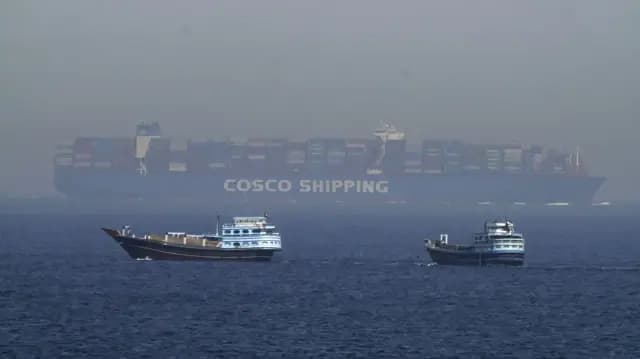
Iran Considers Allowing Limited Oil Tanker Passage Through Strait of Hormuz if Traded in Yuan
10 sources compared

US Strikes Iran's Kharg Island Military Sites
14 sources compared

Unknown attackers fire missiles at U.S. Embassy in Baghdad
43 sources compared