Ukraine War27 April, 20268 min read
Ukraine Strikes Russian Oil Infrastructure in Orsk and Perm, Over 1,500 Kilometers Away
Ukraine strikes oil facilities in Orsk and Perm, deep inside Russia. Perm strike conducted by Ukrainian drones.

Deep strikes in Russia
Ukrainian long-range drones struck Russian oil infrastructure in Orsk and Perm, more than 1,500 km from the Ukrainian border, as Ukraine’s campaign against Russia’s energy sector continued to expand beyond the front line.
In Orsk, the Ukrainian monitoring channel Exilenova+ said drones likely targeted a local oil refinery, and later OSINT analysts from the Russian outlet Astra confirmed that “one of Russia’s largest refineries, Orsknefteorgsintez, was hit.”

The Kyiv Post reported that Orsk is located “approximately 1,500 kilometers (930 miles) from the Ukrainian border,” and that Orsk mayor Artem Vorobyov urged residents to “stay indoors.”
The Orenburg region governor Yevgeny Solntsev said several industrial sites were targeted but did not specify which, adding that “no casualties were reported and that four drones were “shot down.”
Flight restrictions were imposed at Orsk airport, while in Perm local authorities confirmed an attack on one industrial site where “a fire broke out.”
Kyiv Post reported that social media reports suggested a facility belonging to Transneft was on fire, and that Perm region governor Dmitry Makhonin said, “Workers have been evacuated. There are no injuries. A fire broke out at the facility,” as the drone struck an industrial site in the Perm municipal district.
Ukrainian and Russian accounts also tied the Perm fire to a specific node in the pipeline system, with Exilenova+ saying the fire may be at the Perm Linear Production Dispatch Station (LPDS) in the Malinovskaya area, described as “a key node in the Transneft pipeline system responsible for pumping, storing, and distributing oil through trunk pipelines.”
Zelensky frames “fair responses”
Ukrainian leadership presented the Orsk and Perm strikes as part of a broader strategy to reduce Russia’s ability to sustain the war, while also tying the timing to a new phase of long-range sanctions.
The Kyiv Post said Ukrainian President Volodymyr Zelensky published footage of the aftermath of the strike in Perm, “effectively confirming Ukraine’s involvement,” and reported that Zelensky received a report from the acting Head of Ukraine’s Security Service (SBU) Major General Yevhen Khmara on “Ukrainian long-range sanctions.”
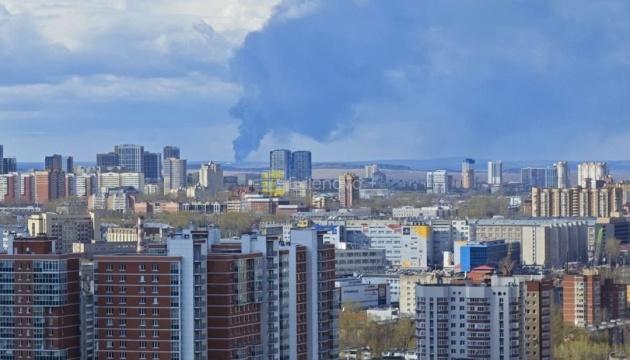
Zelensky wrote that he was “grateful to the SBU for their accuracy,” adding, “The distance is over 1,500 km in a straight line,” and he declared, “We will expand these ranges. These are fair Ukrainian responses to Russian terror,” while saying the strikes reduce Russia’s “military production, logistics, and oil export capacity.”
The SBU later confirmed the destruction of the oil pumping station, stating that “specialists from the SBU’s Alpha Special Operations Center struck the Perm linear production and dispatching station, located more than 1,500 km from the Ukrainian border,” and that “a large-scale fire broke out at the facility following the drone strike.”
In parallel, Radio Free Europe/Radio Liberty described the April 30 attack as coming “hours after US President Donald Trump and his Russian counterpart, Vladimir Putin, spoke by phone to discuss a potential cease-fire,” and quoted the Security Service of Ukraine’s Telegram message: “The enemy must understand a simple fact: it no longer has a 'safe rear'.”
Zelensky also told RFE/RL that “We will continue to extend these ranges, and these are entirely justified Ukrainian responses to Russian terror,” and in the same reporting he framed the strikes as responses to Russian actions.
The Kyiv Post further reported that Khmara said, “Strikes on oil logistics create resource shortages for the Russian military-industrial complex, disrupt fuel supply chains for the army, and force the enemy to spend significant resources on restoring and protecting infrastructure.”
Cease-fire talks and continued attacks
The Orsk and Perm strikes unfolded alongside diplomatic signals about a temporary cease-fire, while Ukrainian and Russian officials continued to trade accusations over who was escalating. The Irish Times reported that Ukrainian President Volodymyr Zelenskiy was seeking details of a short-term ceasefire Russia proposed to US President Donald Trump, saying Putin proposed it to coincide with “victory day” in Russia in a phone call with Trump, according to the Kremlin. Zelenskiy said, “We have instructed our representatives to contact the United States president’s team and clarify the details of the Russian proposal for a short-term ceasefire,” and Kremlin spokesman Dmitry Peskov said, “For now, no concrete decision has been made,” adding that it would be for Putin to decide on the specific terms.
In the same reporting, Zelenskiy said Ukraine was proposing a longer-term ceasefire, writing, “We will find out exactly what is being discussed, whether it’s a few hours of security for a parade in Moscow or something more.” Radio Free Europe/Radio Liberty described the phone call as a 90-minute conversation in which Trump told reporters at the White House on April 29 that a cease-fire next month to mark the anniversary of the end of World War II in Europe was broached, and Trump said he suggested “a little bit” of a cease-fire “and I think he [Putin] might do that.”
RFE/RL also quoted Yury Ushakov saying Putin was prepared to have a cease-fire “through or around May 9,” and it noted that Zelensky reacted by instructing his team to contact the US administration to clarify Russia’s proposed temporary cease-fire, writing, “We will clarify what exactly this is about -- a few hours of security for a parade in Moscow, or something more.” While the cease-fire discussions were underway, RFE/RL reported that Russian and Ukrainian Telegram channels described explosions overnight near an oil pipeline facility in Perm, and that Ukraine’s Security Service claimed responsibility for targeting a major oil refinery in the city.
Oil strikes, sanctions, and markets
Beyond Orsk and Perm, multiple reports described how Ukraine’s drone campaign against Russian energy infrastructure is being pursued while Russia benefits from higher crude prices and certain sanctions relief, creating a contested economic backdrop for the war.
CNN en Español said the Ukrainian Army “intensificó los ataques contra la infraestructura energética de Rusia,” while “Moscú se beneficia de los precios más altos del petróleo crudo y de cierto alivio de las sanciones,” and it described a campaign that began “el verano pasado” to target “una de las mayores fuentes de ingresos de Rusia.”
CNN en Español reported that the Ukrainian Army claimed “10 ataques importantes este mes” against Russian energy infrastructure, including attacks “en lo profundo de Rusia,” and it said the “alcance del impacto no está claro,” while Russia floated the possibility of prohibiting gasoline exports.
In the same CNN report, Zelensky told CNN during a call with journalists that the long-range drones had become more effective, and it said the latest attack claimed by Ukraine’s Army was early Saturday against a large Russian oil refinery in Yaroslavl, northeast of Moscow, where “hubo un impacto directo en la refinería, seguido de un incendio.”
CNN en Español also described the Russian export terminal Ust-Luga being attacked twice in the last week, with the Security Service of Ukraine saying the drones “dañaron las estructuras de carga de petróleo y un parque de tanques que contenía petróleo y productos petrolíferos,” and it quoted Zelensky saying, “Respondimos al ataque contra nuestra infraestructura energética. Respondimos con un golpe poderoso, reduciendo las capacidades de Ust-Luga.”
Zelensky added, “En esa instalación quedó el 40 % de sus capacidades” after the drone attacks, according to CNN en Español.
Meanwhile, CBC described the broader pattern around Tuapse, stating that “the refinery, which belongs to the Russian oil giant Rosneft, has been hit three times in the past two weeks,” and it quoted Timothy Ash saying, “It's like the Ukrainians have figured out we've got economic leverage, too ... this can be a game changer for us.”
Environmental fallout and next steps
As Ukraine’s strikes hit Russian refineries and export infrastructure, reporting also highlighted environmental consequences and the scale of cleanup efforts, while other outlets described how the attacks fit into a wider operational tempo.
Al Jazeera reported that cleanup volunteer Sergei Solovev arrived in Tuapse and described an “unpleasant odour” and everything “coated in a layer of black grime,” telling the outlet, “I saw train carriages covered in residue from the black rain and animals. It’s all very toxic,” and “And the smell was oily.”

The outlet said Tuapse had been hit by “a series of three Ukrainian drone strikes targeting its refinery,” with the first strike on April 16 causing a fire that lasted two days, and a second strike on April 20 leaving a fire that lasted for five days, while smoke released poisonous chemicals and analysis found concentrations of benzene, xylene, and soot were “three times above safe levels.”
Al Jazeera quoted residents and volunteers describing the “black rain,” including Elena Lugovenko saying, “The rain covered all the cars and animals,” and it said volunteers set up animal cleanup centres and collected distressed animals including cats, dogs and birds.
By the end of the April 20 attack, Al Jazeera reported that “at least eight storage tanks at the refinery lay destroyed,” and that authorities dispatched “more than a dozen boats” to clean up the slick at sea, while booms were installed on beaches.
The report also included a warning from Ruslan Khvostov, chairman of the Green Alternative party, who said long-term consequences “could be serious and last for years,” adding, “Oil products settle in the bottom sediments of the Black Sea, disrupting the food chain, and everyone will suffer,” and that biodiversity restoration “will take five to 10 years or longer.”
France 24 similarly described Tuapse residents wearing masks due to air pollution, reporting that “About 60,000 Tuapse residents were urged to stay home, and schools were closed,” and it quoted a Tuapse resident saying, “The river was on fire,” while also citing that “Three people, including a 14-year-old girl, were killed in Tuapse during the Ukrainian attacks in April.”