Ukraine Strikes Tuapse Oil Refinery, Triggering Carcinogenic Blaze and Black Rain in Russia
Key Takeaways
- Ukrainian drones struck Tuapse refinery, causing large fires and widespread oil pollution.
- Smoke visible from space and residents wore masks in Tuapse.
- Drones targeted oil facilities across Russia, including Perm refinery and Ust-Luga port.
Tuapse refinery strikes
Ukraine intensified drone strikes on Russian oil facilities, hitting a key Black Sea refinery in Tuapse multiple times and triggering what environmentalists described as a carcinogenic blaze.
“It's been a prime target in Russia for the Ukrainian army in recent days”
The Washington Post reported that a plume of black smoke rose over Tuapse on Friday after Ukraine struck the refinery and oil terminal there overnight, described as the fourth in a spate of attacks.
It said firefighters battled for days to extinguish major fires at the refinery and storage facilities since the first strike on April 16, only for fires to reignite after repeated drone attacks.
The Washington Post also tied the strikes to “black rain” falling on residents and to contamination along the coastline, while Reuters and other outlets described residents complaining of inadequate government response and coverup.
tv5monde and Radio France both described Ukraine’s deep-strike priorities as targeting oil facilities far from the front, with Robert Brovdi describing the logic of striking energy infrastructure.
In parallel, the Kremlin framed the attacks as targeting civilian infrastructure, with Vladimir Putin warning Kiev after the intensification of attacks against Russian civilian infrastructure, including the Tuapse oil refinery.
Black rain and downplayed risks
As the Tuapse refinery fires burned, Russian authorities and residents described sharply different realities about health and environmental risk.
Euronews reported that cities and the Russian coast on the Black Sea were fighting fires and oil spills caused by Ukrainian attacks on refineries, and it said residents and activists reported “smoke from fires visible from space, rivers of oil on the streets, and fuel-oil stains in the waterways.”
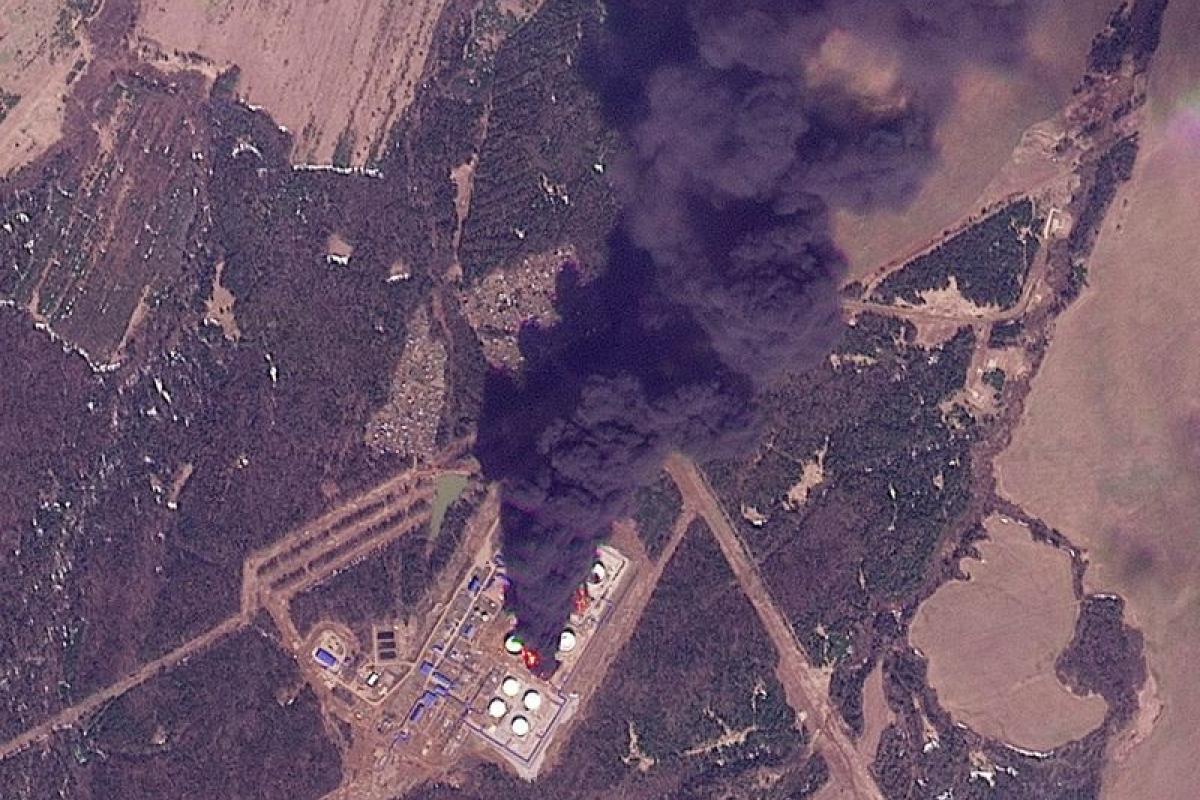
It also said that only after the third attack, on April 28, did regional authorities declare a regional emergency, while the Kremlin’s first comment on the environmental crisis was to acknowledge only exceedance of permissible concentrations of benzene and xylene in the air.
Euronews added that authorities advised residents not to go out except for urgent needs and not to go out without masks, and to keep windows closed.
France 24 described Tuapse residents wearing masks to protect themselves from air pollution caused by Ukrainian drone strikes against an oil refinery, and it quoted a 63-year-old retiree, Vladimir, saying, “The river was on fire.”
The Washington Post said Tuapse residents “railed against the government’s efforts to play down the impact of the strikes,” and it quoted Alina Orlova asking, “Why won’t he come here himself, look people in the eye, support them personally? He keeps talking about unity, but in reality it’s all just words. We’re living in smoke, with fear and anxiety for the health and future of our children.”
Brovdi’s deep-strike doctrine
Ukraine’s deep-strike campaign was presented by its drone commander Robert Brovdi as a system with multiple objectives, including oil facilities, Russian FSB agents, and the morale of the population.
“Cities and the Russian coast on the Black Sea are fighting fires and oil spills caused by Ukrainian attacks on refineries”
tv5monde said Brovdi gave a rare interview to the BBC from an underground command post and described his deep-strike priorities as “oil facilities, agents of the Russian Federal Security Service (FSB), and, beyond that, the morale of the population.”
It reported that the BBC accompanied a launch team east of Ukraine where long-range drones are assembled quickly, and it said the observed model can travel “more than 1,000 kilometers.”
In the same interview, Brovdi told the BBC that “Vladimir Putin extracts natural resources and turns them into blood dollars, which he then directs against us in the form of Shahed drones and ballistic missiles,” and he argued that refineries become “a legitimate military target, liable to destruction.”
Radio France similarly quoted Brovdi’s instruction that “30% of all drone strikes must target military personnel,” and it said that amounts to “more than 30,000 men per month.”
Radio France also described Brovdi’s aim to create “a certain fermentation” within Russian society through fires and casualty rates, while The Washington Post said the strikes demonstrated Ukraine’s increasing reach and ability to evade Russian air defenses.
Putin’s warning and official framing
Russia’s response combined warnings about civilian infrastructure with efforts to reassure the public about health risks.
In remarks relayed by Reuters, Vladimir Putin accused Kiev of deliberately targeting civilian infrastructure after a series of drone strikes targeting Russian oil facilities, and he pointed to the Tuapse oil refinery as an example.
Ladepeche.fr quoted Putin saying, “Drone strikes against civilian infrastructure are becoming more and more frequent,” and it quoted him adding, “The latest example is the drone strikes against the Tuapse energy facilities, which could potentially entail serious environmental consequences.”
The same outlet reported that Putin sought to reassure residents, saying, “There does not appear to be any serious danger, and residents are facing it on the ground.”
Euronews described the Kremlin’s first comment as acknowledging only exceedance of permissible concentrations of benzene and xylene in the air, and it said authorities advised residents not to go out except for urgent needs and not to go out without masks.
The Washington Post reported that Putin acknowledged the strikes for the first time last week and said that “there don’t seem to be any serious threats; people on the ground are coping with the challenges they face,” while Anna Popova said there were “no health risks” despite the ongoing fire.
Escalation beyond the Black Sea
The Tuapse episode was portrayed across outlets as part of a broader pattern of Ukraine diversifying targets deeper inside Russia, including the Urals and other industrial regions.
“War in Ukraine: Vladimir Putin warns Kiev after the intensification of attacks against Russian civilian infrastructure”
The Washington Post said the Ukrainian strikes also damaged and caused fires last week at a refinery and oil-pumping station in Perm near the Urals, and it described the strikes as demonstrating Ukraine’s increasing reach “thousands of kilometers into Russian territory.”

Le Parisien reported that allies urged Kyiv to stop strikes on Russian refineries amid a fuel crisis, citing Kyrylo Budanov saying, “We will respond diplomatically. We are receiving signals on this matter,” while not specifying whether requests would be acted on.
Boursorama reported that Ukrainian drones struck, for the second consecutive day, an oil refinery near Perm, located 1,500 kilometers from Ukraine, and it said the refinery is owned by Lukoil and has a capacity of nearly 13 million tonnes per year.
Euronews described additional incidents, including that about 50 kilometers of coastline had been polluted and that almost 10,000 cubic meters of water-oil mixture and contaminated soil had been removed.
BFM described Ukraine’s ability to strike far from the front and said the Ust-Luga port was struck on March 25, 27 and 29, with the site normally handling “700,000 barrels per day,” and it said the strike was carried out using drones that traveled more than 900 kilometers.
More on Ukraine War

Trump Meets Zelensky at G7 in Évian, Urges Russia to Make a Deal
10 sources compared

Trump Urges Russia To Make A Deal To End Ukraine War At G7
15 sources compared
Donald Trump Signs G7 Declaration, Threatens Reimposing Russian Oil Sanctions
23 sources compared

G7 Leaders Press Russia to End Ukraine War as Zelenski Meets Trump in Evian
23 sources compared