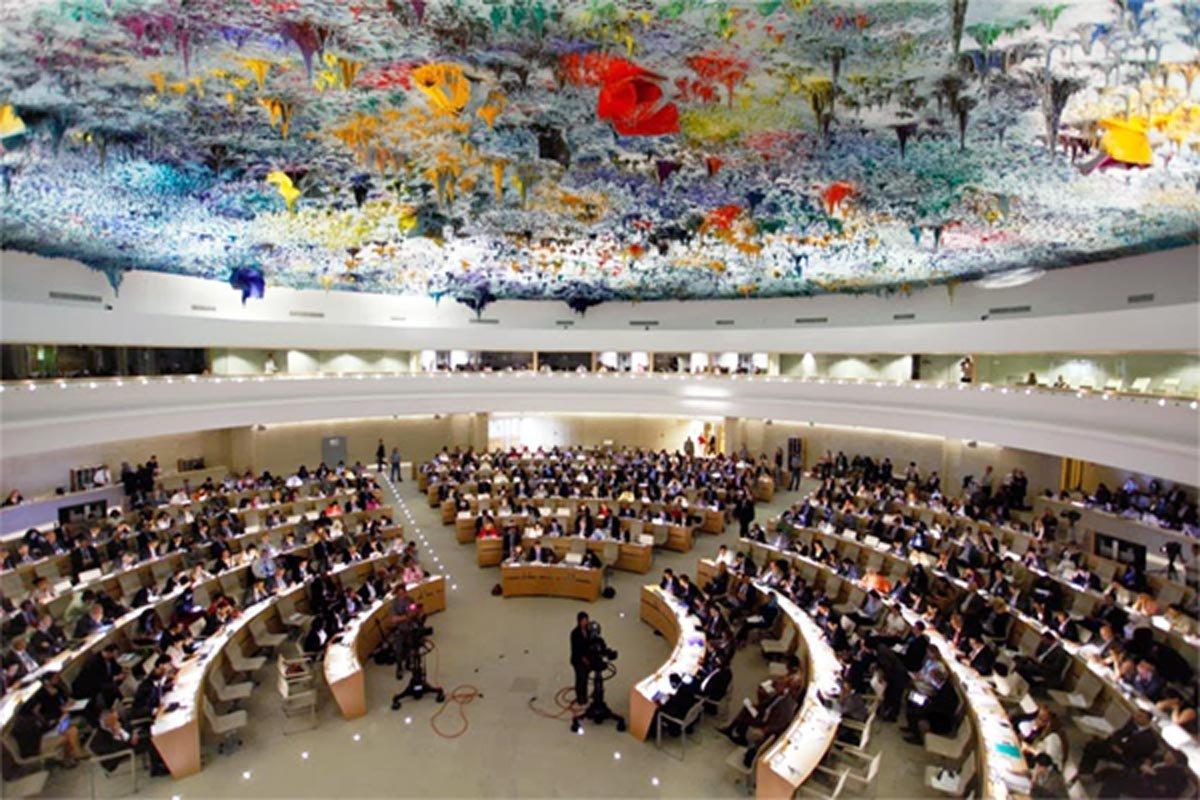
UN Human Rights Council condemns Iran's attacks on the Gulf and Jordan and demands compensation
Key Takeaways
- UNHRC emergency session condemned Iran's attacks on GCC states.
- Gulf states demand full reparations for damages.
- UN rights bodies push for accountability; Gulf states join calls.
UN Emergency Session
The UN Human Rights Council in Geneva held an emergency session on Wednesday to address Iran's ongoing attacks targeting Gulf Cooperation Council countries and Jordan.
“Gulf officials have told the United Nations Human Rights Council that Iranian attacks on their countries amount to a gross violation of state sovereignty, demanding full reparations as the United States-Israeli war on Iran approaches the one-month mark”
The session concluded with a strong UN condemnation of Iranian attacks and calls for compensation for resulting damages.

The UAE's Permanent Representative, Jamal Al-Musharakh, revealed the extent of the escalation, announcing that his country had intercepted more than 200 ballistic missiles since the attacks began.
The council adopted a motion by consensus condemning Iran's 'unprovoked and deliberate' strikes, seeking reparations from Iran and asking the U.N. rights chief to monitor the situation.
The resolution, while not legally binding, demanded that Iran immediately 'cease all unprovoked attacks' and called for full and swift 'reparation' to all victims of its strikes.
Regional Impact
Iranian missile and drone strikes have posed an existential threat to regional security and stability, with Gulf states describing the danger as unprecedented.
The attacks targeted critical infrastructure including electricity and desalination plants, which have serious environmental consequences and undermine rights guaranteed by human rights provisions.
The de facto closure of the Strait of Hormuz - through which about one-fifth of the world's oil and gas supplies transit - became a source of great concern due to its potential dire consequences on the global economy and supply routes.
The UAE ambassador denounced Iran's 'attempt to destabilise the international order through reckless adventures of expansionism,' while Kuwait's ambassador described the situation as a 'humanitarian catastrophe' that undermines peace.
Arab Consensus
Arab delegates presented a united front during the emergency session, all speaking in a firm tone against Iranian aggression.
“Geneva, Switzerland – The UN Human Rights Council in Geneva held an emergency session on Wednesday to discuss the serious repercussions of Iran’s ongoing attacks targeting Gulf Cooperation Council (GCC) countries and the Hashemite Kingdom of Jordan”
Saudi Arabia's delegate condemned the 'brutal' attacks, asserting that hesitation in confronting Iran was no longer acceptable and that Tehran could not evade its international responsibilities.
Bahrain called for an immediate cessation of the violations and adherence to the principles of international law, while Qatar's representative condemned the 'indiscriminate' attacks targeting civilians despite its policy of neutrality.
Oman emphasized that targeting infrastructure constitutes a flagrant violation of human rights, and Cairo warned against threatening the resources of nations.
Oman considered the attacks on its territory an unjustified assault on its sovereignty and demanded an immediate de-escalation of the situation.
Iran's Defense
Iran defended its actions during the session, claiming that Tehran was acting in 'self-defense' against the United States and Israel.
The Iranian representative alleged that American and Israeli attacks had targeted civilians and resulted in approximately 1,500 deaths, attempting to justify Iran's cross-border military operations.
Iran's ambassador to the U.N. in Geneva Ali Bahreini stated, 'We fight on behalf of all of you against an enemy that, if not restrained today, will be beyond containment tomorrow,' referring to Israel.
Iran, backed by China, announced it would hold its own emergency session on a fatal strike on a primary school.
Meanwhile, the International Service for Human Rights, an independent NGO, warned against 'selective outrage,' calling instead for a focus on violations by all perpetrators in the conflict.
UN Chief Warning
The United Nations' top rights official Volker Turk issued a stark warning about the deteriorating situation, describing it as extremely dangerous and unpredictable.
“Quick Summary Gulf Arab states warned the U”
Turk stated that attacks on civilians and civilian infrastructure must end, warning that if such attacks are deliberate, they may constitute war crimes.
The session reflected Iran's diplomatic isolation in international human rights forums, with the resolution passing by consensus among the 47-member council.
Oman's ambassador, who had served as a mediator between the United States and Iran before the conflict, acknowledged that U.S.-Israeli strikes had preceded Iran's retaliatory attacks, describing them as 'the spark that ignited the escalation currently affecting the region.'
Al Jazeera's reporting from Dubai noted that GCC countries are looking for guarantees from Iran similar to how Iran seeks guarantees from the US and Israel, indicating the complex diplomatic dynamics at play.
More on Iran

Pentagon orders 1,000 82nd Airborne troops to West Asia amid Kharg Island seizure talks
13 sources compared

U.S. Prepares to Deploy 1,000 82nd Airborne to West Asia to Seize Airfields
17 sources compared

Pentagon deploys 3,000 82nd Airborne troops to West Asia to backstop Iran war operations
14 sources compared

US, Israel escalate West Asia strikes as US demands Iran roll back nuclear program
12 sources compared