South America05 January, 20264 min read
U.S. forces arrest President Nicolás Maduro, send him to New York for federal prosecution
This article is an automated aggregation of coverage from news outlets. Our editorials offer in-depth analysis curated by the NewsCord team.
Maduro and his wife captured by U.S. forces and moved to New York. A large-scale strike preceded the capture; U.S. aims to run Venezuela.
Capture Operation
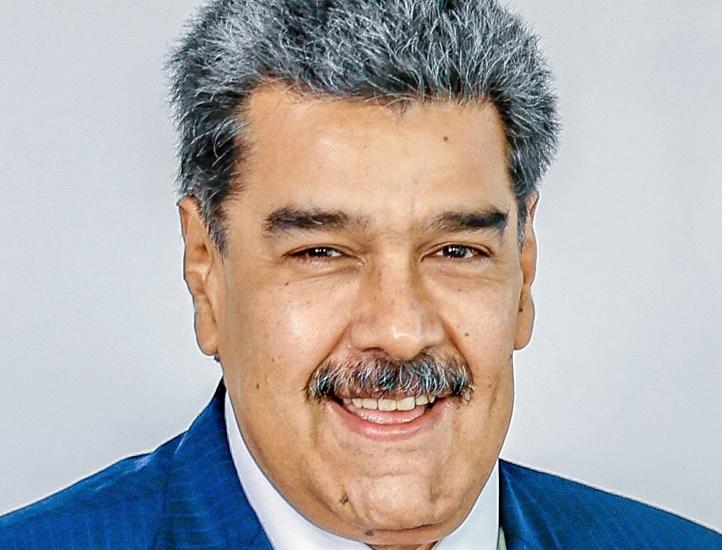
U.S. forces conducted a dramatic overnight operation to capture Venezuelan President Nicolás Maduro and his wife Cilia Flores. The operation targeted them at their home within the Fort Tiuna military installation in Caracas. Multiple explosions and low-flying aircraft swept through the Venezuelan capital during the operation.
“H.R. McMaster, who had served as national security adviser during President Trump's first term, says the capture of Maduro is just the first step in U.S. intervention in Venezuela.”
Maduro's government immediately denounced it as an 'imperialist attack' and urged citizens to take to the streets. The captured Venezuelan leader was first taken aboard a U.S. warship before being transported to New York.
A plane carrying the deposed leader landed late Saturday afternoon in the United States. The capture came after months of stepped-up pressure by Washington on the Venezuelan government.
Legal Charges
Maduro and his wife have been indicted in the U.S. District Court in the Southern District of New York on narco-terrorism conspiracy charges.
U.S. Attorney General Pam Bondi announced on social media platform X that they will 'soon face the full wrath of American justice on American soil in American courts.'

The Venezuelan ruling party leader Nahum Fernández described the capture as 'what we could call a kidnapping of the president and the first lady of the country.'
He emphasized the dramatic nature of the operation that occurred at their home within the Fort Tiuna military installation.
Bondi's announcement came as part of the Trump administration's broader campaign against the South American nation.
The legal proceedings represent a significant escalation in U.S.-Venezuela relations.
Trump's Plans
President Trump has announced that the United States will 'run' Venezuela following Maduro's capture.
“McMaster also said the action both increases pressure on the regime and is 'mainly focused on drying up their cash flow.' 'That's what you see in the interdiction of the oil tankers and the destruction of the boats, cutting off his access to the narcotics funds,' he said.”
He declared that 'No nation in the world could achieve what America has achieved yesterday or frankly in a short period of time.'
Trump made these remarks during a Saturday news conference flanked by U.S. Secretary of State Marco Rubio and U.S. Defence Secretary Pete Hegseth.
He failed to provide specific answers about how the U.S. would oversee Venezuela.
When asked who would specifically lead Venezuela, Trump replied, 'The people who are standing right behind me.'
He stated that 'We're not afraid of boots on the ground.'
The administration's approach focuses on replacing the Maduro regime with what McMaster described as 'a legitimate regime.'
They also aim to 'dry up their cash flow' through interdiction of oil tankers and destruction of boats.
Global Reactions
The capture of Maduro has sparked significant international and domestic reactions. The Congressional Black Caucus blasted Trump over the operation as 'a grave and illegal abuse of power.' The caucus warned that the deployment of U.S. military power threatens to draw the U.S. into an indefinite conflict in Venezuela.
They also stated it threatens regional stability and weakens America's standing on the world stage. Canadian Prime Minister Mark Carney welcomed the opportunity for 'freedom, democracy and prosperity for the Venezuelan people.' Carney noted that Canada has not recognized the 'illegitimate regime of Maduro since it stole the 2018 election.'

Protests gathered outside the Brooklyn jail where Maduro is being held, with demonstrators calling for his release. Protesters questioned what might stop Trump from similar actions against other countries.
Oil Control
Trump has made clear his intentions regarding Venezuela's vast oil reserves. He stated that he'll get the oil flowing and sell it to several countries. The wealth would go 'back to the people' of Venezuela as well as to the U.S.
“Asked by 'Face the Nation' moderator Margaret Brennan about reports of previously detained Americans still being held in Venezuela, Sen. Chris Van Hollen , 'I've not gotten an update from the administration on those detained Americans. But certainly, my view is we should work to bring back every American who is wrongfully detained overseas.'”
Trump claimed his government's involvement in Venezuela 'won't cost us a penny' because the U.S. would be reimbursed from the 'money coming out of the ground.' This has raised legal concerns about who really owns the oil. Matthew Waxman, a Columbia University law professor, noted that seizing control of Venezuela's resources opens up additional legal issues.
Waxman pointed out that 'An occupying military power can't enrich itself by taking another state's resources.' Maduro has long accused Washington of wanting to take control of Venezuela's oil reserves, the largest in the world.
Future Uncertainty
There remains significant uncertainty about Venezuela's future leadership and governance following Maduro's capture. Trump claimed the U.S. would 'run' Venezuela and that it's up to Rubio to work out the details. He did not offer a specific timeline for how long the U.S. would lead the country.
Under Venezuelan law, Vice-President Delcy Rodriguez would take power. Trump claimed Rubio had been in touch with Rodriguez, quoting her as saying, 'We'll do whatever you need.' However, Rodriguez later demanded the U.S. free Maduro and called him the country's rightful leader.
Opposition leader María Corina Machado said opposition candidate Edmundo González should assume power. She claimed he rightfully won the 2024 presidential election.
Despite the dramatic operation, U.S. forces appear to have no control over the country itself. Maduro's government appears to still be in charge in many respects.