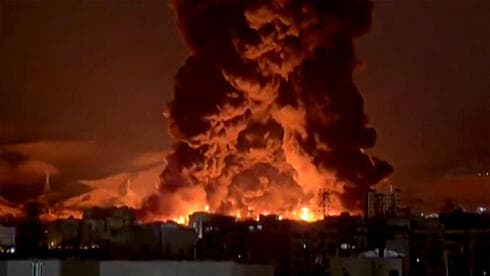
Trump Says U.S. Bombed Kharg Island, A Major Strike on Iran's Oil Network
Key Takeaways
- US bombed military targets on Kharg Island, Iran's main oil-export hub.
- Trump called it one of the most powerful raids, claiming oil infrastructure spared.
- Iran vowed retaliation; Gulf states monitor energy markets amid the strikes.
Strike Announcement
President Donald Trump announced on March 13, 2026, that the United States had conducted a major bombing raid on Iran's strategic Kharg Island.
“Fighting escalates between Israel and Hezbollah An Israeli strike in southern Lebanon hit a health care centre in the village of Burj Qalaouiyah, killing 12 doctors, paramedics and nurses, the Lebanese Health Ministry said early Saturday”
He described it as 'one of the most powerful bombing raids in the History of the Middle East' via Truth Social.

Trump claimed U.S. Central Command 'totally obliterated every MILITARY target in Iran's crown jewel, Kharg Island' under his direct orders.
He emphasized that while military targets were destroyed, the island's vital oil infrastructure was deliberately spared 'for reasons of decency.'
Trump warned this decision could change if Iran interferes with shipping through the Strait of Hormuz.
The president claimed Iran has 'NO ability to defend anything that we want to attack' and urged Iran's military to surrender.
Trump stated they would be 'wise to lay down their arms, and save what's left of their country, which isn't much!'
He also declared that Iran's alleged plans to dominate the Middle East and destroy Israel are 'now dead.'
Strategic Importance
Kharg Island represents Iran's most critical energy infrastructure asset, serving as the primary terminal through which approximately 90% of the country's crude oil exports pass.
Located about 25-30 kilometers off Iran's southwestern coast in the Persian Gulf, the five-mile long island has been described as Iran's 'crown jewel' and 'oil lifeline' by multiple sources.

Analysts note that Kharg Island's strategic importance stems from its ability to handle up to 7 million barrels per day, with most exports flowing to Asian markets including China and India.
The island's deep-water terminals and extensive storage facilities make it central to Iran's economy, particularly under sanctions where Iran relies on 'shadow fleet' tankers for its energy exports.
JPMorgan warned that 'a direct strike would immediately halt the bulk of Iran's crude exports, likely triggering severe retaliation,'
while Business Insider noted that even attacks on military targets immediately raise the risk profile for the broader oil supply chain.
Iranian Response
Iran responded to the Kharg Island strike with warnings of severe escalation, with Iranian parliament speaker Mohammad Bagher Qalibaf declaring that attacks on Persian Gulf islands would cause Iran to 'abandon all restraint.'
“The United States announced that it bombed military targets on the strategic Iranian Kharg Island, while Iran carried out a series of missile and drone attacks that caused fires in Israeli cities and targeted several sites in Gulf countries”
Qalibaf specifically warned Trump would be responsible for 'the blood of American soldiers' if the islands came under attack.
Iranian state media reported that 15 explosions occurred on the island during the American attack, targeting air defenses, the Goshan naval base, and the control tower at the island's airport.
They confirmed the oil infrastructure remained undamaged despite the strike.
The attack comes amid Iran's daily missile and drone attacks on Israel and neighboring Gulf states, which have effectively closed the Strait of Hormuz through which a fifth of the world's traded oil passes.
Iran's supreme leader Mojtaba Khamenei, who recently succeeded his father, has warned Tehran would 'look to open other fronts in the war' if U.S. and Israeli attacks continue.
He has vowed to ensure the Strait of Hormuz 'remains effectively closed.'
Military Escalation
The Kharg Island strike represents a significant escalation in the ongoing military conflict between the U.S.-Israel alliance and Iran, which has now entered its second week under the operation name 'Epic Fury.'
U.S. Defense Secretary Pete Hegseth announced that over 15,000 enemy targets have been struck since the war began, averaging more than 1,000 targets per day.

The Pentagon is reinforcing its military presence in the region by deploying an additional 2,500 Marines and the amphibious assault ship USS Tripoli from Japan, though officials emphasize this does not necessarily indicate a ground operation is imminent.
The U.S. Navy currently has 12 ships, including the aircraft carrier USS Abraham Lincoln and eight destroyers, operating in the Arabian Sea.
Meanwhile, Israel has launched multiple waves of strikes against Iran-backed Hezbollah militants in Lebanon, where the humanitarian crisis has deepened with nearly 800 people killed and 850,000 displaced.
The conflict has also seen dangerous friendly fire incidents, including the crash of a U.S. KC-135 refueling plane in Iraq that killed all six crew members.
Global Economic Impact
The Kharg Island strike has had immediate and severe consequences for global energy markets, with oil prices soaring to their highest levels in over three years.
“It was not immediately clear who was responsible”
Brent crude settled above $100 per barrel for the second straight session, while U.S. crude futures reached near their highest since July 2022.

In the United States, the national average for a gallon of gas hit $3.54, marking the highest levels in about two years.
The global impact extends beyond energy markets, as fruit and vegetable producers across the country have warned they may be forced to stop production and end the season early due to rising energy and transportation costs.
Meanwhile, shipping through the Strait of Hormuz has effectively collapsed, with maritime traffic dropping dramatically as ship owners avoid the area following missile, drone, and small-craft attacks on merchant ships across the Persian Gulf.
The collapse in shipping has led to millions of barrels of oil remaining trapped in the Persian Gulf, exacerbating supply chain disruptions and raising concerns about prolonged energy shortages.
More on Iran
Trump Says U.S. Bombed Military Sites on Kharg Island, Iran's Oil Hub
14 sources compared
FBI Warns of Iranian Drone Plot Based on Unverified Tip; California Says No Credible Threat
10 sources compared

White House Demands ABC Retract Report Claiming Iran Sought To Launch Drone Attacks On California
11 sources compared

Iranian Proxy Claims It Shot Down US Refueling Plane in Iraq; US Military Says Otherwise
17 sources compared