
US Threatens Most Intense Bombing Campaign Against Iran
Key Takeaways
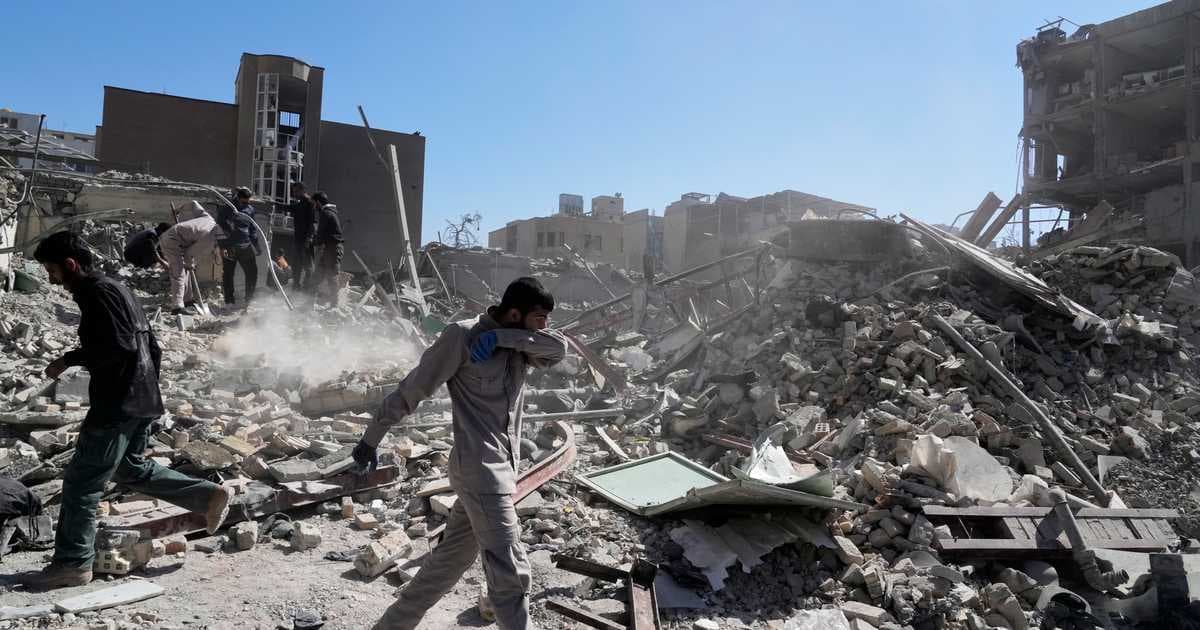
- Explosions in the Iranian capital produced clouds of dark smoke early Saturday
- Tehran retaliated by firing missiles at Israel
- United States warned of an upcoming bombing campaign, calling it the most intense yet
Cross-border escalation summary
The supplied report describes a rapidly escalating cross-border confrontation involving U.S., Israeli and regional actors who are preparing for and conducting strikes.
“Explosions sent up clouds of dark smoke in the Iranian capital city early Saturday, and Tehran retaliated by firing missiles at Israel as the United States warned of a forthcoming bombing campaign that officials said would be the most intense yet in the weeklong conflict”
Saudi authorities reported intercepting and destroying four drones bound for the Shaybah oil field.
The Israeli military announced it had begun a "broad-scale" wave of strikes in Tehran after working to intercept missiles launched from Iran toward Israel.
Loud explosions were reported over Jerusalem.
U.S. and Israeli officials have warned of further escalations.
The piece notes that "one U.S. official [was] calling for a major night of bombing," and frames U.S. rhetoric and planning as a driver of the heightened threat environment.
Energy and transport attacks
The reporting highlights attacks on energy and transport infrastructure across the region.
In Iraq’s Basra province, at least two drones struck energy infrastructure and facilities tied to U.S. contractors, causing fires, and the update stated it was unclear if there were casualties.
The summary also records that attacks have hit oil fields and the cargo section of Basra International Airport.
It notes the Shaybah oil field as a specific Saudi target in the wave of drone activity, underlining the conflict’s immediate impact on energy nodes.
U.S. military posture and rhetoric
U.S. political and military leadership is portrayed as both defending current actions and preparing for expanded operations.
“Explosions sent up clouds of dark smoke in the Iranian capital city early Saturday, and Tehran retaliated by firing missiles at Israel as the United States warned of a forthcoming bombing campaign that officials said would be the most intense yet in the weeklong conflict”
President Trump defended U.S. military actions as "phenomenal," said those responsible for Iran "should be worried," and announced that defense contractors have agreed to ramp up production of high-end weapons while the U.S. is also ordering more basic munitions.
At the operational level, Joint Chiefs Chairman Gen. Dan Caine said the military "has sufficient precision munitions but is shifting from long-range rockets to less sophisticated, shorter-range bombs," indicating adjustments in force posture and ordnance mix amid the escalation.
Drone, missile and air escalation
The bulletin frames the situation as a region-wide surge in drone, missile and air activity, noting active responses from U.S., Israeli and Saudi forces and preparations for further operations.
Its closing line summarizes: "Overall, the region is experiencing a rapid escalation of drone, missile and air strikes, with U.S., Israeli and Saudi responses and preparations continuing," capturing both the kinetic spread and the political-military mobilization behind it.
Sources and limitations
This summary is constructed from a single supplied update and therefore reflects only the facts and statements presented there.
“Explosions sent up clouds of dark smoke in the Iranian capital city early Saturday, and Tehran retaliated by firing missiles at Israel as the United States warned of a forthcoming bombing campaign that officials said would be the most intense yet in the weeklong conflict”
Those include official Saudi and Israeli claims of interceptions and strikes, reports of strikes on Basra energy infrastructure, and U.S. leadership statements about military action and munitions.
The bulletin does not include the perspectives of Iranian officials, independent on-the-ground verification, or broader regional or humanitarian assessments.
Those perspectives were not present in the supplied text and would be needed for a fuller, multi-source account.
More on Iran-Israel

Escalation in Iran Pushes Oil Near $120, Sparks Gas Price Surge in Los Angeles
10 sources compared
U.S. Intercepts Iran Message Activating Sleeper Cells After U.S.-Israel Strike Kills Khamenei
14 sources compared

Iran Threatens To Confiscate Property Of Iranians Abroad Who Support US And Israel
14 sources compared
Ukraine Sends Drones, Experts to Shield U.S. Bases in Jordan From Iran
16 sources compared