
USA · 21 April, 2026 · 8 min read
Virginia Voters Approve Redistricting Plan Boosting Democrats’ Chances for Four House Seats
Virginia voters approved a mid-decade redistricting amendment enabling Democrats to redraw congressional maps. The new map could boost Democrats by up to four House seats, altering Virginia's delegation.
Predicted impact on seat distribution (magnitude and scope of gains).
16 of 17 outlets skipped it: the redistricting referendum was described by BBC as the most expensive ballot measure in Virginia's history..
36outlets compared
Same story, two versions
tap a side to read it in full
The New York Times
“The new map could eliminatefour of the state’s five Republican-held seatsfor the 2026 midterm elections, giving Democrats a significant boost in their quest to regain control of the House.”Read the original ↗
CBS News
“Virginia voters on Tuesday approved a new congressional map that would give Democrats an advantage in 10 House districts, leaving just one safe Republican seat, CBS News projects.”Read the original ↗
Shows how different outlets frame the tilt: one emphasizes eliminating four GOP-held seats, the other emphasizes a 10-district advantage (with only one safe GOP seat). The framing reflects different narratives about how dramatic the map change could be.
Virginia votes on map
Virginia voters approved a mid-decade redistricting plan in a Tuesday referendum that could boost Democrats’ chances of winning four additional U.S. House seats in November’s midterm elections, according to the Associated Press and CBS News projections.C
“Virginia voters approve redistricting plan that could boost Democrats’ seats in Congress”
The AP reported that the constitutional amendment “narrowly backed by voters bypasses a bipartisan redistricting commission” to allow the use of new districts drawn by Virginia’s Democratic-led General Assembly.
CBS News projected that the new congressional map would give Democrats an advantage in 10 House districts, leaving “just one safe Republican seat.”
The Washington Post, citing Associated Press projections, said the referendum could add as many as four Democratic seats to the House of Representatives.
Multiple outlets framed the vote as part of a national redistricting fight that began after President Donald Trump urged Republican officials in Texas to redraw districts.
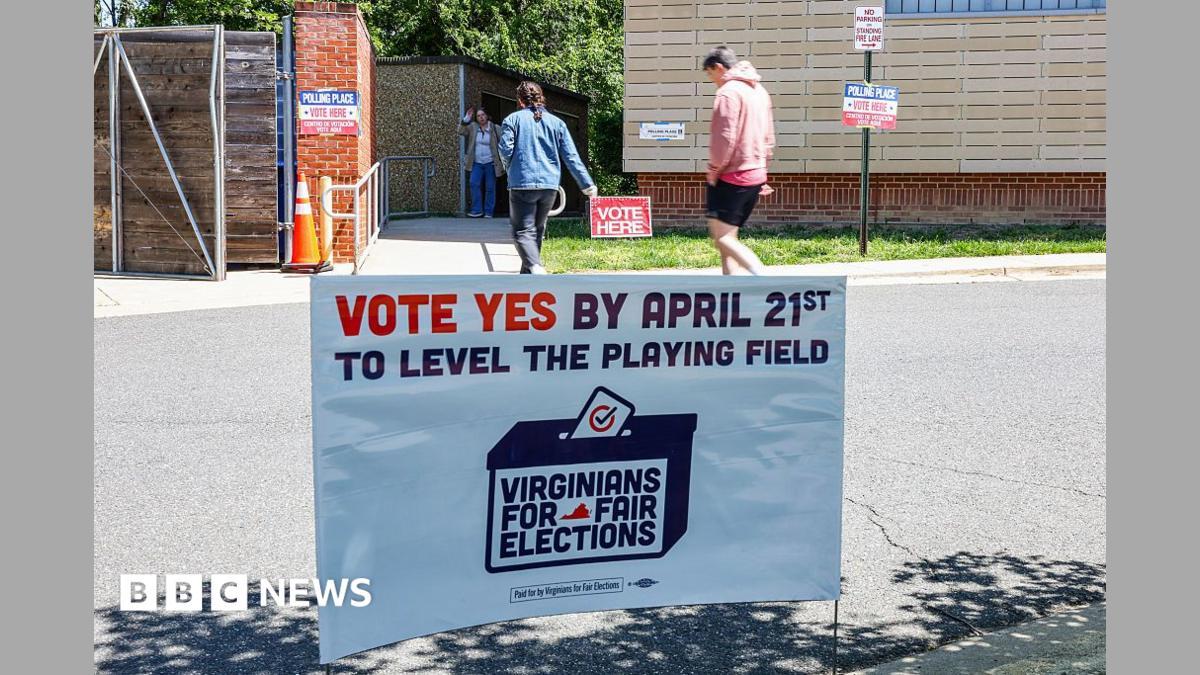
The BBC said the ballot measure would redraw Virginia’s congressional map to help Democrats flip as many as four House seats held by Republicans.
In Virginia, the referendum was also described as a temporary measure that would replace the current maps drawn by the commission until the 2030 census, when the previous system would return.
The NBC News live results coverage and USA Today’s reporting both described the referendum as a full redrawing of Virginia’s congressional districts that could transform the state’s 11-member delegation from a 6-to-5 Democratic edge to an overwhelming 10-to-1 advantage, depending on the final tally.
How the fight escalated
The Virginia referendum was presented by multiple outlets as the latest move in a mid-decade redistricting arms race that began after President Donald Trump urged conservative states to re-examine voting maps to help Republicans keep the party’s slim congressional majority.
The AP said Trump “kicked off a national redistricting battle last year by urging Republican officials in Texas to redraw districts,” and it described the goal as helping Republicans win more seats in November and hold on to a narrow House majority.

The BBC likewise described the state as “the latest in a national redistricting arms race that was launched after President Donald Trump urged conservative states to re-examine voting maps to help Republicans keep the party's slim congressional majority.”
Several reports traced the tit-for-tat pattern: Texas adopted a map that could add up to five Republican seats, and California responded with a ballot measure designed to give Democrats five more seats.
The AP said Democrats hoped to offset the gap created by Republican gains elsewhere, noting that Republicans believe they can win up to nine more House seats in newly redrawn districts in Texas, Missouri, North Carolina and Ohio.
The BBC added that California voters approved their new maps in a special referendum in November, giving Democrats an edge in five new districts, and it listed Utah as another court-imposed district that could give Democrats an advantage in one district.
CBS News described how Virginia’s referendum set aside the current maps drawn up by the commission and replaced them with maps drawn by the Democratic-controlled General Assembly, while also stating that “The previous system will be put back in place after the 2030 census.”C
USA Today and the Washington Post both emphasized that the referendum was a temporary bypass of Virginia’s bipartisan commission, with the Washington Post noting that Democrats and their allies poured at least $64 million into the campaign.
Reactions from both parties
Reactions to the Virginia vote came quickly from Democratic leaders, Republican leaders, and national party figures, with each side framing the referendum as either a defense of voting rights or an unconstitutional power grab.
““Virginia just changed the trajectory of the 2026 midterms,””
The AP quoted Democratic state House Speaker Don Scott saying, “Virginia just changed the trajectory of the 2026 midterms,” and it also reported that Democratic Virginia Gov. Abigail Spanberger said, “I understand the urgency of winning congressional seats as a check on this President.”
The Washington Post carried Scott’s statement that “Tonight, Virginians sent a message heard across this country: we will not let Donald Trump or MAGA Republicans rig our democracy,” and it quoted Virginia House GOP Leader Terry Kilgore saying, “From the start, this process was tilted: misleading ballot language and a massive spending advantage made this an uphill climb for voters trying to make sense of a deeply complicated issue.”
Republicans pledged to continue court challenges, with the AP reporting that Kilgore said, “Serious legal questions remain about both the wording of this referendum and the process used to put it before voters.”
The AP also quoted National Republican Congressional Committee chair Richard Hudson saying the “close margin reinforces that Virginia is a purple state that shouldn’t be represented by a severe partisan gerrymander.”
CBS News included a statement from House Minority Leader Hakeem Jeffries saying, “While many expected Democrats to roll over and play dead, we did the opposite,” and it reported that the Democratic National Committee said, “Virginians refused to let Trump play games with Americans' right to fair representation.”C
On the Republican side, Fox News quoted Hudson arguing, “Virginia Democrats can’t redraw reality,” and it also included Glenn Youngkin’s call on the Virginia Supreme Court, writing, “I urge the Virginia Supreme Court to rule against this unconstitutional process that will disenfranchise millions of Virginians.”
Outside the party leadership, USA Today quoted Marc Morial, CEO and president of the National Urban League, saying, “This was an important response to what Trump initiated,” and it also included a comment from Rep. Suzan DelBene calling the result “a massive rebuke” of Trump and Republicans’ efforts to rig the midterms.
Different outlets, different emphasis
Coverage of the Virginia referendum diverged across outlets in how it emphasized the map’s expected partisan impact, the mechanics of the vote, and the legal and financial stakes.
The AP focused on the referendum’s narrow approval and the possibility that the state Supreme Court could decide whether the plan is illegal, noting that “The state Supreme Court is considering whether the plan is illegal in a case that could make the referendum results meaningless.”
The Washington Post emphasized the scale of spending and the campaign’s message, saying Democrats and their allies poured at least $64 million into the Virginia campaign and describing the vote as “a high-stakes bid” to counter President Donald Trump’s push.
USA Today highlighted the practical election-law mechanics, including that “if the margin of victory is less than one-half of 1%, the defeated side has the right under Virginia election law to ask for a state-funded recount,” and it also described the recount request deadline as “within 10 days of the declaration of the outcome.”
NBC News framed its coverage as a live results operation, while also noting turnout dynamics such as “Turnout in Virginia tracking lower than 2025 gubernatorial election, especially in bluer areas.”
The BBC emphasized the referendum’s place in the national redistricting arms race and included a broader explanation of gerrymandering, stating that “Historically, the party of the current president would lose House seats during this congressional election.”
France 24 leaned into the political consequences, saying the vote could “boost Democrats’ representation in the US House by as many as four seats” and describing it as “a stinging defeat for Trump” after he joined a telephone rally with House Speaker Mike Johnson and warned, “The whole country is watching.”
Fox News and CBS News both quoted Richard Hudson and Glenn Youngkin, but Fox News foregrounded the argument that the process was an “egregious power grab” and that “Virginia Democrats can’t redraw reality,” while CBS News foregrounded the map’s projected structure, saying Democrats would have advantage in 10 districts and that the new districts spread out the Democratic stronghold in northern Virginia, Richmond and Virginia Beach.C
What happens next
The immediate next steps after Virginia’s referendum centered on courts, possible recounts, and the timeline for when the new districts would take effect for the 2026 midterm elections.
“The state Supreme Court is considering whether the plan is illegal in a case that could make the referendum results meaningless”
The AP said the state Supreme Court was considering whether the plan is illegal and that the case could make the referendum results meaningless, while it also reported that Republicans pledged to continue the battle over Virginia’s new map in court.
The Washington Post described that Republicans filed lawsuits to block the referendum and its amendment to the state constitution, adding that “several of those challenges are set to be heard by the Supreme Court of Virginia later this week.”
USA Today laid out the recount threshold and process, saying the losing side could request a state-funded recount if the margin of victory is “either 50 votes or less, or a difference of 1% or less,” and it added that “The recount request must be submitted by a group of registered voters within 10 days of the declaration of the outcome.”
CBS News reported that lawsuits from GOP officials challenging the Virginia referendum were still pending in state court, though it also said the Virginia Supreme Court allowed the referendum to go forward while those legal challenges were considered.C
Several outlets also tied the Virginia vote to the broader national schedule, including the possibility that Florida could become the next battleground, with the AP saying the Republican-led Legislature is to convene April 28 for a special session that could result in more favorable congressional districts for Republicans.
The BBC and CBS News both described the 2030 census as the point when the previous system would return, and Fox News said the Democratic-controlled Virginia legislature would have temporary redistricting power through the 2030 election.C
Looking ahead to the political stakes, the AP said the referendum could help nullify Republican gains elsewhere, and it quoted Democratic state House Speaker Don Scott saying, “Virginia just changed the trajectory of the 2026 midterms.”