The strike, in plain English
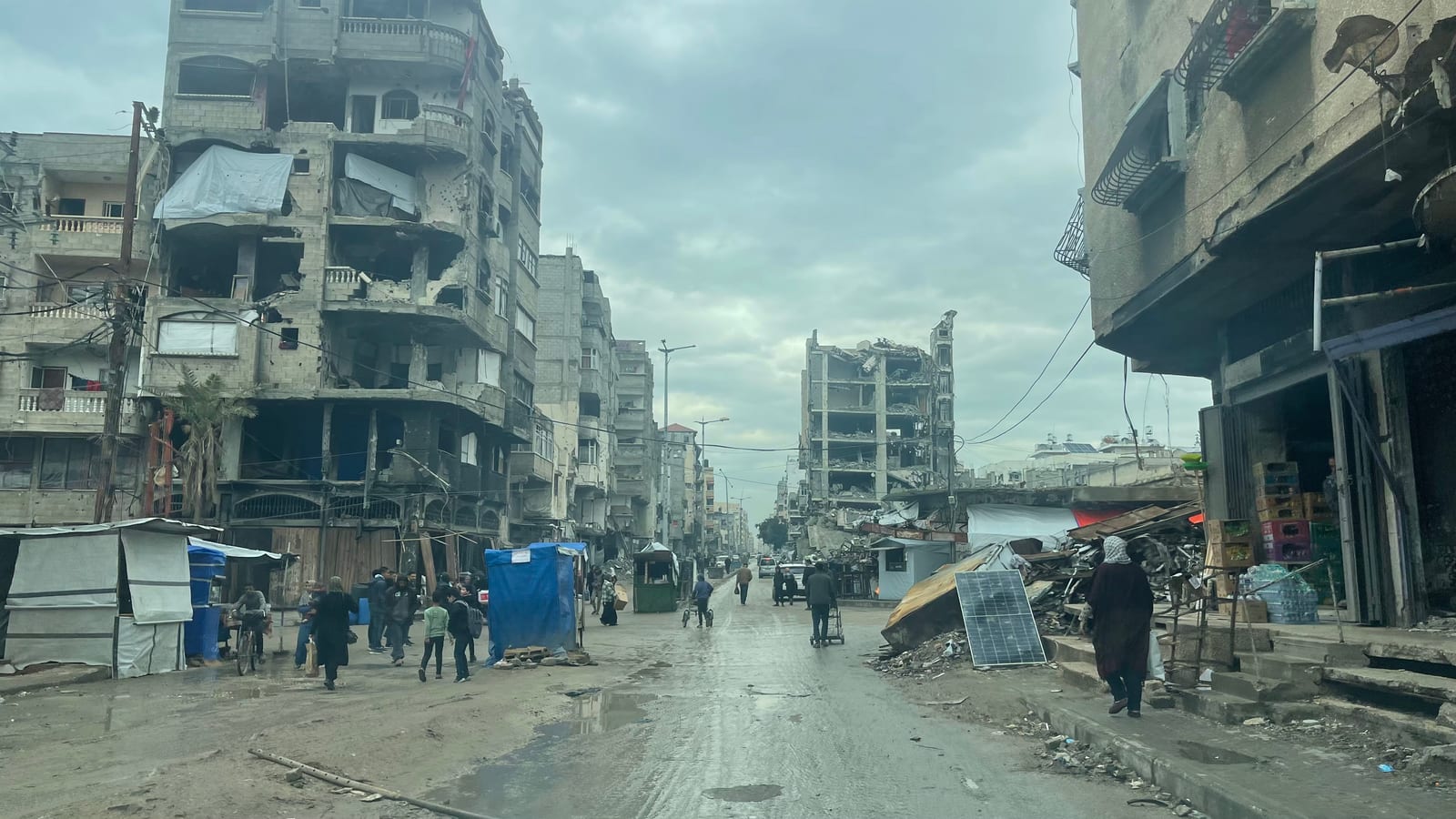
On Friday 15 May 2026, Nakba Day, Israeli warplanes struck a residential apartment building in Gaza City’s Rimal neighbourhood and a civilian vehicle that left the same location. Three Israeli Air Force fighter jets dropped thirteen bombs. The civil defence spokesman in Gaza, Mahmoud Basel, said no warning was given. Hundreds of people were living inside the targeted building.
At least seven Palestinians were killed. Three women and a child were among the dead. More than fifty were injured, several critically. The Palestine Red Crescent Society transported nearly thirty wounded patients to a field hospital. The mortuary at Al-Shifa Hospital received the seven bodies.
Israel said it was trying to kill Izz al-Din al-Haddad, head of Hamas’ military wing. As of writing, Israel has not confirmed his death and Hamas has not commented.
A ceasefire has been in place since mid-October 2025. According to Gaza’s health ministry, over 850 Palestinians have been killed in Israeli attacks during that ceasefire.
That is the news event. Now look at how the six outlets reported it.
The articles in question
- BBC News — Gaza City strike, 15 May 2026
- The Independent — URL slug ‘israel-hamas-gaza-benjamin-netanyahu-gaza-city’
- Reuters — ‘Seven killed in Gaza as Israel says it targets Hamas leader’
- The New York Times — ‘Israeli Strike Targeted Top Hamas Leader in Gaza, Officials Say’
- Anadolu Agency — ‘8 Palestinians killed, dozens injured in Israeli strikes on Gaza City despite ceasefire’ (comparison)
- Al Jazeera — ‘Seven killed in Gaza on Nakba Day as Israel says it targets Hamas member’ (comparison)
Take action
Send the four complaints in one click
One BBC complaint via the BBC complaints API. One IPSO Editors’ Code Clause 1 (Accuracy) complaint against The Independent. One corrections email to Reuters citing the Thomson Reuters Trust Principles. One to the NYT Standards Editor citing the NYT Guidelines on Integrity.
The headlines, ranked by what they centre
| Outlet | Headline | Leads with the deaths? |
|---|---|---|
| BBC | Centres Israel’s targeting of the Hamas military chief | No |
| The Independent | Names Israel, Hamas, Netanyahu, Gaza CityURL slug: ‘israel-hamas-gaza-benjamin-netanyahu-gaza-city’ | No |
| The New York Times | “Israeli Strike Targeted Top Hamas Leader in Gaza, Officials Say” | No |
| Reuters | “Seven killed in Gaza as Israel says it targets Hamas leader” | Partial (passive) |
| Anadolu | “8 Palestinians killed, dozens injured in Israeli strikes on Gaza City despite ceasefire” | Yes |
| Al Jazeera | “Seven killed in Gaza on Nakba Day as Israel says it targets Hamas member” | Yes |
Three Western outlets put Israel’s claimed objective in the headline (BBC, Independent, NYT). One placed the verified outcome first but stripped the actor and the word ‘Palestinians’ (Reuters). Two led with the deaths and named the contextual frame (Anadolu, Al Jazeera).
The hierarchy is visible. The further from the Western foreign desk, the more verified facts get into the headline.
What is wrong with the BBC and Independent framing
1. They led with the unverified claim, not the verified outcome
The most basic test in news judgement: what do we know happened, and what does someone say happened? Seven Palestinians are dead. Their bodies are in Al-Shifa Hospital. That is a verified, sourced, evidenced fact. Israel says it was targeting Haddad. Israel has not confirmed Haddad is dead. The targeting is the claim. The deaths are the news. The BBC and Independent reversed that order. They put the claim above the fact.
2. They erased the ceasefire
A ceasefire is in force. Over 850 Palestinians have died under it. A strike that kills seven civilians during a ceasefire is, by definition, a ceasefire violation or a ceasefire that does not function as one. Either reading is newsworthy. The headline that names the ceasefire forces the reader to ask which it is. The headline that omits the ceasefire allows the reader to skip the question entirely. Anadolu used three words to name the violation: “despite ceasefire”. The BBC and Independent used zero.
3. They erased Nakba Day
15 May is the 78th anniversary of the Nakba, the day Palestinians mark the expulsion of an estimated 750,000 people from their homes in 1948. Al Jazeera’s headline placed the strike inside that anniversary. The BBC and Independent did not. The date is not coincidental context. The targeting of Gaza City, the use of the word ‘displacement’ in coverage, the symbolism of the apartment building in Rimal: all of these acquire different weight on Nakba Day. A reader denied the date is denied the frame.
4. They buried the deaths
In the BBC piece, the seven Palestinian deaths appear several paragraphs into the article, beyond the BBC’s own analytics’ typical scroll-depth of 60 to 70 percent. By the time a reader reaches the death toll in the BBC piece, they have already absorbed Israel’s narrative as the headline, the lede, and the framing. The deaths arrive as a downstream consequence of a targeting operation, not as the central event. The Independent uses the same structure. The slug, the headline, and the lede all foreground Israel’s stated objective. The deaths appear lower down the page.
5. They named the alleged target, not the actual victims
Izz al-Din al-Haddad is named in the headline of both BBC and Independent coverage. The three women and the child killed in the strike are named in neither. This is a clear hierarchy: the name worth headlining is the man Israel claims to have targeted, not the civilians whose deaths are confirmed.
The basic test: replace the geography and the actors. A bombing in Belfast killed seven people, including three women and a child. The bomber said he was aiming at a single political figure who may or may not have been at the address. Would the BBC headline read “IRA targets political rival”? Or would it read “Seven killed in Belfast bombing”?
Reuters: better than peers, but three failures remain
Reuters’ headline structure is the best of the four Western outlets. By placing ‘Seven killed in Gaza’ at the head of the sentence, Reuters foregrounded the verified outcome rather than the unverified claim. That is the correct editorial choice and the complaint acknowledges it.
But three framing failures remain. First, the passive construction obscures the actor: ‘Seven killed in Gaza’ names a death toll and a location but not who killed them. Standard Reuters practice in comparable contexts uses active voice (‘Russia strikes Ukrainian city’). Second, the dead are not identified as Palestinians: Reuters customarily identifies victims by nationality when Israeli citizens are killed; the asymmetry is the bias. Third, critical context is absent: no ceasefire, no Nakba Day. Anadolu and Al Jazeera, reading the same wires, included both.
Reuters is a wire service. Its framing decisions cascade across hundreds of client newsrooms. The standard set at the source matters.
The New York Times: ‘Officials Say’
The Times headline reads: “Israeli Strike Targeted Top Hamas Leader in Gaza, Officials Say”. The construction does two things at once. It tells the reader what Israel attempted, not what Israel achieved. And it attributes the entire newsworthiness of the article to Israeli officials. There are no Palestinian sources in the headline. There is no independent verification in the headline. The headline functions as a transmission of an Israeli military communique.
Compare how the Times typically headlines comparable events involving other actors. When Russian forces strike Ukrainian civilians, Times headlines name the action and its victims directly. The ‘Officials Say’ framing reserved for Israeli operations against Palestinians is asymmetric. It introduces a hierarchy of attribution that systematically privileges one side’s narrative.
The honorific construction (‘Top Hamas Leader’) is doing rhetorical work. It elevates the significance of the strike. It justifies, by implication, the scale of the operation (three jets, 13 bombs, a residential building, a vehicle, no warning). It does so without verifying that the strike achieved its objective: Israel has not confirmed Haddad’s death.
The 2017 elimination of the Public Editor role removed the formal in-house ombudsperson at the Times. The Standards Editor and the corrections desk are the relevant editorial accountability channels. The Times has historically corrected headlines after sustained external pressure.
The pattern this fits
This is not an isolated lapse. NewsCord has documented the same framing repeatedly across BBC, Independent, NYT and Reuters coverage of Israeli military operations:
- Lead with Israel’s stated military objective.
- Use passive or impersonal language for Israeli actions.
- Quote Israeli officials in the lede; quote Palestinian medical sources lower in the piece.
- Omit ceasefire context, occupation context, or anniversary context that frames the action.
- Name Israeli individuals (officials, hostages); leave Palestinian dead un-named, counted, or unmentioned in the lede.
When this pattern repeats, it is not editorial accident. It is editorial choice. The BBC and IPSO frameworks both treat consistent patterns of distortion as breaches of standards. This piece is one entry in a documentable pattern.
What a corrected headline would look like
A correction does not require taking a side. It requires putting the verified fact in the lede.
- “Israeli strike on Gaza City kills seven, including three women and a child; Israel says it targeted Hamas commander”
- “Seven Palestinians killed in Israeli air strikes on Gaza City as ceasefire continues”
- “Israel kills seven in Gaza City strike during ceasefire; says target was Hamas military chief”
Each leads with the verified outcome. Each names the actor. Each gives Israel’s claim its proper place: as a claim, after the fact.
What we are asking for
- A corrected headline that leads with the verified death toll.
- A correction note appended to the article acknowledging the original framing.
- An explanation from each outlet of the editorial process that produced the original headline.
- A review of the broader pattern across the outlet’s Gaza coverage.
The campaign that accompanies this analysis puts those asks on the desks of the editors who made the original decision. The complaints to the BBC and The Independent are formal regulatory submissions (BBC complaints API and IPSO Clause 1). The Reuters and NYT submissions are corrections requests citing the Thomson Reuters Trust Principles and the NYT Guidelines on Integrity respectively.
Take action
Send the four complaints in one click
One BBC complaint via the BBC complaints API. One IPSO Editors’ Code Clause 1 (Accuracy) complaint against The Independent. One corrections email to Reuters citing the Thomson Reuters Trust Principles. One to the NYT Standards Editor citing the NYT Guidelines on Integrity.
This analysis was produced by NewsCord, a UK-registered media watchdog tracking bias, accountability and accuracy in mainstream news coverage. For source links, full article texts, and downloadable evidence files, contact [email protected].