António Guterres Tells ICJ Rulings Are Binding, Not Optional Under UN Charter
Key Takeaways
- ICJ provisional measures aim to prevent Gaza crisis from worsening.
- ICJ urged Israel to prevent genocide and allow humanitarian access.
- United Nations Secretary-General António Guterres says ICJ rulings are binding.
ICJ rulings and binding force
United Nations Secretary-General António Guterres told the International Court of Justice on April 17, 2026 that “respect for rulings of the International Court of Justice is not optional, but binding under the United Nations Charter.”
“The six measures the UN court requires Israel to comply with in Gaza (and what happens now)”
Speaking in New York on Friday, Guterres said that “this Court continues to be a guarantor that sovereignty and equality are not mere words on paper,” and he framed the ICJ as a check on power by warning that “even overwhelming strength cannot, and must not, replace legal obligation.”
In the same speech, he stressed that “the force of law must always prevail over the law of force,” and he warned that “Violations of international law are unfolding before our eyes.”
Guterres said that “Military operations trample the basic rules that govern conflict” and that “Humanitarian obligations are ignored,” while also arguing that the erosion of trust is not limited to the margins of the system.
He warned that “When the law of force replaces the force of law, instability becomes contagious,” and he urged countries to “respect ICJ judgements, follow through on its advisory opinions and uphold the UN Charter.”
The WAFA report places Guterres’s remarks in a broader moment of heightened legal confrontation, as the ICJ issued new provisional measures in a separate case involving Gaza on Friday.
Provisional measures in Gaza
On Friday, the International Court of Justice urged Israel to take steps aimed at preventing genocide in Gaza while also requiring immediate action to enable humanitarian access.
In The Hague, EFE reported that the ICJ urged Israel to “take all measures within its power to prevent the commission of genocide” and to “take immediate and effective measures” to allow access to humanitarian assistance, while avoiding calling for a ceasefire as a provisional measure.

The ICJ’s order, as described by EFE, came in a case brought by South Africa accusing the Israeli state of having a “genocidal intent” in Gaza, and it required Israel to ensure “with immediate effect” that its military forces do not infringe the Genocide Convention through acts such as “killing members of the group” among Gaza’s Palestinian civilians.
EFE also said the court required Israel to prevent and punish “direct and public incitement to commit genocide,” and to “adopt immediate and effective measures to enable the provision of basic services and urgently needed humanitarian assistance.”
The BBC’s account of the ruling emphasized that the measures were temporary and aimed at preventing the Gaza crisis from worsening, and it said the ICJ did not order Israel to immediately halt its military operations.
BBC News Mundo reported that the court ordered six provisional measures, including steps to prevent genocidal acts, prevent incitement, ensure humanitarian access, prevent destruction of evidence, and submit a report within one month.
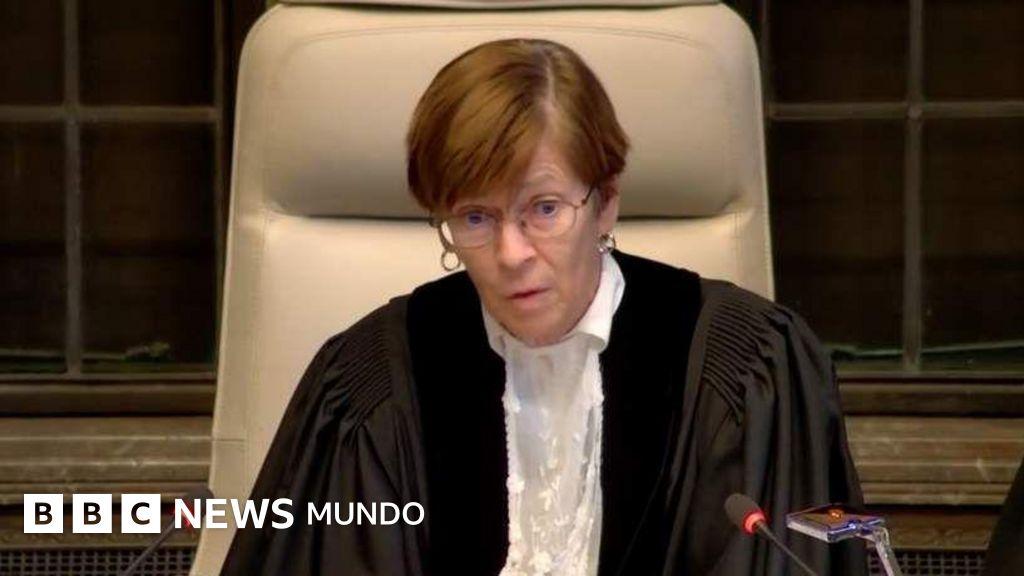
The BBC also quoted the ICJ president Joan E. Donoghue as saying the court was “deeply concerned about the ongoing loss of lives and human suffering,” while the EFE report said Donoghue read the decision and noted statements by senior officials and UN reports highlighting the gravity of the humanitarian situation in Gaza.
Competing reactions from officials
Reactions to the ICJ ruling split sharply across political and legal actors, with Israeli leaders rejecting the genocide accusation while Palestinian officials and Hamas welcomed the provisional measures.
“«Un tremblement de terre juridique », « un avis qui marquera l’histoire », « j’en reste sans voix »… Telles sont quelques-unes des réactions des juristes à l’avis rendu par la Cour internationale de justice (CIJ), le 19 juillet dernier, sur les « conséquences juridiques découlant des politiques et pratiques d’Israël dans le territoire palestinien occupé, y compris Jérusalem-Est »”
EFE reported that Israeli Prime Minister Benjamin Netanyahu said on Friday that the genocide accusation against Israel “is not only false, it is outrageous,” and he said he welcomed that the court did not order an immediate end to hostilities, adding, “Like any country, Israel has the basic right to self-defense.”
EFE also quoted Netanyahu saying the Hague court “rightly rejected the scandalous demand to deprive us of this right,” and it reported that the Palestinian Authority foreign minister Riyad al-Maliki celebrated the ruling and said, “Palestine welcomes the provisional measures ordered by the ICJ against Israel today.”
In a video message released by his ministry, Maliki said, “We call on all states to ensure that all provisional measures ordered by the Court are implemented, including Israel, the occupying power. This is a binding legal obligation,” framing the decision as enforceable through international compliance.
The BBC’s account added that Israeli Defense Minister Yoav Gallant rejected the ruling, writing on social media that “The State of Israel does not need sermons on morality to distinguish between terrorists and the civilian population in Gaza,” and he called South Africa’s case anti-Semitic.
The BBC also reported that Hamas welcomed the ruling, describing it as “an important development that helps isolate Israel and expose its crimes in Gaza,” and it said Hamas called for implementation of the court’s decision.
South Africa’s position, as described by EFE, was that implementing the ICJ orders “implies a ceasefire,” with Minister of International Relations Naledi Pandor warning that “if we read the decision (of the ICJ) by implication, a ceasefire is essential.”
Pandor also asked, “how do you transport humanitarian aid and ensure that the wounded receive medical care without a ceasefire? Without a ceasefire, none of these things could be carried out,” while EFE reported that South Africa said issuing some of the nine provisional measures requested was a “decisive victory.”
What happens next and evidence
Beyond the immediate demands, the ICJ ruling described by EFE and the BBC includes procedural steps and a focus on evidence preservation, while the BBC also outlines what the ruling does and does not decide.
EFE reported that the court’s decisions are legally binding on Israel, while noting that the ICJ has few means to enforce them, and it said the judges indicated that Israel must prevent destruction and ensure the preservation of evidence related to the case.
EFE added that Israel must submit a report within one month on “all measures taken,” and it described the presiding judge Joan E. Donoghue reading the decision while noting statements by senior officials and UN reports about the humanitarian situation.
The BBC’s explanation of the six measures similarly included that Israel must prevent any destruction of evidence that could be used in a genocide case and must submit a report to the court within one month.
The BBC also said the court expressed “grave concern about the fate of hostages held by Hamas and called for their immediate release,” and it described the court’s jurisdiction to proceed with the case even though a verdict on the genocide accusation is not expected for years.
BBC News Mundo also reported that Jeremy Bowen said the ruling indicates that “the way Israel is conducting the war must radically change under these conditions,” and it said Israel rejects the ruling while Hamas welcomes it.
In EFE’s account, the court avoided ordering a ceasefire as a provisional measure, but South Africa argued that without a ceasefire “none of the measures demanded” could be carried out.
The BBC’s framing likewise emphasized that the provisional measures do not amount to a final determination of genocide, stating that “a verdict on the genocide accusation is not expected for years” and that the court does not state that Israel has committed genocide.
Broader legal landscape
The Gaza provisional measures arrive alongside other ICJ interventions described in the sources, including a July 19, 2024 advisory opinion discussed by Le Monde diplomatique and a UN-centered argument about legal obligation emphasized by WAFA.
“The six measures the UN court requires Israel to comply with in Gaza (and what happens now)”
Le Monde diplomatique reported reactions from jurists to an ICJ advisory opinion rendered on “le 19 juillet dernier” on “les « conséquences juridiques découlant des politiques et pratiques d’Israël dans le territoire palestinien occupé, y compris Jérusalem-Est »,” and it said the court was seized by the UN General Assembly in December 2022.
The publication described the ICJ’s view that the occupation of the West Bank, East Jerusalem, and the Gaza Strip—forming “une seule et même entité territoriale, dont l’unité, la continuité et l’intégrité doivent être préservées et respectées”—is “illégale” by its modalities and duration.
It also highlighted a legal point attributed to jurist Johann Soufi, saying, “Israël ne peut pas invoquer l’article 51 de la Charte de l’ONU relatif à la légitime défense (…) car ce droit ne s’applique pas aux territoires occupés.”
Le Monde diplomatique further described the ICJ’s reasoning that even after Gaza was evacuated in 2005, it remained occupied because Israel retained “la « faculté d’exercer, et continuait d’exercer, certaines prérogatives essentielles (…), notamment le contrôle des frontières terrestres, maritimes et aériennes, l’imposition de restrictions à la circulation des personnes et des marchandises, la perception des taxes à l’importation et à l’exportation, et le contrôle militaire sur la zone tampon (…).”
It added that this was “Cela est encore plus vrai depuis le 7 octobre 2023,” tying the legal analysis to the post–October 7, 2023 escalation.
In parallel, WAFA’s report framed the ICJ’s role as a guarantor of sovereignty and equality and warned that “respect ICJ judgements” and “uphold the UN Charter” are essential choices at a “critical moment.”
Together, the sources depict a legal landscape where international courts issue binding or advisory guidance and where political actors respond with competing interpretations of legality and obligation.
More on Other

Israel Intensifies Ceasefire Violations, Establishing ‘Yellow Line’ in Southern Lebanon
37 sources compared

Pope Leo XIV Leads Open-Air Mass in Douala as 120,000 Attend
15 sources compared

Israel And Lebanon Hold Historic Talks In Washington To Disarm Hezbollah
18 sources compared

NASA Artemis II Crew Returns Safely After Record-Breaking Moon Voyage
16 sources compared