Australia · 05 May, 2026 · 8 min read
Australia Opens Royal Commission Hearing Into Bondi Beach Hanukkah Massacre After 15 Killed
Australia's Royal Commission on Antisemitism and Social Cohesion opened its first hearings in Sydney. Bondi Beach massacre killed 15 people during a Hanukkah celebration.
The role of policing/intervention before or during antisemitic incidents during protests.
10 of 12 outlets skipped it: the interim report included confidential recommendations and specific security coordination changes (e.g., high-level security procedures for Jewish festivals beyond High Holy Days, and creation of a full-time Commonwealth Counter Terrorism Coordinator)..
13outlets compared
Same story, two versions
tap a side to read it in full
Manila Standard
““The sharp spike of antisemitism that we have witnessed in Australia has been mirrored in other Western countries and seems clearly linked to events in the Middle East,” inquiry chief Virginia Bell said in opening remarks.”Read the original ↗
The Guardian
““The sharp spike in antisemitism that we’ve witnessed in Australia, has been mirrored in other western countries, and it seems clearly linked to events in the Middle East,””Read the original ↗
This difference matters because it affects how readers interpret causality: both cite Bell’s linkage to Middle East events, but Guardian’s phrasing cuts off mid-sentence in the excerpt provided, potentially changing the perceived emphasis or completeness of the claim.
Royal commission opens in Sydney
Australia’s Royal Commission on Antisemitism and Social Cohesion opened its first public hearing on Monday in Sydney, holding the session in the aftermath of last December’s Bondi Beach Hanukkah massacre.
“held its first public hearing on Monday in Sydney”
Multiple outlets described the commission as the “highest level of government inquiry” and said it was created to probe factors leading to the attack by two gunmen on Jewish families near Australia’s best-known beach.
Inquiry chief Virginia Bell told the hearing that “The sharp spike of antisemitism that we have witnessed in Australia has been mirrored in other Western countries and seems clearly linked to events in the Middle East,” and she added that “It’s important that people understand how quickly those events can prompt ugly displays of hostility towards Jewish Australians simply because they are Jews.”
The counsel assisting the inquiry, Zelie Hegen, said the commission had received “thousands of submissions” about the impact of “one of society’s oldest hatreds,” and witnesses were granted pseudonyms because of fear of reprisals.
The Jerusalem Post reported that the hearings would run through May 15 and that the first block would focus on defining antisemitism and examining its historical and contemporary manifestations, while listening to the experiences of Jewish Australians.
The Times of Israel likewise said the inquiry opened public hearings Monday into an antisemitic Islamic State-inspired terrorist attack in which a father and son killed 15 people at a Jewish Hanukkah event on Sydney’s Bondi Beach.
In the same opening remarks, Bell framed the commission’s task as understanding how quickly hostility can emerge, while the Australian Broadcasting Corporation reported that Commissioner Virginia Bell delivered her interim report on Thursday making 14 recommendations.
Gutnick testifies and frames Bondi
Sheina Gutnick, daughter of the late Reuven Morrison who was killed in the Bondi attack, testified before Commissioner the Hon Virginia Bell AC SC during the commission’s first public hearing in Sydney.
CAM said Gutnick told the hearing that Bondi once represented her family’s happiest memories because it was where her refugee parents first met, but that the iconic beachfront locale now carries a “heavy weight” for the Australian Jewish community.
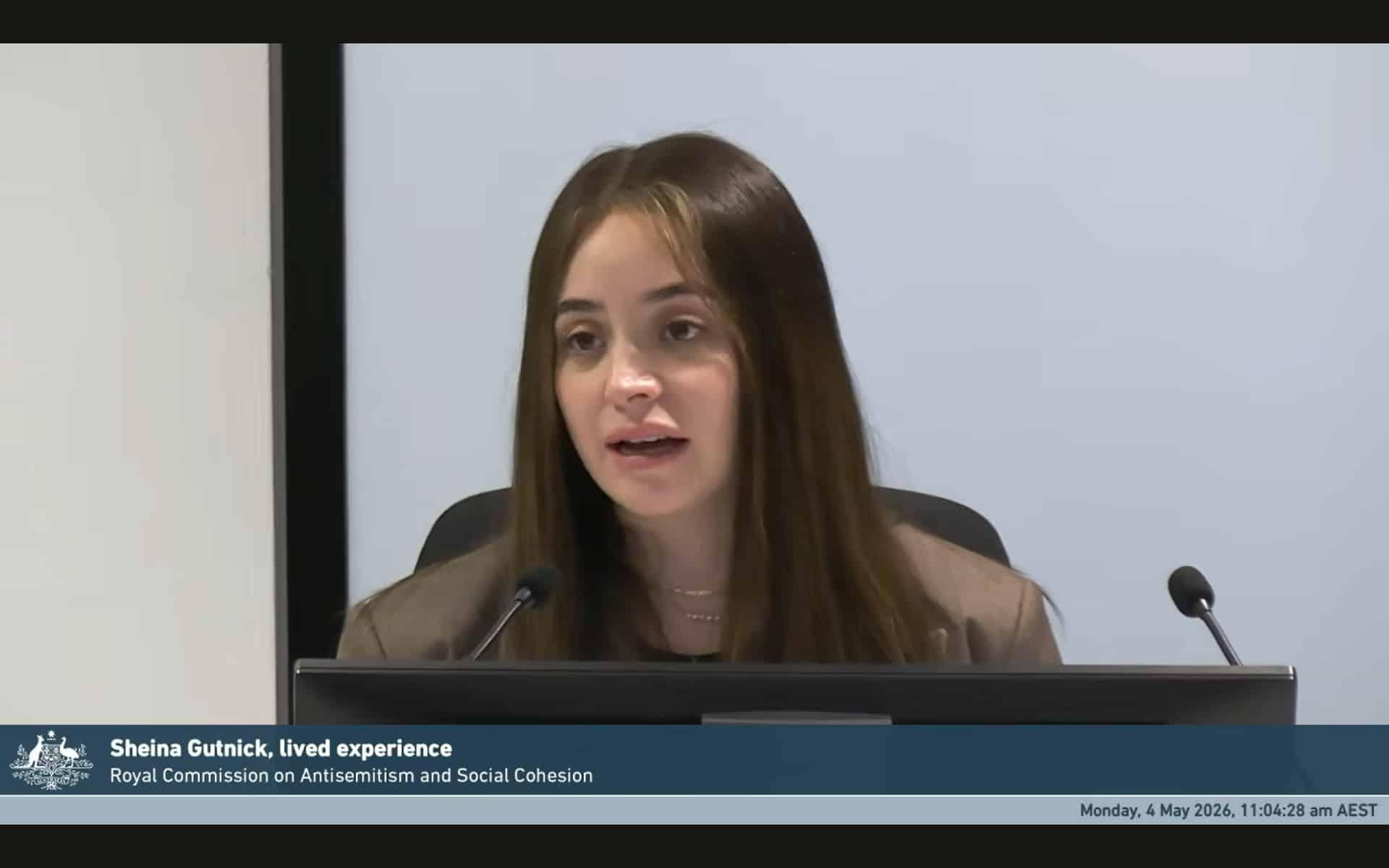
In testimony carried by multiple outlets, Gutnick said antisemitism had been “allowed to come into the open” in the lead-up to the Bondi massacre, particularly in the aftermath of the October 7th attacks in Israel in 2023.
The Manila Standard reported Gutnick told the inquiry there had been a shift in antisemitism since 2023, when the Gaza war began, and she said, “Antisemitism was allowed to come into the open.”M
The Guardian quoted Gutnick describing Bondi as a place of “treasured memories and torment,” and it reported her statement that “Bondi holds a really heavy weight in our community’s heart.”T
CAM also carried Gutnick’s longer statement after the hearing: “Today, I spoke not only as Reuven Morrison’s daughter, but on behalf of every Australian Jewish family that was told for too long to keep our heads down and hope it passes. It did not pass. It came to Bondi. The Royal Commission is Australia’s chance to make sure no other family has to endure what mine has.”
CAM CEO Sacha Roytman characterized the commission as a “moral wake-up call for every Australian leader,” and he said, “The Bondi massacre did not happen in a vacuum — it was preceded by years of escalating hate that institutions chose to manage rather than confront.”
The Guardian further reported that Gutnick’s father, 62-year-old Reuven Morrison, was one of 15 people shot and killed at Bondi on 14 December, and it said Morrison was killed after he threw bricks at the gunmen.T
Incidents, fear, and escalation
Beyond Gutnick’s testimony, the commission heard accounts describing fear, hostility, and escalating incidents in the period after October 7, 2023.
“Jewish community groups recorded 2,062 antisemitic incidents the following year”
The Manila Standard reported that Jewish community groups recorded 2,062 antisemitic incidents the following year, and it said parents feared sending children to Jewish schools.M
It also described a “summer of terror” in which there was a string of arson and grafitti attacks against synagogues and Jewish businesses in Sydney and Melbourne, and it said a woman who works with a Jewish security group recounted having to escort people to safety from a Melbourne synagogue in November 2023 on the anniversary of the Nazi Kristallnacht pogrom as a “mob” of around 30 people dressed in black, their faces masked, appeared.
The Times of Israel similarly said the inquiry heard about antisemitic chants during a protest against the war in Gaza outside Sydney’s Opera House in October 2023, shortly after the Hamas attack on Israel, and it described the same “mob” of around 30 people dressed in black at the Melbourne synagogue.
The RFI report quoted a Jewish woman who grew up near Bondi and whose grandparents were Holocaust survivors, saying she was “shocked to see flags being burnt at the Opera House — it was such an un-Australian thing,” and it added that she was “incredibly disappointed that police hadn’t stepped in before things got as bad as they did.”
The Guardian reported that an anonymised witness, AAK, told the commission that Jewish people “we’ve had many generations of discrimination and we have a bit of a sixth sense when things are going to be potentially uncomfortable or even dangerous for us,” and it quoted the witness saying, “Dead Jewish people don’t need love, alive Jewish people need people to listen to us when we tell people we feel like history is repeating itself.”T
The Guardian also quoted another witness, given the pseudonym AAL, saying, “I have to admit, things have changed: I really have to think very, very seriously whether this is the country for my grandchildren.”T
In addition, the Australian Broadcasting Corporation reported that Jewish author Michael Gawenda said “Friendships ended,” and it quoted him describing how he was being reduced to “a Zionist supporter of a genocidal Israel.”
Ryvchin’s threats and the interim report
Alex Ryvchin, chief executive of the Executive Council of Australian Jewry, gave evidence that tied the commission’s focus on security and intelligence to personal escalation in antisemitic attacks.
The Manila Standard reported that Ryvchin said many victims of the Bondi attack were from a tight-knit community of refugees from the Soviet Union and that “They were patriots who loved this country,” recalling several friends who died.M

It also said a firebomb attack on Ryvchin’s former family home in January 2025 marked an escalation in antisemitic attacks because it targeted a private home, and it quoted him saying, “We were on a path to catastrophe,” and “That was January; by December on that same road, three kilometres down, there was a horrific massacre that has transformed us permanently.”
The RFI report similarly quoted Ryvchin saying, “We were on a path to catastrophe,” and it said he detailed death threats he continues to receive while he sent his children away and fielded concerned calls from the prime minister, police and the counter-terrorism squad.
The Guardian described Ryvchin’s evidence as impassioned and said he told the commission Australia now resembled the antisemitic Soviet Union his family had fled when he was a child, quoting him: “The things we’ve seen in this country replicate what happened there: the rampant abuse, the violence, the denigration, and the sheer relish with which it is inflicted on the Jewish people.”T
Alongside these testimonies, the commission’s interim report was central to the hearing’s framing of what authorities did or did not do before the attack.
The Jerusalem Post reported that ahead of the first hearing block, the commission released its interim report about failings in Australia’s security, intelligence, and law enforcement agencies, and it said the interim report included 14 recommendations, though five were confidential.
The Australian Broadcasting Corporation added that Commissioner Bell said some hearings may be held behind closed doors to discuss sensitive evidence on matters of intelligence and national security and material which could prejudice ongoing criminal proceedings, and it said the interim report provided new information about the police presence organized for the Chanukah by the Sea event in the days before attendees were attacked.
Competing frames and what comes next
As the commission began its first block of hearings, outlets also diverged in how they emphasized the commission’s scope and the broader policy implications.
“The interim report included 14 recommendations, though five of them were confidential.”
The Jerusalem Post focused on the interim report’s structure and recommendations, saying the first hearings would define antisemitism and examine its historical and contemporary manifestations, and it detailed that the interim report recommended changes such as applying high-level security procedures used for the High Holy Days to other Jewish festivals and events.
It also described recommendations touching on coordination and leadership for counter-terrorism infrastructure, including that the Commonwealth Counter Terrorism Coordinator become a full-time role, and it said the recommendations included calls to implement an updated National Firearms Agreement and to prioritize a National Gun Buyback scheme.
The Australian Broadcasting Corporation, by contrast, emphasized the lived-experience dimension and the process, saying “people with lived experience of antisemitism” were invited to appear and that hearings would continue over the next five months, with the final report and recommendations due by December 14.
It also reported that Commissioner Bell delivered her interim report on Thursday making 14 recommendations and that she could make urgent recommendations at any time, while being due to present her final report by the first anniversary of the terror attack on December 14.
The Combat Antisemitism Movement outlet framed the commission as a “moral wake-up call” and said the Bondi massacre “did not happen in a vacuum,” while it reported that CAM would co-host with the Waverley Council the Local Government Summit on Social Cohesion and Antisemitism in Bondi Beach, expected to draw hundreds of mayors, councilors, senior council officers, interfaith activists, and community figures from every Australian state and territory.
Looking ahead, the Jerusalem Post said the hearings would run through May 15, while the Australian Broadcasting Corporation said hearings would continue until May 15 with additional sessions over the next five months and that the final report was due by December 14.
The Guardian described a “current fortnightly block of hearings” focused on defining antisemitism and its impact, and it said a third hearing block would examine institutions and industries of concern, including evidence on the role of social media and “the radicalisation it may generate.”T