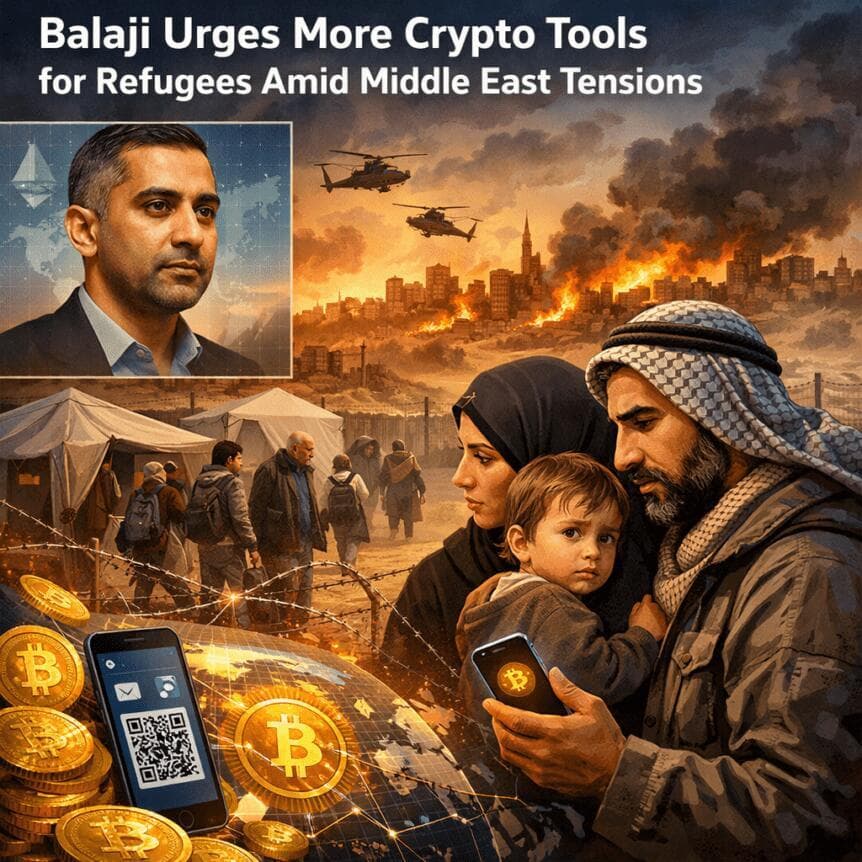
Balaji Srinivasan, former Coinbase CTO, urges crypto tools for refugees amid Middle East tensions
Key Takeaways
- Srinivasan urges crypto industry to build tools for refugees and stateless people.
- Traditional banking and payment systems limit displaced populations, prompting crypto solutions.
- Crypto and digital assets could provide access as banks become harder amid wars.
Humanitarian Crypto Call
Balaji Srinivasan, former Coinbase chief technology officer and tech investor, has emerged as a prominent advocate for cryptocurrency's humanitarian potential by calling on the industry to develop specialized financial tools for refugees and stateless people amid growing global conflicts.
“Tech investor and former Coinbase chief technology officer Balaji Srinivasan has called on the crypto industry to develop more financial tools for refugees and stateless people”
In a recent social media post, Srinivasan made a direct appeal: 'We should build more crypto tools for refugees and stateless people,' positioning blockchain technology as a critical infrastructure for vulnerable populations facing financial exclusion during crises.

His advocacy comes at a time when traditional banking systems are increasingly failing displaced individuals who lose access to their accounts and financial identities, creating an urgent need for alternative financial solutions.
Srinivasan argues that cryptocurrency represents not just an investment vehicle but a practical tool for financial inclusion, emphasizing that the industry must shift from speculative hype toward meaningful humanitarian applications to address the growing crisis of statelessness and displacement worldwide.
Global Crisis Context
The urgency of Srinivasan's call stems from the escalating global conflicts and economic migration patterns that are rapidly increasing the number of displaced individuals worldwide.
He specifically highlighted examples ranging from Ukrainians fleeing war to workers leaving Gulf countries amid regional tensions, noting that 'there may unfortunately be many more refugees and stateless people...and from all social classes.'
This growing crisis has created unprecedented challenges for traditional financial systems, which are ill-equipped to handle the needs of stateless individuals who often lose access to their banking infrastructure during displacement.
MENAFN reports that amid the current climate of intensified conflicts and ongoing economic migration, Srinivasan frames crypto as a strategic shift for an industry often defined by rapid innovation and speculative sentiment, urging developers to focus on refugee-accessible financial tools that can serve as a potential backstop for people who lose reliable access to conventional financial rails during crises.
Technical Infrastructure
Srinivasan envisions cryptocurrency operating in what he calls 'wartime mode for the internet,' where decentralized networks are designed to continue processing transactions even when centralized systems face disruptions from cyberattacks, infrastructure failures, or financial restrictions.
“Balaji Srinivasan urges crypto developers to build tools for refugees and stateless people as global conflicts rise and access to banks becomes harder”
He argues that public blockchains can provide essential financial infrastructure when traditional institutions become inaccessible or unreliable, offering displaced individuals the ability to store value, send remittances, and access identity-linked financial services with fewer intermediaries.
The technical solution involves non-custodial wallets, transparent governance, and cross-border settlement rails that can empower stateless populations to participate in the digital economy more reliably.
Cointelegraph notes that stablecoins have already begun demonstrating this potential, with Srinivasan pointing to the growing role of USD-pegged tokens that are achieving widespread circulation as borderless forms of digital money.
MENAFN highlights reports showing USDC market cap near $80B and related analysis on how capital flows are shifting in response to geopolitical developments.
Industry Misalignment
Despite the clear humanitarian need, Srinivasan's advocacy acknowledges significant industry challenges and critiques from within the crypto community.
Andi Duro, founder of research site TwoCents, provided a blunt assessment: 'It's very unfortunate that crypto is a great solution for refugees who are stateless and forced to interact with crumbling institutions and payment rails. But nobody in crypto builds for refugees because they're not useful consumers for gambling.'
This critique reveals a fundamental misalignment between market incentives and humanitarian needs, suggesting that the industry has historically prioritized speculative and gambling-centric segments over vulnerable populations.
Srinivasan responds by noting that while the industry has not yet delivered a full suite of refugee-centric products, progress already exists in the form of stablecoins expanding their global reach.
He urges the community to translate this critique into concrete product and governance innovations that center humanitarian needs as a core use case rather than a theoretical ideal.
Regulatory Challenges
The development of refugee-focused crypto tools exists within a complex regulatory landscape that balances innovation with necessary oversight, creating both challenges and opportunities for humanitarian applications.
“Tech investor and former Coinbase chief technology officer Balaji Srinivasan has called on the crypto industry to develop more financial tools for refugees and stateless people”
Srinivasan acknowledges this tension, noting that the discourse invites ongoing dialogue about how to design crypto tools that are compliant, secure, and accessible to those who stand to gain the most from resilient financial rails.
MENAFN reports that the conversation intersects with regulatory and policy considerations, highlighting the need for fiduciial structures that can function under duress with clear governance and robust privacy protections.
This regulatory dimension becomes particularly important when considering the geopolitical context, as crypto tools for refugees must navigate international sanctions, anti-money laundering requirements, and varying regulatory frameworks across different jurisdictions.
These tools must still maintain the borderless nature that makes them valuable for displaced populations while complying with regulatory requirements.
Future Vision
Looking ahead, Srinivasan's call represents a potential paradigm shift for an industry that has often been criticized for its speculative focus rather than practical utility.
If the crypto community can align incentives around humanitarian use cases, the result could be a more inclusive ecosystem that extends its benefits beyond early adopters to those who have historically been excluded from formal financial systems.
The evolving narrative urges builders to test and scale with a humanitarian lens, ensuring that security, privacy, and user-centric design are not sacrificed for speed or novelty.
As MENAFN suggests, the potential impact extends to stablecoins like USDC whose global supply dynamics could enable refugees and stateless individuals to participate in the digital economy more reliably.
Bitcoin's ongoing 'geopolitical stress test' may further demonstrate the resilience of decentralized systems during times of crisis.
The success of this movement will depend on the industry's ability to translate Srinivasan's vision into concrete, usable products that address the real-world needs of displaced populations while navigating the complex regulatory and technical challenges involved.
More on Crypto

Mastercard to acquire BVNK for up to $1.8B to accelerate stablecoin strategy.
24 sources compared

Boris Johnson Calls Bitcoin a Ponzi Scheme; Saylor, Eric Trump Defend Crypto
12 sources compared

Bybit Pay Joins Mastercard Crypto Credential Network, Lets Users Send Digital Assets Using Verified Aliases
10 sources compared
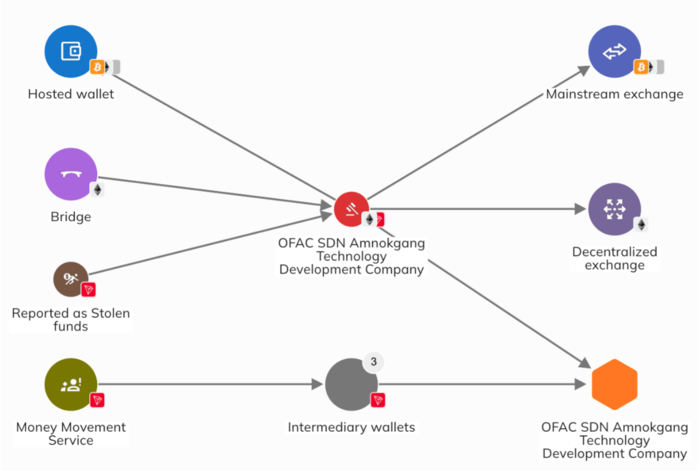
U.S. Treasury Freezes Crypto Network Feeding Nearly $800 Million To North Korea's Weapons Programs
10 sources compared