Crypto17 May, 20263 min read
Boris Johnson Calls Bitcoin a Ponzi Scheme; Saylor, Eric Trump Defend Crypto
This article is an automated aggregation of coverage from news outlets. Our editorials offer in-depth analysis curated by the NewsCord team.
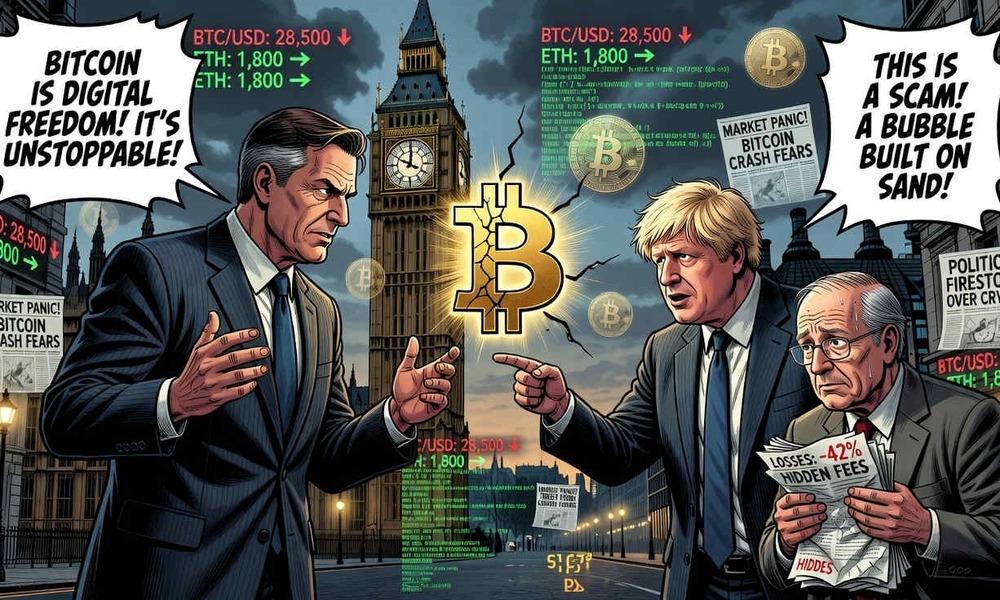
Boris Johnson called Bitcoin a 'giant Ponzi scheme' in a Daily Mail op-ed. Michael Saylor defended Bitcoin, noting no issuer, no promoter, no guaranteed return, driven by code.

Johnson's Accusations
Former UK Prime Minister Boris Johnson sparked significant controversy by publicly labeling Bitcoin as a 'giant Ponzi scheme' in a Daily Mail column. Johnson argued that cryptocurrencies fundamentally rely on continuous new investor inflows rather than intrinsic value. He questioned the legitimacy of a monetary system created by a pseudonymous entity, Satoshi Nakamoto.
“Former U.K. Prime Minister Boris Johnson called Bitcoin a 'giant Ponzi scheme' in a column, questioning the legitimacy of a system created by a pseudonymous entity.”
Johnson expressed skepticism about who investors could contact if issues arose with the cryptocurrency system. He illustrated his concerns with a personal anecdote about a retired man from his Oxfordshire village. The man lost approximately £20,000 after investing £500 on the promise of doubling his money through Bitcoin.

Johnson compared Bitcoin unfavorably to traditional assets like gold and collectible Pokémon cards. He suggested these hold more tangible value as they possess 'cultural or physical appeal' rather than being 'a string of numbers stored in a series of computers.' Johnson warned that such stories highlight particularly high risks for elderly and inexperienced investors.
Crypto Defense Response
Bitcoin proponents and industry leaders swiftly rebutted Johnson's assertions, with Michael Saylor providing the most prominent defense. As Executive Chairman of Strategy, the world's largest corporate Bitcoin holder, Saylor directly challenged the Ponzi classification on X. Saylor explained that a true Ponzi scheme requires 'a central operator promising returns and paying early investors with funds from later ones.'
He emphasized that Bitcoin lacks these essential characteristics. Saylor stated Bitcoin operates as 'an open, decentralized monetary network driven by code and market demand.' He highlighted that Bitcoin has 'no issuer, no promoter, and no guaranteed return.'

This technical rebuttal was supported by Eric Trump, whose American Bitcoin company holds over 6,500 BTC. American Bitcoin is the 17th largest public Bitcoin holder. The defense highlighted Bitcoin's fixed supply, transparent code, and absence of central authority as key differentiators from Ponzi schemes.
Community Backlash
The broader cryptocurrency community rallied to defend Bitcoin, with multiple commentators providing additional context. Crypto commentator TFTC pushed back on X, highlighting a flaw in Johnson's logic. TFTC compared the situation to calling the dollar a scam because someone got robbed near an ATM.
“Crypto commentator TFTC pushed back hard on X. The account pointed out a key flaw in Johnson's logic. Bitcoin did not steal that man's money. A con artist did. TFTC compared it to calling the dollar a scam because someone got robbed near an ATM.”
The note pointed out that Bitcoin itself did not steal the man's money, but rather a con artist did. Other community members emphasized Bitcoin's significant market presence. They noted Bitcoin's $1.42 trillion market cap and $62 billion in daily trading volume.
They highlighted that its blockchain is fully public and open to audit. Pierre Rochard, CEO of The Bitcoin Bond Company, turned criticism back on traditional finance.
He stated that 'the UK is a giant Ponzi scheme financed by debt.' This revealed deeper ideological tensions between crypto advocates and traditional financial systems.
Market Impact
Despite the heated debate, Bitcoin's market performance showed resilience amid the controversy. Bitcoin maintained its position as a significant financial asset. At the time of writing, Bitcoin was trading around $71,096.87.
It experienced slight declines of approximately 0.76-1.13% over the previous 24 hours. The market capitalization remained substantial at $1.41-1.42 trillion. Daily trading volume was $55-62 billion, demonstrating continued investor interest.
Bitcoin showed an 85% correlation with the S&P 500. This indicates increasing integration with traditional financial markets. Bitcoin shows sensitivity to macroeconomic factors and geopolitical risks.
The institutional adoption narrative remained strong. Strategy holds 738,731 BTC, representing approximately 3.52% of Bitcoin's total supply. American Bitcoin continuously accumulated with recent additions of about 500 BTC in 21 days.
Historical Context
The exchange between Johnson and crypto proponents reflects a long-standing ideological battle. This battle has persisted since Bitcoin's inception over 16 years ago. Johnson's criticism aligns with historical skepticism from traditional financial figures.
“Bitcoin has long been described by crypto critics as a Ponzi — a scam where people are rewarded for conning others to pile into a bogus investment with false promises of big returns. Economist Nouriel Roubini has in the past called crypto a 'total real-bubble Ponzi scheme' that will collapse. And European Central Bank Executive Board member Fabio Panetta in 2022 referred to the digital asset industry as a Ponzi, likening crypto to a 'house of cards' that could collapse.”
Economist Nouriel Roubini previously called crypto a 'total real-bubble Ponzi scheme' that will collapse. European Central Bank Executive Board member Fabio Panetta referred to crypto as a Ponzi in 2022. He likened it to a 'house of cards' that could collapse.

Bitcoin advocates counter by emphasizing architectural differences from traditional Ponzi schemes. They highlight Bitcoin's decentralized nature and lack of central operators. The debate raises broader questions about monetary systems and value.
It also questions trust in both traditional finance and digital assets. As Bitcoin matures and gains institutional adoption, these ideological clashes will likely persist.