Bennett And Lapid Merge Parties To Topple Prime Minister Benjamin Netanyahu
Key Takeaways
- Bennett and Lapid merge parties to form joint list for upcoming Knesset elections
- Alliance aims to topple Netanyahu by unseating his coalition government
- The merger revives the 2021 Bennett-Lapid alliance to challenge Netanyahu
Bennett and Lapid Unite
Former Israeli prime ministers Naftali Bennett and Yair Lapid announced they would merge their parties and unite against Prime Minister Benjamin Netanyahu, reviving their 2021 partnership that ended Netanyahu’s “12-year” hold on the country’s leadership.
“By Maayan Lubell JERUSALEM, April 26 (Reuters) – Two of Israeli Prime Minister Benjamin Netanyahu’s most formidable political rivals said on Sunday they were joining forces in a bid to oust his coalition government in the upcoming election expected later this year”
In Herzliya on Sunday, both former prime ministers addressed the press pack from “identical podiums,” with Bennett telling reporters, “Tonight, we are uniting and establishing the ‘Together’ party under my leadership, a party that will lead to a great victory, and the opening of a new era for our beloved country.”

Politico, citing a statement from Lapid’s Yesh Atid party, said the move is intended to “unite the bloc, put an end to internal divisions and focus all efforts on winning the critical upcoming elections.”
Reuters reported that Bennett and Lapid issued statements announcing the merger of their parties, Bennett 2026 and There is a Future, and that Bennett said the new party will be called Together and he will lead it.
Reuters also quoted Lapid saying, “We are standing here together for the sake of our children. The State of Israel must change direction,” while Bennett said, “After 30 years it is time to part with Netanyahu and open a new chapter for Israel.”
The Times of Israel described the merger as “the clearest attempt yet to consolidate the opposition bloc ahead of the next election,” and noted it revives the political partnership that succeeded in toppling Netanyahu in 2021 through a “short-lived diverse coalition.”
Why the Merger Now
The new alliance is presented as a response to Netanyahu’s political durability and to the fragmentation of the opposition, with multiple outlets tying the timing to polling and to the memory of the 2021 “Government of Change.”
Al Jazeera said Bennett and Lapid announced they would “resume the alliance that last toppled Benjamin Netanyahu’s government in 2021,” which “ended the latter’s 12-year hold on the country’s leadership,” and it described the earlier coalition as an unusually broad arrangement spanning “right-wing, centre, and left-wing parties.”

Politico said the 2021 coalition agreement “ended 12 years of Netanyahu rule,” and it described how Bennett served as prime minister for the first year until their coalition fractured, while Lapid held the top job as caretaker prime minister for the final six months.
Reuters reported that Bennett and Lapid’s merger comes as Netanyahu is expected to face elections “later this year,” and it said polls since Hamas’ 2023 attack on southern Israel have predicted Netanyahu will lose the next election, “due by the end of October.”
Reuters also recalled that their 2021 coalition included for the first time in Israel’s history a party drawn from the country’s Arab minority, the United Arab List (UAL), and it said Netanyahu’s comeback followed his November 2022 election victory and the formation of “the most right-wing government in Israel’s history.”
The Times of Israel added that the merger reflects “strategic incentives” for both leaders, including “pooling resources” and “maximizing seats,” and it reported that Lapid’s Yesh Atid party “currently” holds “24 seats” in the Knesset.
Reactions and Competing Claims
The merger immediately drew criticism and competing warnings about what it could mean for Israel’s electoral prospects and for the composition of any future government.
“Israel’s far-right Naftali Bennett and centrist opposition leader Yair Lapid have announced that they will resume the alliance that last toppled Benjamin Netanyahu’s government in 2021, which at the time ended the latter’s 12-year hold on the country’s leadership”
The Jerusalem Post quoted Blue and White Party MK Benny Gantz warning that the Together Party “harms the ability to replace this bad government,” and it reported that Gantz accused Bennett and Lapid of being “entrenched in internal bloc battles and focusing on who will lead, instead of where we will lead.”
Gantz also released a campaign video calling for a bloc representing “all of Israel,” and he argued that Bennett and Lapid were focused on internal leadership battles rather than on forming a broad Zionist government.
In the same report, the Jerusalem Post said Bennett and Lapid had openly called on Yashar! Party leader Gadi Eisenkot to join their alliance, but it noted Eisenkot “has not accepted their request” and instead called on the opposition bloc to focus on gaining as many votes as possible.
World Israel News described Bennett and Lapid’s joint press conference as a “unified electoral list called ‘Together,’” and it quoted Bennett saying, “I am taking the most Zionist and most patriotic step we have ever taken, for our country,” while Lapid said, “We are uniting today to win the elections and to establish a Zionist government, strong and stable.”
Al Jazeera’s analysis added a different set of political reactions by quoting Hassan Jabareen, the founder of Palestinian legal rights organisation Adalah, saying, “delegitimised the Arab vote and legitimised the racism that Palestinians face every day.”
Polls and Seat Math
Different outlets reported different polling snapshots and seat projections for the Bennett-Lapid merger, illustrating how the electoral math remains contested even as the alliance is announced.
The Times of Israel said recent polling suggested that if Eisenkot, Lapid and Bennett ran together, their combined ticket would get “38 seats,” making it the largest faction in the Knesset, while also saying it “would not significantly change the respective sizes of the two main rival blocs.”

It also reported that Lapid’s Yesh Atid could fall to “just five seats” in the next election, barely clearing the electoral threshold, according to recent polling.
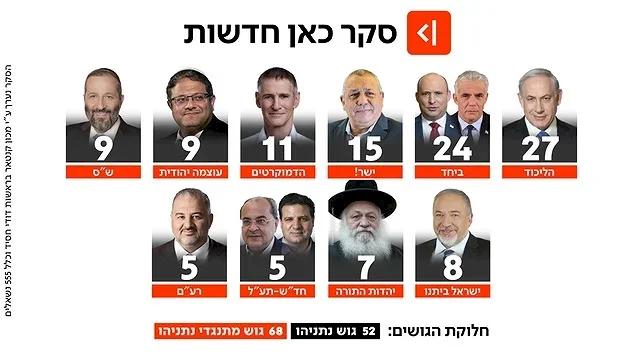
A separate poll described by SadaNews translation on وكالـة صدى نيوز said a new Israeli opinion poll conducted on Monday and published on the Hebrew channel Reshet Kan projected the Bennett-Lapid alliance would achieve “24 seats” if elections were held “these days,” while Likud led by Benjamin Netanyahu would remain the largest party with “27 seats.”
That same poll said the “Yashar” party, led by former general Gadi Eisenkot, would secure “15 seats,” and it said the Democratic Party led by Yair Golan would come in fourth with “11 seats,” while Jewish Power led by Itamar Ben Gvir would obtain “9 seats” and Shas led by Aryeh Deri would achieve “9 seats.”
The Drive’s Reuters report also cited an April 23 survey by Israel’s N12 News finding Bennett securing “21 of the Knesset’s 120 seats” against “25 seats for Netanyahu’s Likud,” and it said Lapid’s party securing “only seven seats, down from the 24 it currently holds.”
What Comes Next
The alliance’s stated goals and the obstacles ahead were laid out across the reporting, with multiple outlets emphasizing that the Together list’s ability to form a government depends on additional partners and on how other parties respond.
The Jerusalem Post said Bennett and Lapid had called on Gadi Eisenkot to join their alliance, and it reported that Eisenkot urged opposition leaders to convene a coordination meeting to secure a Zionist majority to unseat Netanyahu, while also noting Gantz was excluded from the invitation to meet with the opposition leaders.

World Israel News said the joint list is designed to minimize vote-splitting among opposition voters and present a credible alternative for prime minister, and it quoted Lapid saying, “A partnership between the center and right, between religious and secular, between north and south — without draft dodging and without extremism.”
It also reported that Bennett vowed to establish a state commission of inquiry into the October 7 massacre on the first day of his government, quoting Bennett: “On the first day of the new government under my leadership, we will establish a state commission of inquiry into the October 7 massacre to bring truth to the families and answers to all the people of Israel.”
The Times of Israel described the central question as whether the alliance can “materially strengthen the opposition bloc’s chances of unseating Netanyahu,” and it said the path could be reshaped by “Gadi Eisenkot’s decision to join or run alone” and by a potential breakaway “Likud B” faction.
Al Jazeera’s analysis added that there is “little evidence” the partnership would offer Palestinians in Gaza and the West Bank anything different, and it quoted Hassan Jabareen warning that even if international pressure exists, Bennett-Lapid had “delegitimised the Arab vote and legitimised the racism that Palestinians face every day.”
More on Other
Pope Leo XIV Prays With Archbishop of Canterbury Sarah Mullally in Historic Vatican Meeting
12 sources compared
Pentagon Seeks $1.5 Trillion for Golden Dome, Drones, and Counter-Drone Systems in Fiscal 2027
11 sources compared

Israel Intensifies Ceasefire Violations, Establishing ‘Yellow Line’ in Southern Lebanon
37 sources compared

Pope Leo XIV Leads Open-Air Mass in Douala as 120,000 Attend
15 sources compared