
Blue Origin Reuses New Glenn Booster for First Time on NG-3 From Cape Canaveral
Key Takeaways
- New Glenn's NG-3 reused a booster for the first time.
- Cape Canaveral launch carried AST SpaceMobile's BlueBird 7 satellite.
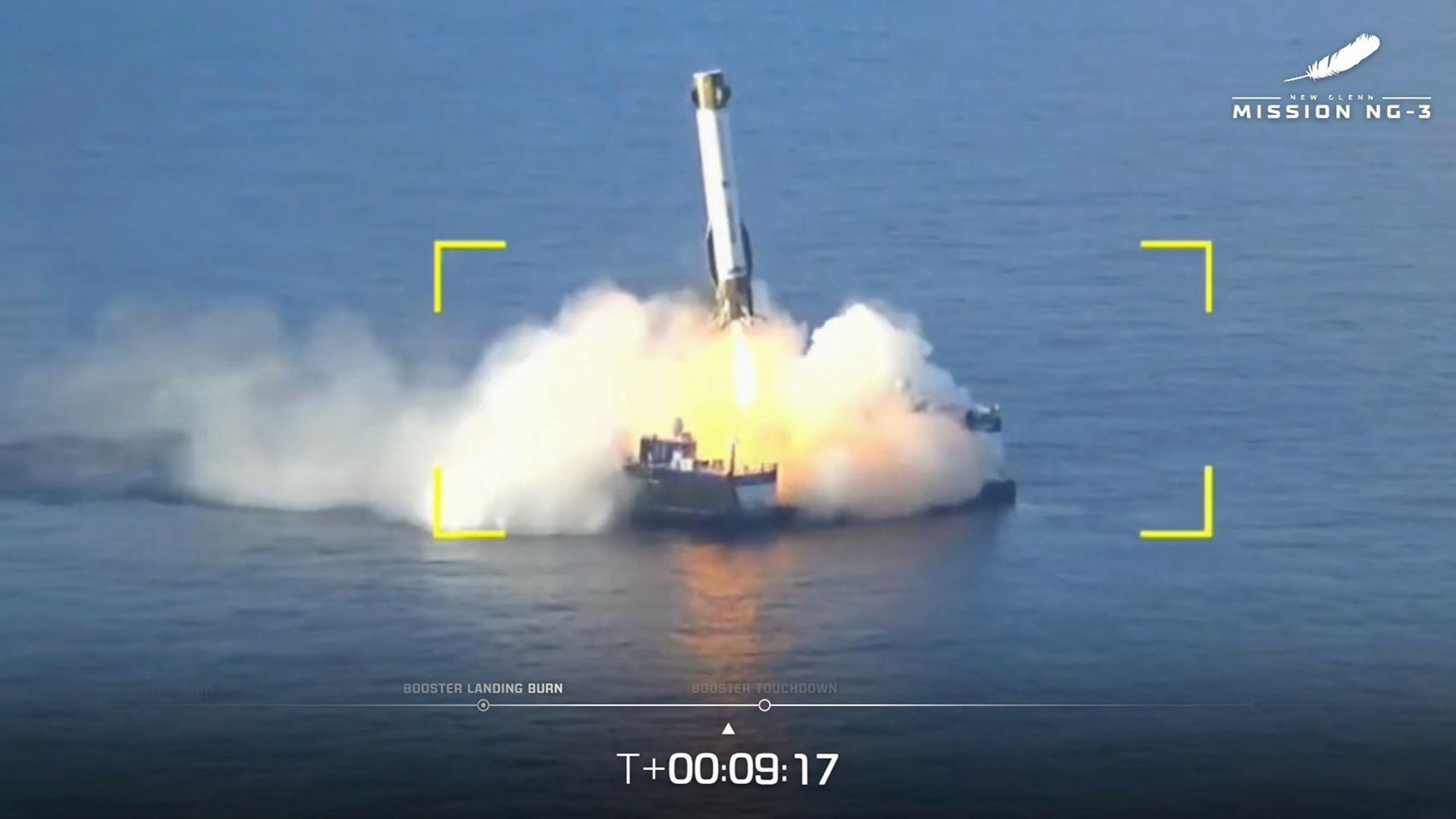
- Booster landed on a barge at sea following launch.
First Reuse, Then Off-Nominal
Blue Origin marked a milestone for reusable heavy-lift rockets by reusing a New Glenn booster for the first time ever during its third flight, NG-3, even as the mission’s overall outcome came under scrutiny after the payload was placed into an “off-nominal orbit.”
“Print Edition Read pdf version Home {{tree}} {{link”
TechCrunch reported that “Blue Origin has successfully reused one of its New Glenn rockets for the first time ever,” and said that roughly two hours after launch the company revealed that the communications satellite New Glenn carried to space for AST SpaceMobile wound up in an “off-nominal orbit.”

Fortune similarly described that the rocket “launched to space on its third flight, reusing a booster for the first time but failing to correctly place the satellite it was carrying into its intended orbit,” adding that “the satellite entered an ‘off-nominal orbit,’, or the wrong orbit.”
Blue Origin said it confirmed payload separation and that AST SpaceMobile confirmed the satellite powered on, writing on X: “We have confirmed payload separation. AST SpaceMobile has confirmed the satellite has powered on,” and “We are currently assessing and will update when we have more detailed information.”
Reuters provided the launch-day timeline, saying the rocket lifted off at around 7:25 a.m. ET (1125 GMT) from Cape Canaveral, Florida, and that the booster touchdown happened about 10 minutes later.
Spaceflight Now put the launch window at 6:45 a.m. EDT (1045 UTC) and said the two-hour window opened on April 19, while Spaceflight Now also noted that U.S. Space Force meteorologists forecast a “90-percent change of acceptable weather for the rocket’s launch.”
What Changed Between NG-2 and NG-3
The reuse attempt depended on refurbishing the booster that previously flew on NG-2, and multiple outlets described how Blue Origin treated the hardware before NG-3.
Spaceflight Now said the booster, “Never Tell Me the Odds,” previously launched in November 2025 and “successfully touched down on the company’s ocean-going landing platform, ‘Jacklyn’,” and it added that while “much of the booster is being reused,” Blue Origin CEO Dave Limp said the engines were not the same as the ones that powered the rocket to deliver NASA’s EscaPADE satellites.

In an April 13 post, Limp wrote, “With our first refurbished booster we elected to replace all seven engines and test out a few upgrades including a thermal protection system on one of the engine nozzles,” and “We plan to use the engines we flew for NG-2 on future flights.”
The News International described the same refurbishment logic, saying “All seven BE-4 engines were replaced with a fresh set,” and that the vehicle received upgrades including “a new thermal protection system on one of the engine nozzles.”
It also reported a pre-launch check: “A 19-second static fire on April 16 was the final check before Sunday's launch.”
Spaceflight Now added that the rocket is fueled by liquid methane and liquid hydrogen, and it said the booster is designed to support up to 25 flights each, while noting it was unclear if that includes reusing the same set of engines 25 times.
Payload, Orbits, and the AST Link
NG-3’s main objective was not only to demonstrate booster reuse but to deliver AST SpaceMobile’s BlueBird 7 satellite into low-Earth orbit, and the sources repeatedly connected the mission’s success to that deployment.
“Blue Origin’s flagship New Glenn rocket launched to space on its third flight, reusing a booster for the first time but failing to correctly place the satellite it was carrying into its intended orbit”
Reuters said New Glenn carried AST SpaceMobile’s BlueBird 7 satellite to low-Earth orbit in a flight that “marks a pivotal step for the company,” and it framed the mission as key to demonstrating that New Glenn “has a reliable booster reuse capability and can compete with the SpaceX Falcon 9 rocket.”
TechCrunch described the payload as a “communications satellite” that New Glenn carried to space for AST SpaceMobile, and it said the satellite ended up in an “off-nominal orbit.”
Spaceflight Now said the launch would carry AST SpaceMobile’s BlueBird 7 satellite into low Earth orbit, and it specified that NG-3 would carry a single “Block 2” satellite.
The News International added that BlueBird 7 represents “the second Block 2 spacecraft manufactured by AST SpaceMobile,” and it gave the antenna size as “2,400 square feet (223 square meters).”
Fortune reported that while the satellite separated from New Glenn’s second stage, it entered the “off-nominal orbit,” and it said Blue Origin was assessing the satellite, which “has powered on,” while promising more information.
Rivalry and Broader Space Stakes
The booster reuse milestone was presented across outlets as part of a wider competition between Blue Origin and SpaceX, with the sources tying NG-3 to NASA lunar plans and to the commercial launch market.
Reuters said the first landing of a reused booster “intensif[ied] its rivalry with Elon Musk’s SpaceX,” and it described New Glenn as a “29-story heavy-lift rocket” designed for the higher end of the commercial launch market, including a “seven-meter (23-foot) nose cone.”

Reuters also quoted New Glenn Vice President Jordan Charles saying, “We foundationally developed New Glenn for what we think space is going to look like 50 to 100 years from now,” and it included another quote from Laura Magginis, “New Glenn is the vehicle that can take NASA or anyone, anywhere in the solar system.”
Fortune framed the issue as a potential setback for Blue Origin’s reputation as an alternative launch provider to SpaceX’s Falcon 9, while also situating the company’s plans within its broader space exploration timeline.
Arab News connected the reuse attempt to Artemis competition, saying Blue Origin is “notably competing with Musk in NASA’s Artemis lunar program,” and it described the U.S. plan to return astronauts to the Moon in 2028.
Reuters also tied the rivalry to lunar landers, saying SpaceX is building a stainless-steel Starship-based Human Landing System while Blue Origin is developing a more traditional Blue Moon lander, and it stated both companies hold contracts with NASA to develop lunar landers with a planned moon landing mission in 2028.
Next Steps After the Off-Nominal
After the payload was reported to be in an off-nominal orbit, the sources described Blue Origin’s immediate posture as assessment and follow-up information, while also highlighting how the outcome could influence near-term plans for New Glenn and AST SpaceMobile’s connectivity goals.
“April 19 (Reuters) - Jeff Bezos' Blue Origin said on Sunday that its New Glenn rocket booster had touched down after launch, marking its first landing of a reused booster and intensifying its rivalry with Elon Musk's SpaceX”
TechCrunch said that “Roughly two hours after the launch, Blue Origin revealed” the off-nominal orbit and that it was “currently assessing and will update when we have more detailed information,” quoting the company’s X post.
Fortune similarly said Blue Origin was assessing the satellite, which “has powered on,” and that it would provide more information.
TechCrunch also explicitly stated that “Any trouble deploying AST’s satellite could present a risk to Blue Origin’s near-term plans for New Glenn.”
Reuters reported that Blue Origin has a deal with the communications company to send multiple satellites to orbit over the next few years as it works to build out its own space-based cellular broadband network.
Spaceflight Now added that AST expects to deploy “45 to 60 satellites into low Earth orbit by the end of this year,” and it said AST expects the New Glenn booster to be reused every 30 days to support launch cadence during 2026.
More on Technology and Science

Austria Police Find Rat Poison in HiPP Baby Food Jar, Triggering Recall at SPAR
12 sources compared

Trump Signs Executive Order To Fast-Track Psychedelic Drug Research, Including Ibogaine
52 sources compared

Sam Altman’s World Expands Proof-Of-Human Verification With Tinder, Zoom, and Docusign
15 sources compared

Anthropic Launches Claude Design for Prototypes, Slides, and Marketing One-Pagers
13 sources compared