Bowen: Trump has called for an Iran uprising but the lessons from Iraq in 1991 loom large
Key Takeaways
- Trump has called for an uprising in Iran.
- Bowen links Trump's call to the first President George Bush's 15 February 1991 Massachusetts speech.
- Bowen warns presidents can regret urging uprisings they then avoid becoming involved in.
1991 speech and aftermath
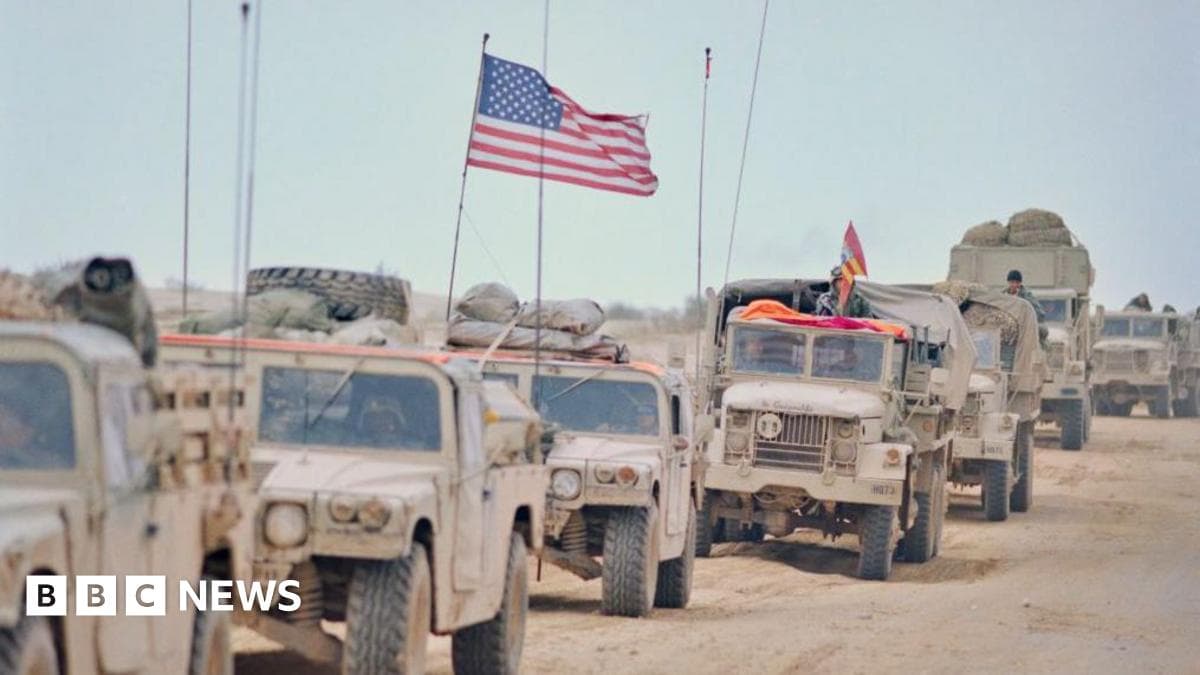
Bowen recalls the 15 February 1991 speech by the first President George Bush at a Patriot interceptor factory, where Bush urged the Iraqi military and people to 'take matters into their own hands' and force Saddam Hussein to step aside—words that some Iraqis took seriously after the Gulf War ceasefire left Hussein in power.
“- Published I know what can happen when an American president calls for an uprising and then doesn't get involved when it starts”
The coalition air campaign had already killed civilians, including more than 400 people in an airstrike on a shelter in the Amiriyah suburb, which Bowen says was wrongly claimed to be a command centre.
After the war, Shia in the south and Kurds in the north rose up against Hussein, but the Americans, British and other coalition members watched and did not intervene, allowing regime helicopters to lead a counter-offensive that killed thousands.
Tens of thousands of Kurds fled to the mountains, many dying of exposure and disease, prompting a later humanitarian rescue and the establishment of no-fly zones and permanent American bases, while the wider consequences helped incubate militants including a young Osama Bin Laden.
Bowen argues that each Gulf war planted the seeds of the next, including the 2003 invasion that removed Hussein and reshaped regional power dynamics.
Calls for Iranian uprising
Bowen draws a direct parallel between that moment and recent calls by Donald Trump and Benjamin Netanyahu for an uprising inside Iran, noting both leaders have encouraged Iranians to try to overthrow the Islamic Republic without promising direct military support.
He contrasts the 1991 war, which had UN Security Council authorisation, with the current war with Iran, which lacks that same legal backing, and warns about the consequences of urging popular revolt without committing to intervene.
Bowen notes Trump's decision to go to war as a joint venture with Israel is unpopular in America according to the latest polls and alarming to most US allies aside from Israel.
He highlights Trump’s claim that Iran could have fired a Tomahawk missile in an attack on a school that Iran says killed more than 165 people, including many schoolgirls, and states the article’s point that Iran does not have Tomahawk missiles.
The US Secretary of Defence, Pete Hegseth—rebranded as Secretary of War—attacked European scruples about using force without UN authorisation or a convincing case of self-defence.
Aims and regional dangers
Bowen outlines the declared aims and the dangers: the current bombing campaign is designed to smash Iran’s military and nuclear ambitions, Israel seeks to destroy the Islamic Republic and weaken Hezbollah, and some US and Israeli supporters argue removing the regime will make the world safer.
“- Published I know what can happen when an American president calls for an uprising and then doesn't get involved when it starts”
He acknowledges the regime’s brutality—citing that in January it killed thousands of fellow Iranians in the streets for marching against repression, corruption and economic collapse, and that it enriched uranium to potentially weaponisable levels—while warning that removing such a regime could have catastrophic consequences.
He recalls the 2003 invasion that ousted Saddam Hussein, which removed a regional enemy of Iran and helped Iran’s rise, and warns that removing a regime without a workable plan led to hundreds of thousands of deaths, sectarian violence and the emergence of extremist groups.
Bowen also notes Israel is taking advantage of the wider focus on Iran to advance steps towards the effective annexation of the occupied West Bank and to pursue long-standing aims against Hezbollah.
Uncertain endgame
Bowen warns the United States and its allies face deep uncertainties about how to end the war, arguing that starting wars is easier than finishing them and that the US appears to have gone to war without a coherent political strategy under a president "making it up as he goes along."
He suggests the conflict could force Gulf states and other US partners to reassess ties with America, especially with China waiting in the wings, and that Trump—who promised no more forever wars—might find himself keeping forces in the Middle East he would rather deploy elsewhere.
Bowen concludes that while the Israelis see a once-in-a-generation chance to reorder the Middle East, the absence of a clear endgame makes the war's consequences at best uncertain and at worst dangerous and catastrophic.
More on Iran
US obliterates military targets on Iran’s Kharg Island, Trump warns
13 sources compared
US Deploys About 2,500 Marines to Middle East After Iran Attacks Gulf Shipping
33 sources compared
FBI Warns of Iranian Drone Plot Based on Unverified Tip; California Says No Credible Threat
10 sources compared

White House Demands ABC Retract Report Claiming Iran Sought To Launch Drone Attacks On California
11 sources compared